
Breed guide / Spanish Water Dog
Living with a Spanish Water Dog
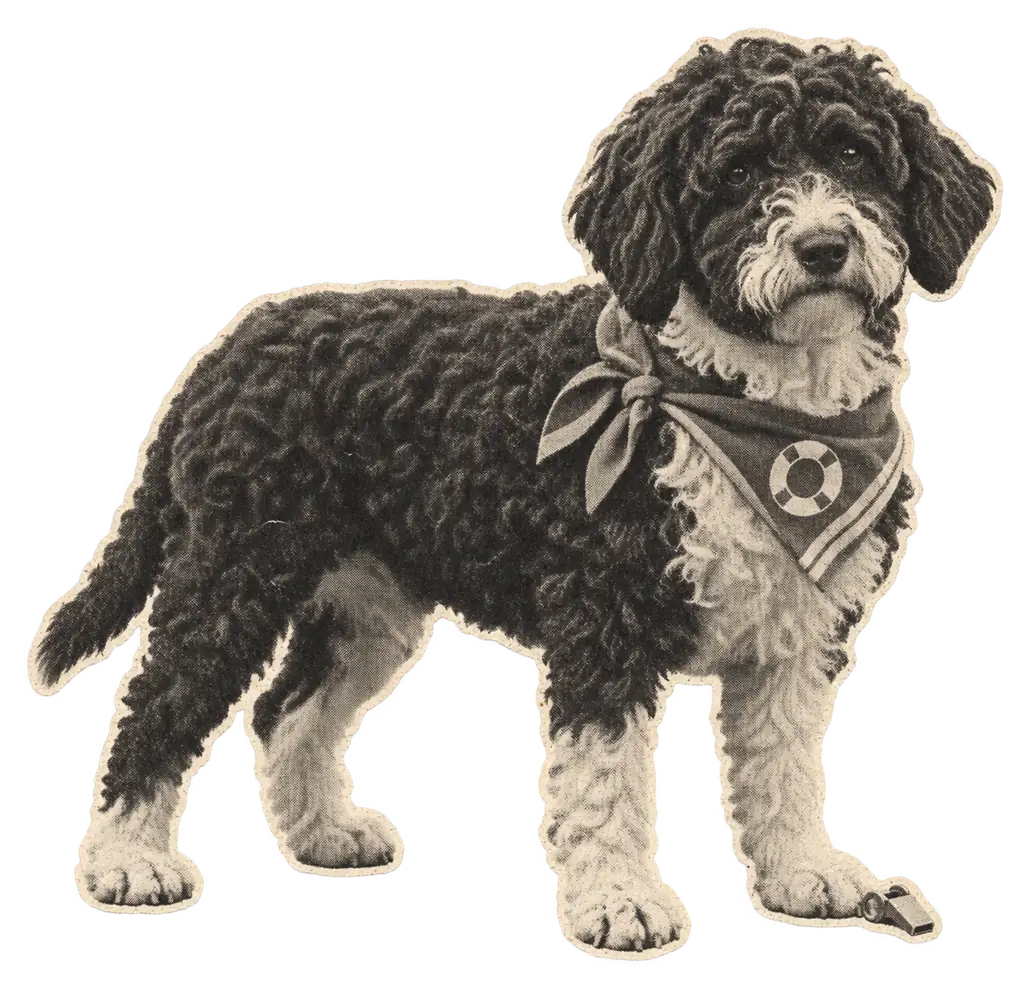
A Spanish Water Dog is a sturdy Spanish working dog with woolly curls that can grow into cords. It once moved sheep and worked with fishermen, which explains how an all-purpose farm dog landed in the UK Gundog group. Owners get two things to learn early: how to handle that coat without brushing out the curls, and how to get the dog’s attention back when something fast goes past. 1 2 3 4 10 11
Jump to a section
Make the ordinary day work first
If yours homes in on a bike or scooter as soon as you leave the house, take a route where you can step well back before it passes. Notice the point where your dog can still look back at you. That gives you somewhere to start next time, rather than discovering how good your brakes are at the kerb. 11 14 27
Spanish Water Dog notes / 01
Short version
Which water dog are we talking about?
In Spain it’s the Perro de Agua Español. The Royal Kennel Club lists it in the UK Gundog group even though part of its working story is herding. The Portuguese Water Dog and the Italian Lagotto Romagnolo have their own separate UK breed entries. Borrowing grooming advice from the first curly dog you see online can send you in exactly the wrong direction. 1 2 3 5 6
The name is no promise your dog will swim. Some go straight for the water; others are perfectly happy to watch the ducks from the bank. Make that an option. 7 8
A middleweight with decent pulling power
The UK breed standard gives adult heights of 44–50 cm for males and 40–46 cm for females; weights of 18–22 kg and 14–18 kg respectively. Those are breed-standard figures, not target weights. Feel for the ribs beneath the coat and ask your vet about body condition rather than judging from the furry outline. 2 19
Fit a harness to the dog you have that day. Try it again after a close clip; check both that the chest straps don’t slide into the legs and that a nervous retreat won’t let the dog back out. If you transport them in a car, choose and fit the travel restraint for that job separately. 20 21
Spanish Water Dog notes / 03
Size and weight
Leave the brush in the drawer
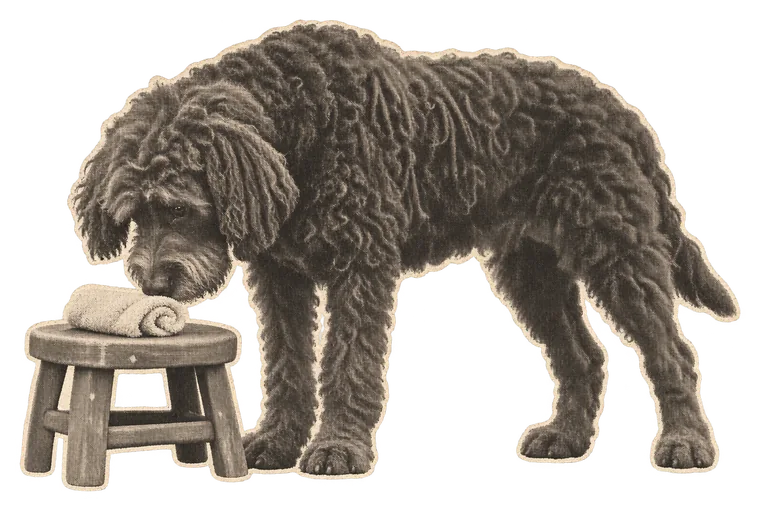
The breed has a naturally woolly coat that can cord as it grows. The UK breed club advises against brushing out the curls. That doesn’t mean leaving the dog to it. Learn to tell separate cords from a felted mat tugging on the skin. Ask someone familiar with the breed to show you what to feel for and how an all-over clip is done. There’s no prize for getting to summer with the longest coat if your dog can’t lie comfortably. 2 4 9
After a wet walk, press water out gently with a towel instead of rubbing the coat in every direction. Part it with your fingers where you can see what you’re doing. Check around the collar, armpits, paws and behind the ears. Ask a suitable groomer about tight mats rather than going in with scissors. Call your vet about a sore patch, smelly ear or suspected embedded grass seed. 4 15 16 22 23
Spanish Water Dog notes / 04
Coat and grooming
| Coat job | What matters |
|---|---|
| Longer coat | Have a breed-experienced groomer show you the difference between cords and mats. 4 9 |
| Practical short coat | Discuss an even clip, with timing based on the dog’s comfort and coat rather than a calendar rule. 2 4 |
| Drying | Press with a towel rather than rubbing; don’t leave the dog on a wet bed. 4 7 |
| Redness, soreness or a persistent smell | Speak to your vet rather than covering it with a grooming product. 15 23 |
You can have people round without a reception committee
Some Spanish Water Dogs watch unfamiliar people before deciding to come over. A visitor doesn’t have to ‘win them over’ by sticking out a hand or calling repeatedly. Start with room for the dog to move away; they can observe from a mat or behind a gate. If they come closer, keep the greeting low-key and let them leave again. 1 4 13 14
Give time alone its own practice. A dog who looks relaxed while you’re on the other side of the room isn’t necessarily fine when the house is empty. Start with very short departures, look at what happens on a recording and make it easier if they can’t settle. If the dog is already distressed, get help rather than increasing the time to see if they'll get used to it. 24 25 26
Spanish Water Dog notes / 05
Temperament
Give them a job with an ending
For a dog that clocks every moving thing, teach a check-in well back from the action. The workable distance is one where they can notice the cyclist and then look back to you. If they stiffen, lunge or can’t disengage, move away; don’t expect the cheese in your pocket to make you more interesting than a child on a scooter at arm’s length. 11 27 28
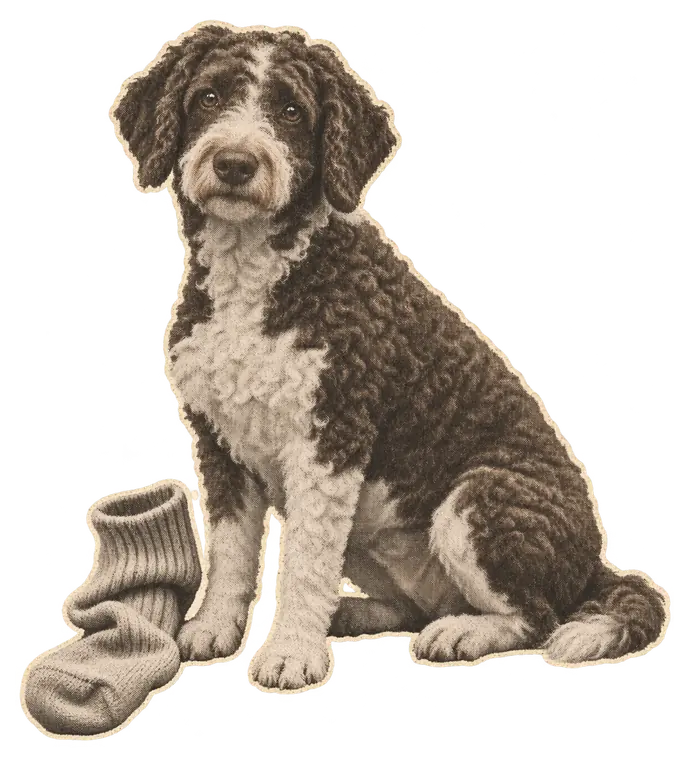
At home, hide a cloth toy in a safe room, let the dog find it and use an easy cue to finish. Then practise settling. If you’re always following play with another throw or a harder search, the dog gets plenty of practice expecting more. Downtime is worth teaching too. 12 27 29
Spanish Water Dog notes / 06
Training
| Useful skill | A simple first rehearsal |
|---|---|
| Check-in past moving things | On lead, at a distance where the dog can turn to you. 11 |
| Coming away | Practise on land with a long line where suitable, well away from traffic or water. 28 |
| Finishing a game | Put the toy away after a short search and reward calm on the mat. 12 29 |
Water is optional; a way out isn’t
For everyday activity, make room for real walks, sniffing and breaks, then adjust to the dog’s age, fitness and health. Be careful round livestock and use a lead where needed. In heat, go at a cooler time if it’s safe or skip that outing; a breed name doesn’t confer air conditioning. 30 31 32
At the water, check the exit before the entry. Start in calm shallows, don’t force a reluctant dog, and leave currents, hidden drop-offs and suspected blue-green algae alone. If a dog gets into trouble in the water, don’t go in after them; call 999. If you want to try structured retrieving in water, an experienced club group is a better start than throwing a ball out past the reeds. 7 8 33 34
Spanish Water Dog notes / 07
Exercise
| Outing | Make this call |
|---|---|
| Water without a safe exit | Keep them on land. 7 |
| Exuberant retriever | Use supervised breaks before the dog gets tired. 7 |
| Stock or moving bikes nearby | Use your lead and practise elsewhere, not in the thick of it. 11 31 |
| New reluctance or stiffness | Ask your vet if it’s unexplained, persistent or painful. 35 |
Put the quiet bit in the right part of the house
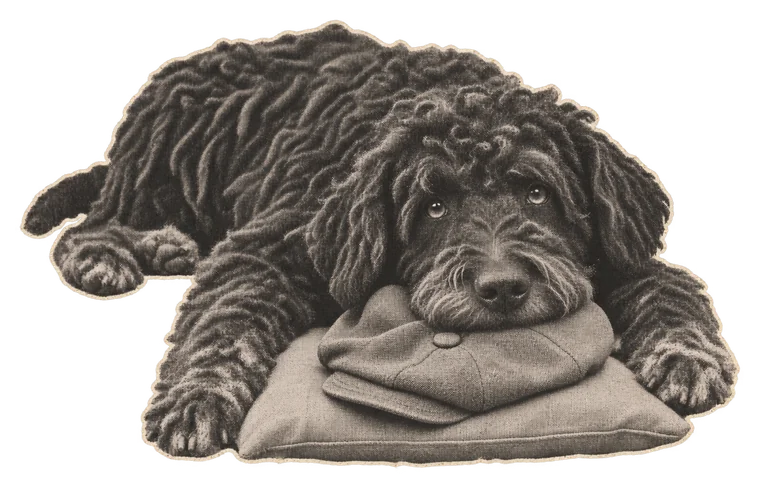
The front window is not always a free entertainment system. If the dog spends the afternoon announcing everything that moves, give them a resting spot away from the pavement view. Practise there when nothing’s happening, with a separate place for towels and kit so the bed isn’t also the family’s changing room. 11 12 14 29
On days when you can’t get to your usual walking spot, a quiet sniffy route and a short search game are useful alternatives. Keep chews and toys safe for the dog and available in a space where nobody will steal them. When a dog has pinned themselves to the window, another ball game isn’t always the next thing they need. 12 29 30 36
Children and the things that move fast
Even a dog who is generally easy around children can get wound up when a group starts running. If your dog watches, follows or tries to intercept the game, separate before it gets frantic. Give children dog-free space to run and give the dog a bed where children don’t follow. If you can’t supervise closely, keep them apart. 11 13 37
For cats and other dogs, keep a route out and build contact slowly. A child or cat hasn’t volunteered to be part of a herding game. If a chase keeps happening despite management, get help from a suitable behaviour professional. 11 26 36 38 39
Spanish Water Dog notes / 09
Children and pets
Eyes, hips and what the DNA reports actually mean
For pre-breeding screening, the Royal Kennel Club lists prcd-PRA DNA, the BVA/RKC/ISDS eye exam and gonioscopy at Good Practice, with its breed profile also advising genetic diversity. NAD-TECPR2 DNA, CHG DNA and BVA/RKC hip scoring are Best Practice. The breed club also discusses a separate early-onset PRA test. A clear prcd-PRA result is not an early-onset PRA result or an all-clear for the eyes. Look for the exact test name, dog and date on the certificate. 1 40 41 42 43
Gonioscopy checks the eye’s drainage angle to help assess predisposition to glaucoma. It’s a screening tool, not an answer to a new symptom. If your dog starts hesitating in dim light, mention it to your vet rather than assuming it’s PRA. 41 44
Urgent eye signs: If an eye suddenly becomes painful, is held shut, looks red or cloudy, call your vet immediately. 18
Spanish Water Dog notes / 10
Health
| Health topic | What to know |
|---|---|
| prcd-PRA and early-onset PRA | See which form the actual DNA certificate covers. These are separate checks. 40 42 43 |
| Eyes and gonioscopy | The eye examination and assessment of the drainage angle provide different information. Check the screening dates. 40 41 |
| Hip dysplasia | Best Practice hip scoring is a pre-breeding check. New limping or stiffness needs its own assessment. 35 40 |
| NAD-TECPR2 | Breed research identified a variant associated with juvenile neuroaxonal dystrophy; it doesn’t tell us today’s UK frequency. 40 45 |
| CHG | Research on affected related puppies identified a TPO variant linked to congenital hypothyroidism with goitre. This test isn’t a general adult thyroid check. 40 46 |
| Lifespan evidence | Dogs Trust’s UK study reports a median of 13.7 years with 37 deaths recorded for the breed. The confidence interval’s lower end was 13.3 years and the upper end wasn’t available in the table. It is not an individual forecast. 47 48 |
Price the bits a generic dog budget misses
Ask whether there is a groomer near you who actually understands this coat and how much they charge for a regular appointment versus a badly matted coat. If you use a walker, ask how they respond to bikes, off-lead dogs or a difficult handover. You want to hear their plan for your dog, not just how big the pack usually is. 4 11 49
Keep routine spend separate from money you’d need quickly for treatment. Read what cover excludes, how the excess works and whether you’d have to pay up front. 50
Spanish Water Dog notes / 11
Costs
| Budget for | Ask about |
|---|---|
| Grooming | Practical clip and maintenance for this dog’s coat. 4 9 |
| Walking or holiday care | Handling near fast movement and around unfamiliar people. 11 49 |
| Vet and insurance | Excess, exclusions and how out-of-hours treatment is paid. 50 |
| Equipment | Fit, ease of washing and whether you’ll use it after a wet walk. 7 20 |
From sheep and fishing boats to your back garden
The UK breed club’s history describes work with livestock and fishermen. The FCI records Spain as the breed’s country of origin; the UK club still runs water-work activities. That history explains why there’s more to the dog than a curly coat, but it isn’t an instruction to put yours in a field of sheep or a deep river. 3 8 10 31
Borrow the bit you can use. You can ask the dog to find something, bring it back and finish the game without needing a boat, a whistle or a waterproof clipboard. The clipboard is entirely your business. 27 29
Spanish Water Dog notes / 12
History
If you’re bringing one home
Ask what the dog does when the doorbell goes, how they cope with a groom and whether they can rest while somebody walks round the room. Meet adult dogs if possible, not just a litter at its cutest. For a puppy, see the mother with the litter where they’re raised, and get the actual parent records. For a rescue dog, ask what has been observed in a home and what is still unknown. 4 13 40 43 51 52
Find someone nearby who knows how to clip and handle cords before you need an appointment. Prospective walkers should know how you handle bikes and busy paths, not just how long you want the walk to be. 4 11 49
Spanish Water Dog notes / 13
Bringing one home
| Ask first | Look for |
|---|---|
| What do the health reports show? | Exact tests, results, dates and named parents. 40 43 51 |
| Can I see the coat handled? | Calm handling, sensible clipping and pauses as needed. 4 13 |
| How do they act around change? | Specific examples with visitors, handling and moving things. 11 14 |
| Where will they get a break? | A quiet route outside and a place to rest indoors. 12 14 |
Sources
- S1Royal Kennel Club UK breed profile and screeningSource · checked 21 November 2026
- S2Royal Kennel Club UK breed standardSource · checked 21 November 2026
- S3FCI official breed record, country and Spanish nameSource · checked 21 November 2026
- S4UK Spanish Water Dog Club breed-specific coat, management and careSource · checked 21 November 2026
- S5Royal Kennel Club Portuguese Water Dog separate breed profileSource · checked 21 November 2026
- S6Royal Kennel Club Lagotto Romagnolo separate breed profileSource · checked 21 November 2026
- S7PDSA vet guidance on swimming safetySource · checked 21 November 2026
- S8UK Spanish Water Dog Club water workSource · checked 21 November 2026
- S9UK Spanish Water Dog Club illustrated breed and coat guideSource · checked 21 November 2026
- S10UK Spanish Water Dog Club historySource · checked 21 November 2026
- S11Dogs Trust preventing or managing chasingSource · checked 21 November 2026
- S12Dogs Trust settling practiceSource · checked 21 November 2026
- S13Dogs Trust comfortable handlingSource · checked 21 November 2026
- S14Dogs Trust reactivity and spaceSource · checked 21 November 2026
- S15PDSA vet guidance on home health checksSource · checked 21 November 2026
- S16PDSA vet guidance on groomingSource · checked 21 November 2026
- S17Blue Cross general grooming supportSource · checked 21 November 2026
- S18PDSA vet guidance on glaucoma or painful eyesSource · checked 21 November 2026
- S19PDSA vet guidance on body conditionSource · checked 21 November 2026
- S20Dogs Trust harness fittingSource · checked 21 November 2026
- S21Dogs Trust safe travelSource · checked 21 November 2026
- S22PDSA vet guidance on grass seedsSource · checked 21 November 2026
- S23PDSA vet guidance on ear symptomsSource · checked 21 November 2026
- S24Dogs Trust introducing time aloneSource · checked 21 November 2026
- S25Dogs Trust recognising separation distressSource · checked 21 November 2026
- S26Dogs Trust sourcing behaviour supportSource · checked 21 November 2026
- S27Dogs Trust positive reinforcementSource · checked 21 November 2026
- S28Dogs Trust recall and long lineSource · checked 21 November 2026
- S29Dogs Trust enrichment and search gamesSource · checked 21 November 2026
- S30PDSA vet guidance on exerciseSource · checked 21 November 2026
- S31Natural England keeping dogs under control in the countrysideSource · checked 21 November 2026
- S32Dogs Trust warm-weather careSource · checked 21 November 2026
- S33Scottish Fire and Rescue Service water safety and emergenciesSource · checked 21 November 2026
- S34Blue Cross blue-green algae guidanceSource · checked 21 November 2026
- S35PDSA vet guidance on stiffness and limpingSource · checked 21 November 2026
- S36Dogs Trust resource guardingSource · checked 21 November 2026
- S37Dogs Trust supervising dogs around childrenSource · checked 21 November 2026
- S38Dogs Trust introducing dogs and catsSource · checked 21 November 2026
- S39Dogs Trust introducing dogsSource · checked 21 November 2026
- S40Royal Kennel Club central Health Standard, Spanish Water Dog rowSource · checked 21 November 2026
- S41BVA/RKC/ISDS specialist gonioscopy guidanceSource · checked 21 November 2026
- S42UK breed club early-onset PRA test announcementSource · checked 21 November 2026
- S43UK Spanish Water Dog Club code of ethics, separate from RKC tiersSource · checked 21 November 2026
- S44PDSA guidance on blindness and changes to sightSource · checked 21 November 2026
- S45Hahn et al. original TECPR2 association in this breedSource · checked 21 November 2026
- S46Fyfe et al. original TPO variant report in Spanish Water DogsSource · checked 21 November 2026
- S47Dogs Trust original UK breed lifespan tableSource · checked 21 November 2026
- S48McMillan et al. original lifespan study and methodsSource · checked 21 November 2026
- S49Dogs Trust finding a dog walkerSource · checked 21 November 2026
- S50PDSA costs and insuranceSource · checked 21 November 2026
- S51Royal Kennel Club Health Test Results FinderSource · checked 21 November 2026
- S52RSPCA buying a puppy and seeing the motherSource · checked 21 November 2026
