
Breed guide / Sheepadoodle
Sheepadoodle: which Poodle, and what’s this dog like to live with?
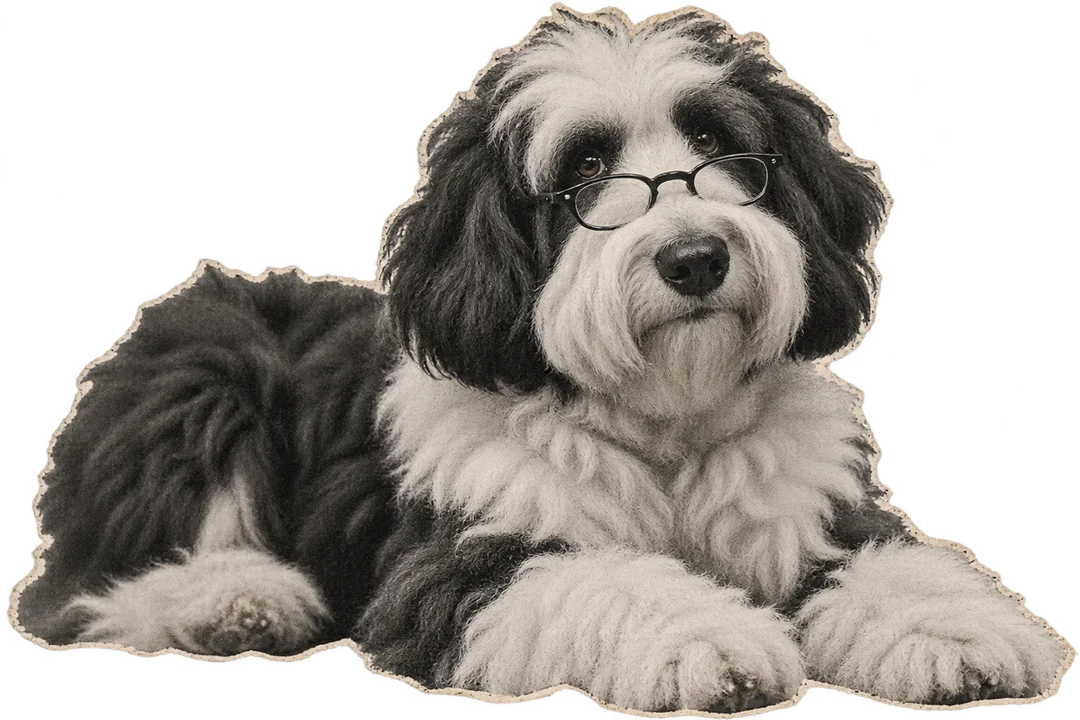
Sheepadoodle is a name used for dogs with Old English Sheepdog and Poodle ancestry. The Poodle might be a Standard or a Miniature, and the label gets used for later generations too. Two dogs with the same name can need different kit, have different coats and take up very different amounts of the back seat. If you already have one, start with how yours moves, what its coat does after a wet walk and which family records you can actually find. 12345
Jump to a section
Read the papers before reading the dog
A UK commercial guide uses the name for Old English Sheepdog × Standard Poodle, also describing Miniature Poodle ancestry and later pairings. That shows what the label can mean, not what your particular dog must be. Blue-grey patches don’t confirm Sheepdog ancestry, and loose curls don’t tell you the Poodle variety. The Royal Kennel Club lists the parents and varieties separately, not a Sheepadoodle standard. 12345
Sheepadoodle notes / 01
Field notes

- What’s documented? Look for the parents’ names and which Poodle variety is recorded. If it is a later cross, ask which dogs are in that generation and where the records came from. 123456
- What’s unknown? Some owners won’t have the paperwork. Keep the unknown bits unknown and tell the groomer or vet what you’ve noticed in your dog. 67
- Have you got a different cross? Labradoodle uses Labrador ancestry; a Sheepadoodle’s name doesn’t pick up the Labrador health evidence along with the curls. 18
Watch the dog get in and out of your car
Sheepadoodle notes / 02
Field notes
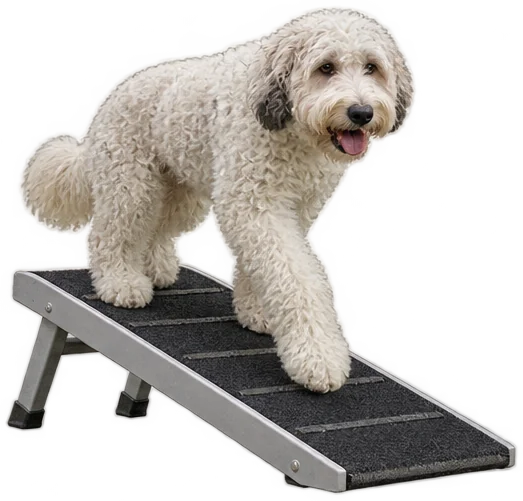
First check that the dog can get through the opening and turn around safely in the travel space. Then check the restraint actually fits, especially if the hair has just been taken down. If there’s a steep jump or the dog hesitates, a suitable, stable ramp may help; introduce it low and reward comfortable steps rather than pushing the dog up it. If using a ramp is suddenly harder than it was, tell your vet. 9101112
Find the bit of the coat your brush keeps missing
Sheepadoodle notes / 03
Field notes
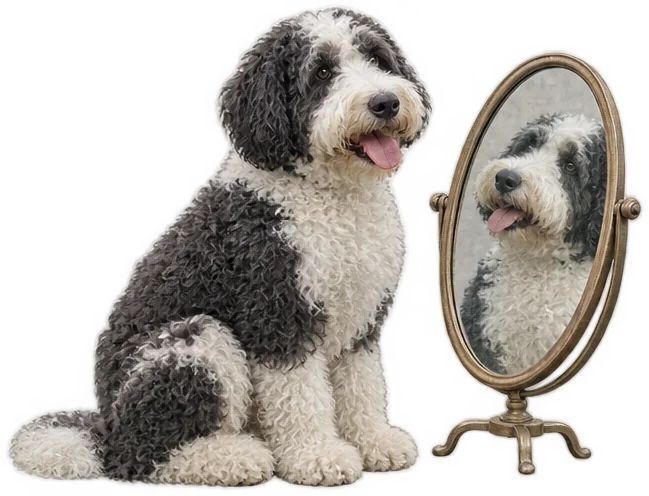
Dense coats can look tidy while hair tangles at the skin. Part it at the legs and under the equipment so you can see what the tool gets through. Ask a groomer to show you how to work with your particular dog’s coat. Don’t insist on keeping it long if you can’t keep up with it or the dog finds the maintenance uncomfortable. A tight mat needs help, not scissors slid under it. 4713
Set up a handover the walker can repeat
Sheepadoodle notes / 04
Field notes
Teach the dog to walk away from the gate with the person holding the lead, before somebody has to do it while the neighbour’s dog is on the other side. Show the walker what happens on a narrow pavement, and agree what they’ll do if the dog locks onto movement. Start where the person and dog can turn away without a wrestle. 11141516
Know what happens after the game ends
Sheepadoodle notes / 05
Field notes
Set out a short job, such as finding a toy round a corner, and give the dog a chance to rest afterwards. If the dog carries the toy straight to you for another round, put it away rather than being drawn into negotiations. This is about practising the switch-off, not trying to exhaust a dog whose family tree includes a working breed. 41718
Watch what the dog does around running children
Sheepadoodle notes / 06
Field notes
Keep your exercise plan adjustable
Sheepadoodle notes / 07
Field notes
Pick a route wide enough for the dog you have, not the dog the breeder guessed you’d have. Pace from condition, age and health. A tired older dog and a growing dog both need a different plan from a fit adult. If your dog changes how they get up, moves oddly or recovers differently, note what changed and seek vet advice rather than diagnosing it from the parent names. 122122
Price maintenance you can actually do
Sheepadoodle notes / 08
Field notes
Ask a groomer what they’d charge for your dog’s present length and texture, and whether they can handle the dog comfortably on their equipment. Take the full walk-and-groom routine into account if you depend on someone else at busy times. Ask about insurance exclusions and how payments work out of hours rather than using another doodle’s quote as a guide. 723
Put the family’s screening results in the right columns
Sheepadoodle notes / 09
Field notes
| Recorded parent | UK Royal Kennel Club screening distinction |
|---|---|
| Old English Sheepdog | Good Practice: hips, elbows and the BVA/RKC/ISDS eye scheme. Best Practice adds primary ciliary dyskinesia (PCD) DNA. Multiocular defect (MOD) DNA is addressed separately below. 25 |
| Standard Poodle | Its central Best Practice row lists PRA (rcd4), prcd-PRA and vWD1 DNA, eye screening and hips. Read its breed profile for import-specific rules and the separate breed-club sebaceous adenitis scheme. 35 |
| Miniature Poodle | Its central Best Practice row lists eye screening, prcd-PRA DNA, osteochondrodysplasia (OC) DNA and hips. This isn’t the Standard panel with fewer entries. 524 |
| Toy Poodle or another recorded variety | Use the exact record for that parent; don’t assume one from measurements alone. The Toy row lists prcd-PRA DNA at Good Practice and adds eyes and hips at Best Practice. 525 |
On Old English Sheepdog MOD: The RKC recognised the DNA test in August 2026 and encourages breeders to use it now. Its formal addition to the Health Standard and Find a Puppy is January 2027. That is a dated parent-breed recommendation, not a Sheepadoodle scheme or an eye examination. 25
Don’t quote a rate from a different cross
Sheepadoodle notes / 10
Field notes
The 2024 Royal Veterinary College study compared owner-reported outcomes in Cockapoos, Cavapoos and Labradoodles and their parent breeds. It didn’t study Sheepadoodles. These sources don’t give us a Sheepadoodle-specific rate, adult size or lifespan estimate. A clear result for one parent or one DNA variant is useful but can’t predict all the health or behaviour of a dog. 2358
Lower shedding wouldn’t mean allergy-proof
Sheepadoodle notes / 11
Field notes
A study that included Poodles found no lower environmental exposure to the main dog allergen in breeds marketed as hypoallergenic. That was not a Sheepadoodle study. Don’t use a puppy’s coat, lightly shed fur or a seller’s reassuring phrase as medical evidence. If allergy is a serious consideration, ask a clinician before committing. 26
Find out how this dog feels about being handled
Sheepadoodle notes / 12
Field notes
Watch the dog during something small: getting its harness on or standing for the comb in a place it tolerates. If it moves away, give it a break rather than closing in. Report a new change to the vet, especially if a previously easy movement or touch seems to hurt. This is more useful at the next vet or grooming handover than a general claim that the dog is used to it. 71227
Before you agree to take one home
Sheepadoodle notes / 13
Field notes
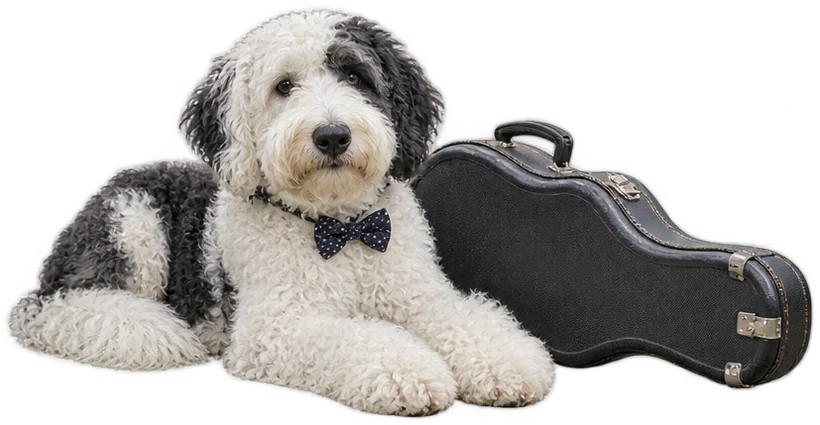
For a puppy, see the mother with the litter where they live and check actual results against the named parents. For an adult, ask what the car, coat care and walking handover have looked like; write down what nobody’s seen yet. If you get one look at an adult dog, make it while they’re moving normally, not just sat neatly for the photo. 611122728
Sources
- S1Purina UK, usage of the Sheepadoodle label onlySource · checked 21 November 2026
- S2Royal Kennel Club Old English Sheepdog profile and dated MOD informationSource · checked 21 November 2026
- S3Royal Kennel Club Standard Poodle profile and separate screening noticesSource · checked 21 November 2026
- S4Royal Kennel Club individual breed standards and directorySource · checked 21 November 2026
- S5Royal Kennel Club current Health Standard, exact tiers and datesSource · checked 21 November 2026
- S6Dogs Trust rehoming and matchingSource · checked 21 November 2026
- S7PDSA grooming and coat workSource · checked 21 November 2026
- S8Bryson et al., original 2024 RVC crossbreed study and populationSource · checked 21 November 2026
- S9Dogs Trust car travel and restraintSource · checked 21 November 2026
- S10PDSA arthritis and movement aidsSource · checked 21 November 2026
- S11Dogs Trust harness fit and trainingSource · checked 21 November 2026
- S12PDSA pain/limping observationsSource · checked 21 November 2026
- S13Dogs Trust introduction to handling and toolsSource · checked 21 November 2026
- S14Dogs Trust managing chasingSource · checked 21 November 2026
- S15Dogs Trust reactivity and distanceSource · checked 21 November 2026
- S16Dogs Trust finding a dog walkerSource · checked 21 November 2026
- S17Dogs Trust enrichment activitiesSource · checked 21 November 2026
- S18Dogs Trust settling practiceSource · checked 21 November 2026
- S19Dogs Trust supervising children and dogsSource · checked 21 November 2026
- S20Dogs Trust general handling at homeSource · checked 21 November 2026
- S21PDSA exerciseSource · checked 21 November 2026
- S22PDSA body conditionSource · checked 21 November 2026
- S23PDSA costs and insuranceSource · checked 21 November 2026
- S24Royal Kennel Club Miniature Poodle profileSource · checked 21 November 2026
- S25Royal Kennel Club Toy Poodle profileSource · checked 21 November 2026
- S26Vredegoor et al., original environmental dog-allergen comparisonSource · checked 21 November 2026
- S27Dogs Trust introducing vet handling and groomingSource · checked 21 November 2026
- S28RSPCA seeing the mother and litterSource · checked 21 November 2026
