
Breed guide / Schnoodle
Living with a Schnoodle
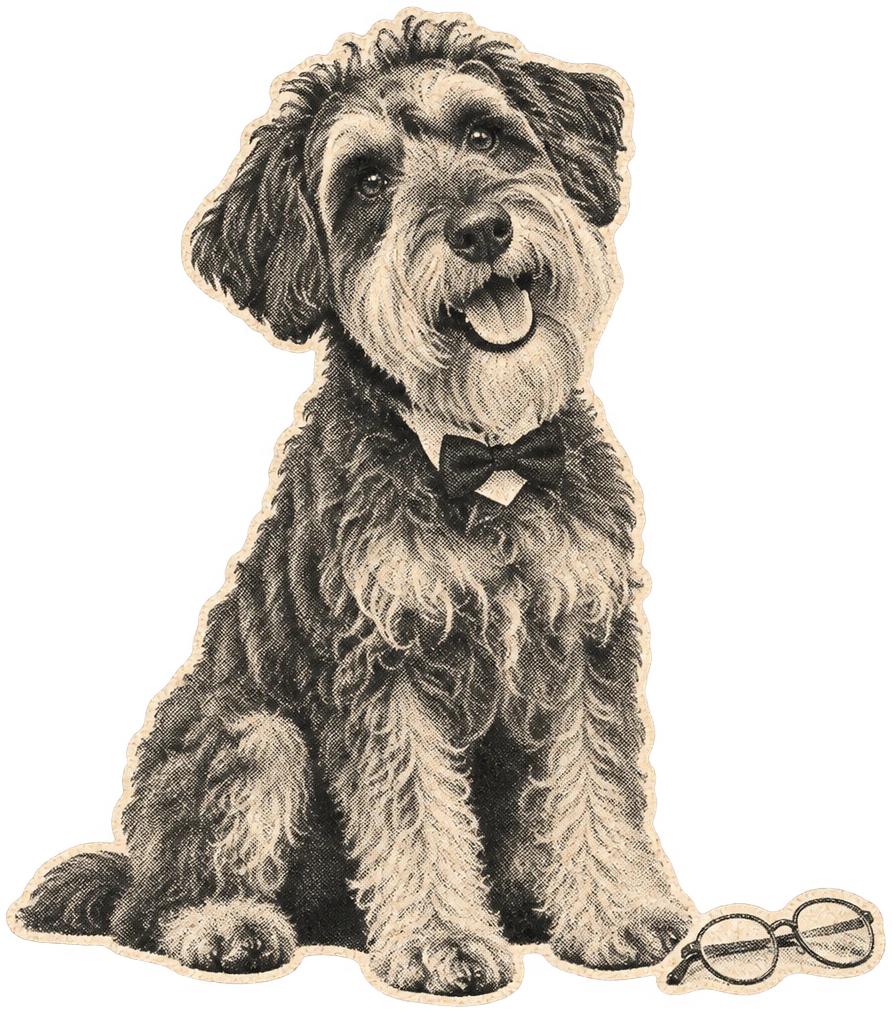
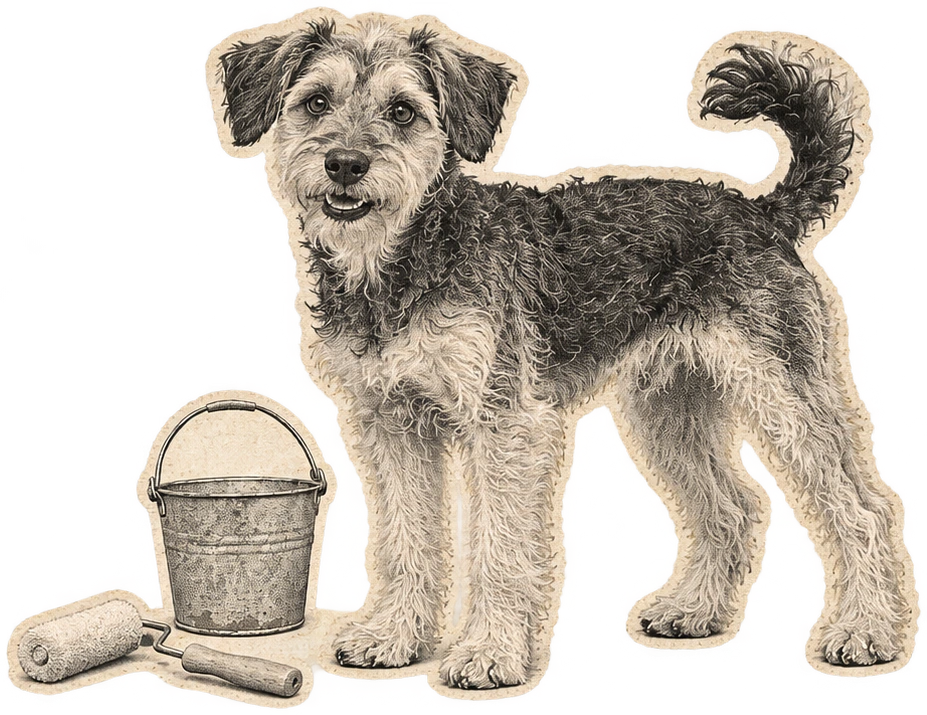
A Schnoodle is a Schnauzer and Poodle cross. It’s a useful name until you try to buy a harness, because both parent names come in very different sizes. Some dogs have a wiry beard that brings half the water bowl with it; others have soft curls that knot behind the ears. Find out which parents are actually known, then spend a bit of time learning what your dog gets up to when there’s nothing much on. 1234567
Jump to a section
The short version
Keep a small towel where they drink if their beard regularly leaves a trail. While the dog’s there, check whether the coat under the jaw is still damp and whether a comb will go through the hair behind the ears. If there’s a knot close to the skin, it’s a groomer job rather than a chance to try out the kitchen scissors. 2378
Find out what happens when you leave them to their own devices. A dog already up for every noise near the front window will need somewhere else to settle, not another toy dropped right beside the window. Reward a quiet moment away from it. 91011
Schnoodle notes / 01
Check the beard and the records
| Start here | What helps |
|---|---|
| Beard and ears | Check where water sits or a comb catches; ask for help with tight mats. 78 |
| Adult size | Ask about the actual named parents and measure the dog for kit. 23456 |
| Window and door | Reduce access to the view and rehearse a calmer place to lie. 910 |
| Screening | Find the right Schnauzer and Poodle rows instead of accepting “doodle tested”. 312 |
The parent names need a bit more detail
Schnoodle is an informal cross name, not a Royal Kennel Club pedigree breed. Miniature and Giant Schnauzers have separate British standards, and so does the middle-size dog. That one’s listed as “Schnauzer”; you may hear it called Standard. Poodles also have separate standards, from Toy and Miniature up to Standard. 12456131415
A dog can have one parent from each breed or come from later crosses. If you meet an adult dog whose ancestry isn’t clear, record what you know and get on with learning how they handle a walk. The amount of beard on their face doesn’t identify the Poodle variety. 2316
Schnoodle notes / 02
Separate breeds
| Part of the name | What to check |
|---|---|
| Schnauzer side | Miniature, Schnauzer (Standard), or Giant are separate British entries. 456 |
| Poodle side | Toy, Miniature or Standard; ask which is recorded for this dog. 131415 |
| Generation | Find out whether there are two known pedigree parents or a more complicated family tree. 23 |
Buy for the actual adult size
A Miniature Schnauzer and a Giant Schnauzer are not two descriptions of the same sized dog. Neither are a Toy and a Standard Poodle. Those differences matter when you’re working out whether the adult dog will fit in the car, but you can’t use the parent standards to do a reliable halfway calculation. 346131415
Ask about the measured adults in the family where there’s good information. When fitting a harness, use the actual chest and watch a couple of turns before deciding it fits. A neck full of hair can make an optimistic size feel snug at home and look quite different after a groom. 371617
Schnoodle notes / 03
Fit the kit to the actual dog
| What you’re deciding | What to use |
|---|---|
| Adult size for your home | Actual dog or adult relatives where documented; no guaranteed Schnoodle range. 2316 |
| Harness | The chest and the way the dog moves, not a weight class in an advert. 17 |
| Healthy weight | Use body condition with your vet rather than a single number for the cross. 18 |
The beard deserves its own towel
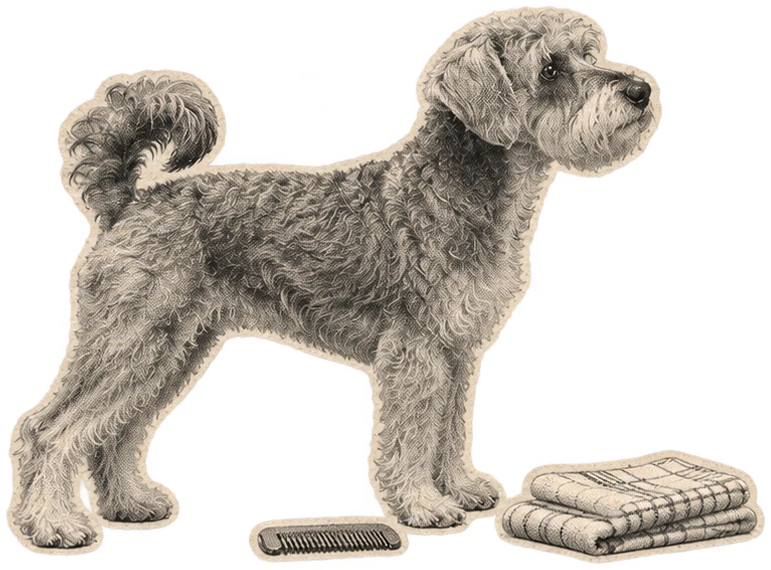
Check under the beard after a drink or a wet walk, and dry it gently if it’s holding a lot of water. Look for sore or smelly skin rather than judging from how clean the hair looks. Try one short touch or wipe at first. Holding the dog’s muzzle still is a good way to make the towel harder to get near them next time. 781920
Part the coat behind the ears and under the harness. A wiry outer layer may not tangle in the same way as softer hair on the legs, so get the groomer to show you what this dog needs. Low shedding isn’t the same as low risk for someone with a pet allergy. Dog allergens can come from dander and saliva. 372122
Schnoodle notes / 04
Look under the beard
| Spot | Useful check |
|---|---|
| Beard and chin | Wipe gently, dry after soaking and check for changes underneath. 81920 |
| Ears and harness line | Comb through a short section near the roots; ask about mats close to skin. 78 |
| Feathering after long grass | Check between toes and seek help for persistent licking or head shaking. 23 |
| Allergies | Talk to a clinician if someone is affected; no coat label guarantees they’ll be fine. 2122 |
See what sets off the commentary
If your dog barks when a person passes, move them away from the view before asking for anything. Give them a job they can do somewhere else, even if it’s just lying on a mat with the front room door shut. Practise it when there’s nobody out there. You don’t need the postie to be timing your training for you. 91024
Watch what the dog chooses to do around people. A dog who turns away doesn’t need further encouragement to be sociable. Let them step back and get help if they seem more worried over time. A new reaction may also be worth discussing with the vet. 20242526
Schnoodle notes / 05
Give them room
An easy job for the nose
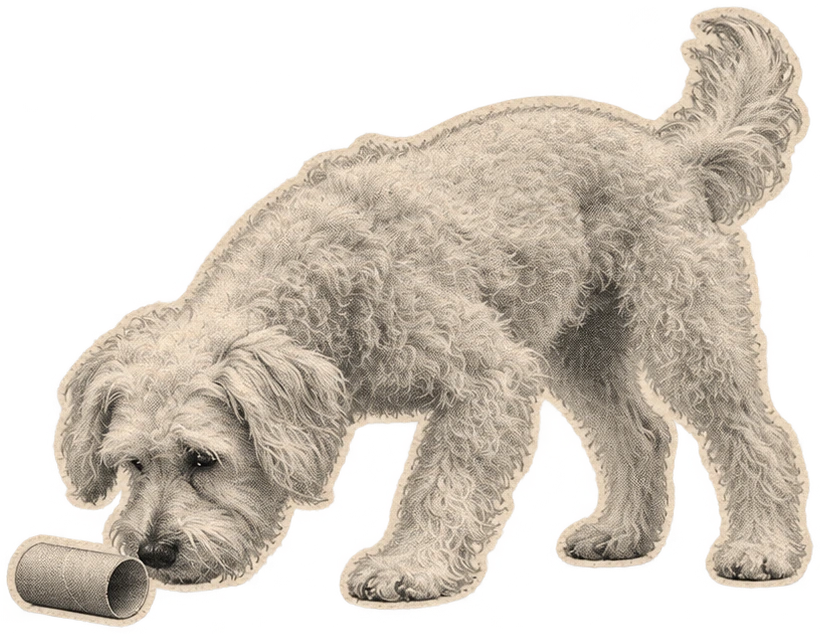
Put a piece of their usual food beside a short cardboard tube while you watch. Once they see how the game works, move the next piece to a slightly less obvious spot. If your dog would rather swallow the tube than use it, swap it for a safe container. A good search doesn’t have to leave the sitting room looking like bin day. 1127
Teach the dog to come away from the front door using a cue and a reward. Do it when nobody is coming in. You can use the same idea when you want to guide them to a quieter spot for grooming. The important bit is to make it easy before trying it in the thick of things. 10202428
Schnoodle notes / 06
Useful jobs for a normal day
Exercise should fit the dog at the other end
Give them regular walks and time to sniff, scaled to their age and fitness. If they struggle to walk past people or dogs, go somewhere you can make space. A small dog can still learn to pull the whole route if it’s the only way they get to smell anything. 11172930
Give growing dogs manageable outings. If an adult suddenly gets stiff, slows down, or avoids something they used to do easily, ask the vet about the change. You can shorten the route without giving up the useful bit of the walk. 3031
Schnoodle notes / 07
Keep the walk comfortable
| Situation | Better plan |
|---|---|
| Too busy to pass comfortably | Choose a wider route or a quieter time. 29 |
| Need to practise recall | Start in safe space on a secure lead or long line as appropriate. 32 |
| Growing dog | Increase activity gradually and follow individual advice. 30 |
| Regular limp or stiffness | Ask the vet; don’t train through it. 31 |
Stop the living room becoming the lookout post
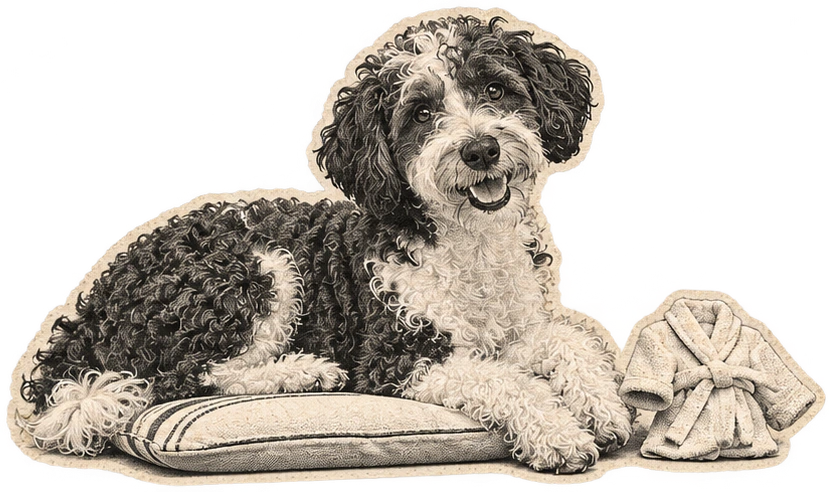
Move the resting place away from the best view of the street. Reward the dog for lying there while you do something ordinary. If the best bed is the one you can see the whole pavement from, it’s not that surprising they keep clocking on. 910
Build time alone in small steps. Use a camera if there’s one available to see whether they sleep after you leave or spend twenty minutes listening for you at the door. If it’s the second one, make the next absence easier and ask for help if the distress persists. 3334
Schnoodle notes / 08
A place to rest
Kids, cats and other dogs
Supervise the dog and children together and protect the dog’s resting area. A beard still belongs to the dog even if it’s funny looking and within reach. Ask children to call the dog over instead of approaching them when they’re eating or trying to sleep. 202535
Start introductions to a cat with separation and a route the cat can take without passing the dog. Pick enough space for dogs to move apart when meeting. Don’t introduce a favourite chew into proceedings until you know how they get on. 25293637
The health tests depend on the actual parent breeds
For Miniature Schnauzers the November 2026 British Health Standard puts clinical and litter eye checks in Best Practice alongside DNA for MAC. The middle-sized Schnauzer’s Best Practice row instead lists hips and DCM DNA, a specific heart-disease risk test. For Giants, Good Practice includes joint screening for both hips and elbows as well as prcd-PRA DNA. Those names don’t give you the Poodle half of the records. Ask for the appropriate results for both breeding dogs. 3123839
The Poodle variety matters too. Toy Good Practice lists prcd-PRA. The Miniature puts clinical eyes and hips in Best Practice alongside prcd-PRA and OC DNA. The Standard Poodle has another row. These recommendations don’t diagnose symptoms or imply that crossing the parents prevents inherited conditions. No representative UK Schnoodle lifespan or condition rate is given in the lifespan table or in the 2024 study of other Poodle crosses. 312404142
Schnoodle notes / 10
Health conditions and screening
| Which documented relative? | Start with the right row |
|---|---|
| Miniature Schnauzer | Best Practice: MAC DNA and clinical Eye Scheme including litter screening; no Good Practice tests listed on the row. 123839 |
| Schnauzer (Standard) | Best Practice: DCM DNA and hips; no Good Practice tests listed on the row. 12 |
| Giant Schnauzer | Good: hips, elbows and prcd-PRA DNA. Best adds DCM, PRA5 and HUU DNA plus clinical eyes and litter screening. 12 |
| Toy or Miniature Poodle | Toy Good: prcd-PRA; Best adds eyes and hips. Miniature Best: eyes, hips, prcd-PRA and OC DNA. 12 |
| Standard Poodle | Best Practice lists PRA (rcd4), prcd-PRA and vWD1 DNA plus eyes and hips. 12 |
| New symptoms | Get veterinary advice, including prompt help for a suddenly sore or shut eye. A DNA result isn’t an examination. 31394043 |
| UK lifespan and health figures | No separate estimate in the cited evidence; don’t copy figures from a parent. 4142 |
The regular grooming goes on the budget
Ask a groomer what they would charge for this coat and what you’d need to do at home. A groomer who can show you where you keep missing a knot is worth more than a picture of the trim. Buy a comb you can actually use rather than an entire drawer of tools. 72044
Find out what routine care costs at your practice and read the insurance exclusions. If one person always does the walks, show your backup how you get past the places where the dog barks or wants to pull. That’s more likely to help than telling them the dog is “usually fine”. 17244445
Schnoodle notes / 11
Budget beyond the food
Two breed histories, lots of individual family trees
The British registry describes Schnauzer breeds with roots in Germany. It gives them distinct standards and histories, just as it does for the Poodle varieties. The cross name doesn’t bring those separate histories together into one documented origin date. A British rescue recording a Schnauzer and Poodle mix as a Schnoodle is evidence of how the name is used, not who bred the first one. 145613141546
If you’re interested in the background, read the relevant parent history once you know which labels are on the record. To find out what you’ll get up to together on a rainy afternoon, ask the dog. Put a reward on the other side of a small empty box and see how they go about finding it. 31127
Schnoodle notes / 12
Two parent histories
| Historical reference | What it tells you |
|---|---|
| Schnauzer names | Separate recognised UK breed entries, with German roots described by the registry. 45646 |
| Poodle names | Separate Toy, Miniature and Standard entries. 131415 |
| Schnoodle | An informal name applied to Schnauzer and Poodle ancestry, no invented breeder or date. 123 |
Before and after bringing one home
Ask which varieties and generations the paperwork actually covers. If you’re buying a puppy, see them with their mum where they were raised and ask for named results. If a rescue knows the dog, ask what happens when they’re brushed and when there’s a sound at the front door. Those two things will tell you plenty about the first day. 312162447
If they’re already home, choose the thing that would make tomorrow easier. Hang a towel by the bowl or give them a better place to settle. If you have health documents somewhere, put them where the vet can see them. The dog won’t be too bothered if you get the correct cross name sorted a bit later. 7101220
Schnoodle notes / 13
Ask for evidence you can use
| Find out | What to ask for |
|---|---|
| Parent details | Actual documented varieties and ancestry, not a prediction based on the coat. 2312 |
| Health screening | Results named to each parent dog and interpreted with a vet. 124047 |
| Life at home | What the dog’s used to around grooming, visitors and settling. 202433 |
| Allergy concerns | Clinical advice rather than a no-shedding promise. 2122 |
Sources
- S1Dogs Friends charity's documented use of the Schnoodle label for a Schnauzer and Poodle crossSource · checked 21 November 2026
- S2Royal Kennel Club guidance on what crossbreed names conveySource · checked 21 November 2026
- S3Royal Kennel Club on cross generations, coat variation and both parents’ screeningSource · checked 21 November 2026
- S4Royal Kennel Club Miniature Schnauzer standardSource · checked 21 November 2026
- S5Royal Kennel Club middle-sized Schnauzer standardSource · checked 21 November 2026
- S6Royal Kennel Club Giant Schnauzer standardSource · checked 21 November 2026
- S7PDSA coat care, brushing and avoiding tight mat removal by scissorsSource · checked 21 November 2026
- S8PDSA checking skin and coat at homeSource · checked 21 November 2026
- S9Dogs Trust on window barking and blocking visual triggersSource · checked 21 November 2026
- S10Dogs Trust teaching a calm settleSource · checked 21 November 2026
- S11Dogs Trust home enrichment and scent activitiesSource · checked 21 November 2026
- S12Royal Kennel Club formal parent breed and variety Health Standard rowsSource · checked 21 November 2026
- S13Royal Kennel Club Toy Poodle breed standardSource · checked 21 November 2026
- S14Royal Kennel Club Miniature Poodle breed standardSource · checked 21 November 2026
- S15Royal Kennel Club Standard Poodle breed standardSource · checked 21 November 2026
- S16Dogs Trust finding a compatible rescue dogSource · checked 21 November 2026
- S17Dogs Trust safe equipment and lead walkingSource · checked 21 November 2026
- S18PDSA healthy dog weight and body conditionSource · checked 21 November 2026
- S19PDSA overview of canine skin problemsSource · checked 21 November 2026
- S20Dogs Trust gradual gentle handlingSource · checked 21 November 2026
- S21Allergy UK pet allergens factsheetSource · checked 21 November 2026
- S22Original published dog allergen studySource · checked 21 November 2026
- S23PDSA grass seed signs and symptomsSource · checked 21 November 2026
- S24Dogs Trust preparing for visitorsSource · checked 21 November 2026
- S25Dogs Trust recognising dog body language and discomfortSource · checked 21 November 2026
- S26RSPCA reward training and qualified behaviour supportSource · checked 21 November 2026
- S27Dogs Trust supervised scent search and activity boxSource · checked 21 November 2026
- S28Dogs Trust positive reinforcement and rewardsSource · checked 21 November 2026
- S29Dogs Trust reactivity and choosing distanceSource · checked 21 November 2026
- S30PDSA exercise by age, size, fitness and individual needSource · checked 21 November 2026
- S31PDSA limping and stiffnessSource · checked 21 November 2026
- S32Dogs Trust recall training and long-line adviceSource · checked 21 November 2026
- S33Dogs Trust gradual time aloneSource · checked 21 November 2026
- S34PDSA separation distress and supportSource · checked 21 November 2026
- S35Dogs Trust children and active supervisionSource · checked 21 November 2026
- S36Dogs Trust dogs and cats living togetherSource · checked 21 November 2026
- S37Dogs Trust introducing a dog to other dogsSource · checked 21 November 2026
- S38Royal Kennel Club scope of Miniature Schnauzer MAC DNA testSource · checked 21 November 2026
- S39British Veterinary Association clinical Eye Scheme and litter screeningSource · checked 21 November 2026
- S40British Veterinary Association health screening scope and limitationsSource · checked 21 November 2026
- S41Dogs Trust UK 2024 dog lifespan tableSource · checked 21 November 2026
- S42Bryson et al. original UK study of three other Poodle crossesSource · checked 21 November 2026
- S43PDSA painful or closed eye veterinary adviceSource · checked 21 November 2026
- S44PDSA costs of keeping a dog and insuranceSource · checked 21 November 2026
- S45Dogs Trust finding the right dog walkerSource · checked 21 November 2026
- S46Royal Kennel Club account of Miniature and original Schnauzer rootsSource · checked 21 November 2026
- S47RSPCA responsible puppy buying and parent checksSource · checked 21 November 2026
