Breed guide / Rottweiler
Living with a Rottweiler
A cattle dog from southern Germany, with eyebrows that can stop a conversation. At home, a Rottweiler’s size makes the small stuff matter: where they wait when the door opens, how they walk past another dog and whether they can get up easily after a kip.
Jump to a section
The short version: there’s a lot of dog behind those eyebrows
A Rottweiler was built to move cattle, so there’s a reason the one filling your hallway has a broad chest and can cover ground at a decent clip. The job at your place is probably more modest. You want to get the shopping through the front door without both of you trying to stand in exactly the same spot. Start there. The walk, the rest afterwards and the little routines everyone in the house follows are where living with one gets easier. If your dog has spent years hopping into the car and now waits beside it, that’s worth noticing too. 123
Rottweiler notes / 01
Get the everyday bits right
Start with the walk, the hall and how the dog gets up after a kip.
| Three things worth sorting | What that looks like this week |
|---|---|
| The lead | Everyone who walks the dog can manage them comfortably. Practise in a quiet spot before tackling the busy route. |
| The doorway | Dog and visitor don’t have to meet in a narrow hall. Give the dog a familiar spot with room to move away. |
| The joints | Know how this dog normally stands up, walks and gets into the car. Ring the vet if that changes, rather than making them do it again for a better look. |
Names: Rottie will do
Rottweiler is the registered name, and the Royal Kennel Club puts it in the Working group. The FCI lists Germany as the country of origin. There’s no separate UK breed standard for a “German” or “American” Rottweiler. If somebody uses one of those labels, ask whether they mean the dog’s birthplace, the parents’ registration or a preference about looks. The answers might tell you something. The label on its own won’t. 45
Rottweiler notes / 02
Labels for the dog in front of you
The label isn’t an instruction manual.
| Label | What you can use it for |
|---|---|
| Rottweiler, Rottie | Registered breed name and its everyday nickname. |
| Working line, show line | A reason to ask what the relatives do and how they settle at home. No promise about this dog’s behaviour. |
| Rottweiler cross | Ask what’s known of the parentage and what’s been observed in the individual. Don’t transfer the size table, screening results or disease figures to a cross. |
| Working group | The UK registry’s group label. It doesn’t promise a dog’s behaviour or suitability for work. 14 |
| FCI standard 147 | International listing for the same breed. 5 |
| German name | Rottweiler is the official breed name, not a separate UK variant. 45 |
| Black and tan | A coat description. It doesn’t identify a dog or imply a temperament. 4 |
Do I need a muzzle because I own a Rottweiler? The breed itself isn’t a prohibited type in England, Wales, Scotland or Northern Ireland. That doesn’t determine the status of an individual dog: prohibited types can be assessed by appearance, not what the seller called it, and a control notice, court order or specific venue can have separate requirements. This is easy to mix up with the Republic of Ireland, which lists Rottweilers as restricted and has separate lead and muzzle rules in public. Check the relevant official guidance if travelling or if there’s a question about an individual dog. 678910
Size: measure the boot before you buy the crate
A healthy Rottweiler can look substantial without carrying spare weight. The show standard gives shoulder heights but no numerical target weight. VetCompass found an adult median of 44.9 kg in its older UK primary-care records, which tells you why a dog flap or car ramp needs a tape measure and a load rating. It doesn’t tell you what your dog should weigh. Ask the vet or nurse to show you where you should be able to feel the ribs and what to look for at the waist. If the figure on the scales is creeping up, it’s more useful to know the trend than to win an argument about how big their dad was. 41112
Rottweiler notes / 03
A dog who needs measuring
Check the boot with a tape, not with a puppy in your arms.
| Measure | Source and interpretation |
|---|---|
| UK show-standard height at shoulder | Males 63–69 cm; females 58–64 cm. A description of the show ideal, not a test of an individual dog. |
| Observed adult weight | UK VetCompass records: median 44.9 kg overall (middle half 39.55–51.00); males 48.5 kg (43.0–54.0); females 41.5 kg (37.0–46.4). Older veterinary population, not a healthy-weight range. |
| Equipment | Measure actual chest, height and usable boot space; check the load rating for any ramp and choose secure, non-slip footing. |
| Day-to-day weight check | Measure meals, count training rewards and compare repeat weights on the same scales where practical. Agree the target with your vet. |
Coat: short hair still gets into your socks
The coat has a flat outer layer and an undercoat, and it sheds. The marks over the eyes and around the cheeks are the ones you notice first, but have a look under the chest and along the forelegs next time you brush them. It’s a decent chance to notice a sore bit under a harness or a nail that sounds different on the kitchen floor. If they’re fine with the shoulders but hate having a back foot handled, keep the session short and ask what might be making that foot uncomfortable. 413
Rottweiler notes / 04
The short-coat checklist
Easy to brush isn’t the same as nothing to check.
| Job | Practical version |
|---|---|
| Brush | The Royal Kennel Club suggests weekly grooming as a baseline. Increase as needed during shedding and adapt to what the dog is comfortable with. |
| Feet and nails | Check the pads after muddy or gritty walks. Ask a vet nurse or groomer for a demonstration if you haven’t clipped nails before. |
| Ears and skin | Notice changes such as repeated scratching, smell, redness or rub marks. Don’t put cotton buds or spare drops in a sore ear. |
| UK standard colours | Black with defined tan to mahogany markings over the eyes, on cheeks and muzzle sides, and in specific places on the body and legs. Colour doesn’t predict behaviour or health. |
| Friction points | Look under straps and round the elbows for rub marks and signs of discomfort. 3 |
| After a soaking | Towel the dog, then check and dry the feet. Look rather than guessing that the hair hides nothing. 13 |
| If they resist the brush | Pause, practise briefly when they’re comfortable and ask the vet about pain if the change is new. 316 |
Temperament: what do they do once everyone’s sat down?
If you’ve got one who likes company, it may be perfectly happy to sit near you while you finish the washing up. If yours keeps getting up to check the hall, see what’s actually happening outside it. A delivery, a reflection in the glass and an aching hip call for different answers. Ask the people who know the dog what happens at the start of a greeting and five minutes later. That second bit tells you much more about how the afternoon is likely to go. A breed label, a show description and an old veterinary behaviour code can’t tell you whether this dog is comfortable with this visitor. 1411
Rottweiler notes / 05
Read what the dog does next
The greeting is only half the story.
| What you’re seeing | What to do next |
|---|---|
| Dog can notice someone and then disengage | Reward the quiet moment and let them choose whether to stay nearby. |
| Stiffening, freezing, repeatedly barking or trying to leave | End the approach and give them space. Set up a barrier before the next visit if needed. |
| Unexpected reaction to touch or sudden behaviour change | Start with the vet. If fear, guarding or bite risk persists, ask the vet about a qualified reward-based behaviour professional and manage access meanwhile. |
Training: start with the three steps to the gate
A loose lead in the living room sounds like an odd thing to practise until you’ve been to the end of the street behind a dog who spotted their mate first. Reward a couple of easy steps, then try the garden, then the pavement at a quiet time. Practise when you don’t need to be anywhere. If the lead is already tight before you’re out of the gate, give yourself a quieter starting point tomorrow. At home, make the mat or bed a place they’re glad to use before asking for it with the doorbell going. 151617
Rottweiler notes / 06
Give the calm thing a reward
Start before anyone rings the bell.
| Skill | A useful first session |
|---|---|
| Loose lead and turn away | Use well-fitting equipment and reward walking with slack. Rehearse a turn in a quiet spot so you have one ready on a busy pavement. |
| An ordinary doorway | Behind a safe barrier, reward the dog for settling while someone opens and closes the door. Visitors needn’t be part of early practice. |
| Recall | Start in a secure space, pay for a good return and sometimes release back to sniffing. Don’t test an unfinished recall near livestock or a road. 18 |
| Handling | Keep early brush and harness practice brief, with a reward. Stop before the dog needs to struggle to get away. |
Exercise: give the walk a bit of room
PDSA suggests at least two hours daily for the breed; the Royal Kennel Club lists more than two hours. Use those as planning guidance for a healthy adult, not an instruction to finish a route with a sore dog. Break the day into outings you can both enjoy: a quieter loop when they can sniff, a little training and a chance to rest afterwards. A sustained change in how far they want to go, or a limp after playing, is useful information for your vet. Before a livestock walk, look up local access guidance and signs. Give animals space and choose another route if the field is crowded. 131
Rottweiler notes / 07
Make today’s walk work
You don’t need to earn the same distance every day.
| Situation | Adjustment |
|---|---|
| Fit adult with sound joints | Mix walks, sniffing and games with rest. Put in a few good minutes of training while both of you are still interested. |
| Growing puppy or dog returning from injury | Ask the vet for age- and recovery-appropriate activity. Don’t use the adult figure or a blanket minutes-per-month formula. |
| Older or stiff dog | Offer shorter suitable outings and stable footing; talk to the vet about a change from their normal movement. 19 |
| Farmland | Keep the dog under close control and use a lead where appropriate or required. Check England and Wales 20, Scotland 21 or Northern Ireland 22 guidance instead of assuming one access rule covers the UK. |
Home: put a rug where the take-off happens
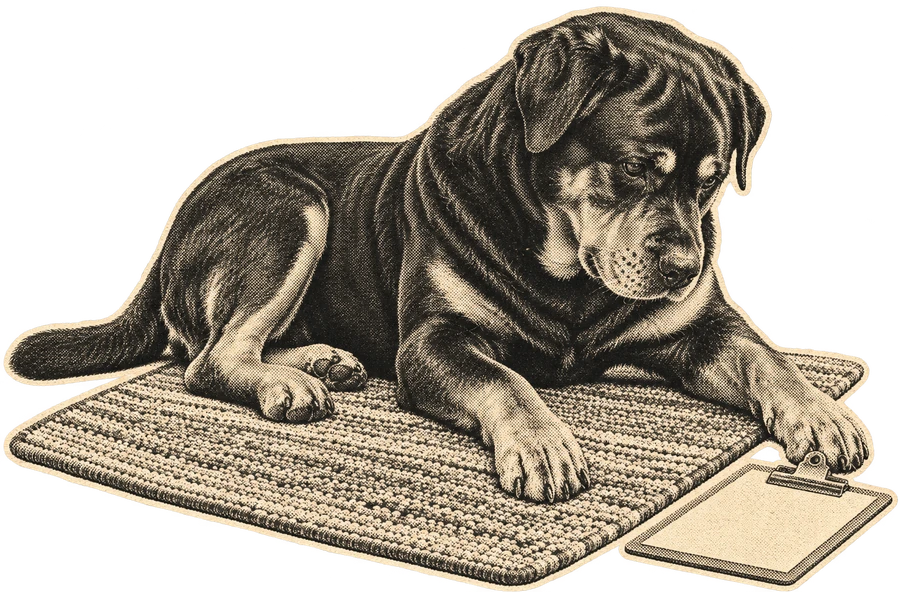
If the dog slips on the turn from the kitchen into the hall, that’s a good place to start. Put down a runner that stays put and take a look at the steps into the garden while you’re at it. An older dog needs a bed they can get off without having to swing round a table leg. Have somewhere comfortable they can go when the house is busy, rather than hoping they’ll sleep through a birthday party beside the front door. 1923
Rottweiler notes / 08
Put grip and space where it counts
The square of rug might get more use than the second lead.
| Home check | What to change |
|---|---|
| Floors and car access | Add grip where the dog turns or stands. Ask for advice before introducing a ramp if they’re sore or unsteady; use a stable, suitably rated one. |
| Gate and quiet space | Check latches and barriers suit the actual dog. Keep the resting place out of the main route through the house. |
| Being left | Build from absences the dog can manage. If they pace, bark or can’t settle, shorten the plan and arrange cover. |
| Weekday backup | Walk together before handing the lead to a new helper. Show them the quiet route and what to do if a greeting gets crowded. |
| Busy front hall | Teach a resting spot away from the opening door and give visitors room to pass. 1417 |
| Regular feeding | Keep rewards within the day’s food plan so several people don’t keep paying for the same good sit. 12 |
Kids, dogs and cats: make it easy for everyone to leave
You don’t have to make an introduction just because two people have arrived at a gate at the same time. With another dog, start where there’s room to move away and skip the greeting if one is tense. At home, an adult should actively supervise children around the dog and separate them whenever that isn’t possible. An enthusiastic dog can knock a small child over without meaning to, and a quiet dog still needs to be left alone while eating or sleeping. If there’s a cat, the cat should have places it can reach without going past the dog. Don’t wait for the first chase to find out where those are. 2425
Rottweiler notes / 09
Leave everyone a way out
A familiar dog still needs a quiet route out.
| At home with | What to arrange |
|---|---|
| Children | Separate during meals, sleep or busy play. Teach children to give the dog space; adults manage the setup. |
| Dogs | Choose low-pressure meetings and give each dog a way out. Keep valued food and chews separate while you learn how they get on. |
| Cats and smaller pets | Use barriers and separate safe areas. An individual dog’s known experience helps, but living with one cat doesn’t settle how they’ll react to another. |
| Food and chews | Arrange separate quiet spots for eating. Don’t use a valuable chew to test how another animal approaches. 2425 |
Health: know their ordinary walk and when to call
It helps to know how your dog usually gets off the rug or comes back from a walk. A new limp could be a sore paw, a joint problem or something more serious; even a dog that still wants to go out can be in pain. Tell the practice when you first saw it and what has changed. A short phone video taken without making the dog repeat a painful movement can help. If they’re in severe pain, can’t put a leg down, collapse, struggle to breathe or keep trying to vomit with nothing coming up, call the vet or out-of-hours service straight away. Don’t wait to take a video. 32627
Recorded diagnoses, not a forecast. The historical study identified 5,321 Rottweilers in 455,557 dogs across 304 UK clinics. The table below uses the 2,197 reviewed Rottweiler records, and reports problems recorded in 2013. These are selected useful care findings, not a ranked list or a recent population survey. A common recorded problem doesn’t automatically show a special breed predisposition. 11
Rottweiler notes / 10
Conditions, lifespan and breeding
What the records can show, what screening means and when to ring the vet.
| Selected recorded condition | Dogs out of 2,197; recorded percentage (95% CI) |
|---|---|
| Overweight or obesity | 155 dogs; 7.06% (6.02–8.21) |
| Outer-ear inflammation | 135 dogs; 6.14% (5.18–7.23) |
| Degenerative joint disease | 103 dogs; 4.69% (3.84–5.66) |
| Cruciate disease | 51 dogs; 2.32% (1.73–3.04) |
| Separate evidence | How to read it |
|---|---|
| Elbow joint disease | 6.16 adjusted odds ratio versus crossbred dogs (95% CI 3.89–9.75) in UK VetCompass research published in 2020. This is relative odds for recorded elbow joint disease, not incidence of elbow dysplasia or a percentage of Rottweilers affected. 28 |
| Osteosarcoma | 0.84% one-year recorded prevalence among Rottweilers in 2016 (95% CI 0.64–1.07); 61 cases among 7,284 Rottweilers. The relative odds were elevated, but this does not make a limp a cancer diagnosis or the figure a lifetime risk. 29 |
| Lifespan, older practice records | Median age at death 9.0 years across 415 recorded deaths, middle half 7.2–10.5. 11 |
| Lifespan, 2024 multi-source UK study | Median survival estimate 10.6 years (95% CI 10.4–10.7). Different methods and source populations from the earlier study, so don’t read the difference as proof that lifespan improved by 1.6 years. 3031 |
Eight things to recognise
Familiar changes worth getting checked
Elbow dysplasia and other elbow problems
Watch for a shortened front stride, stiffness after activity or starting to avoid a familiar route. Both elbows can be affected, so the dog doesn’t always favour one side. Book a vet check; ask how to adapt exercise while you wait. 32
Hip dysplasia and later joint pain
Difficulty getting up, new reluctance on stairs or hind-end stiffness are reasons to get the dog examined. Add grip where they slip, but don’t assume that a rug solves the cause. Parental hip scores don’t rule out pain in your dog. 33
Weight gain
Check the ribs and waist as well as the scale. If several people feed and train, start by noting what actually went into the bowl and the treat pouch. Let the vet set an individual goal and help with an appropriate feeding plan, especially for a growing puppy or dog with another condition. 12
Outer-ear inflammation
Repeated shaking, redness, discharge or a different smell needs a prompt appointment; ears can be painful. Don’t reach for leftover drops. Ask for the underlying cause to be considered if it keeps coming back. 34
Less common or high-consequence concerns
Osteosarcoma, a bone cancer
The breed has an elevated recorded risk. Call the vet promptly about a persistent or worsening limp or a firm, painful swelling. Severe pain or a leg the dog can’t put down warrants immediate contact. Plenty of conditions can cause lameness; an examination is the way to work out what’s going on. 2935
GDV, sometimes called bloat
This is an emergency relevant to large, deep-chested dogs. Trying repeatedly to vomit without bringing anything up, especially with pacing, drooling or a swollen abdomen, means call the emergency vet now. The swelling isn’t always obvious. Don’t wait for all the signs or try to treat it with food, exercise or a home remedy. No UK Rottweiler-specific rate is asserted here. 27
Inherited conditions screened before breeding
JLPP, juvenile laryngeal paralysis and polyneuropathy
This inherited nerve disease can start in puppyhood. A different bark, noisy breathing, trouble swallowing or unusual weakness warrants prompt veterinary assessment, immediately if the dog is struggling to breathe. The DNA test is for a known variant; it’s not an explanation for all noisy breathing. 3637
LEMP-2, leukoencephalomyelopathy
An inherited neurological disorder linked to progressive walking problems in young dogs. Dragging paws, turning the top of a paw under or worsening unsteadiness needs a vet check. Similar signs have other causes; don’t wait to get the parents’ results before seeking advice. 38
Screening before breeding
| Pre-breeding tier (Royal Kennel Club, checked 20 November 2026) | What to look for |
|---|---|
| Good Practice | JLPP DNA; BVA/RKC hip and elbow schemes. 39 |
| Best Practice, in addition to Good Practice | LEMP-2 DNA and BVA/RKC/ISDS eye scheme. 3839 |
| What results can and can’t do | Ask for the actual results for both parents, which tests they had and how the results work as a pair. Screening reduces specific risks but does not replace a vet assessment or guarantee an unaffected dog. A DNA carrier is not the same as an affected dog; ask a vet or the scheme to explain the pairing rather than interpreting it from a “clear” sticker. |
| Unknown | No robust current UK breed prevalence asserted for GDV, JLPP or LEMP-2; screening recommendations are not prevalence estimates. |
Costs: the ordinary month and the bad Saturday
PDSA’s general large-dog basket is a useful starting point: £560 setup and £116 a month, with prices collected in 2024. Its separate Rottweiler page still shows £105/month, so the dated general basket is the clearer figure to use for planning. Neither is a breed-specific forecast or a quote. The basket includes routine care and insurance but leaves out treatment after illness or injury, special diets, day care and training classes. Get your actual food and cover prices first. While you’re at it, find out who answers the phone on a Saturday night and where you’d need to drive. 4013
Rottweiler notes / 11
The budget beyond the dog bowl
Sort costs you can predict, then make a plan for the ones you can’t.
| Put these into the budget separately | Questions worth asking |
|---|---|
| Regular costs | What does the actual food cost at your dog’s measured portion? Can the walker manage this dog and what does a regular slot cost locally? |
| Setup and replacement | Add fitted equipment, floor grip, safe car setup and any change to gates or fencing. The 2024 basket doesn’t price your home. |
| Policy and emergencies | Compare exclusions, excess, co-pay and limits, including what happens at renewal. Check up front how the practice handles payment out of hours. |
| Purchase or adoption costs | No verified UK breed-wide current price given. Ask the actual breeder or rescue what’s included rather than using an advert average. |
| Initial large-dog basket | £560 setup in PDSA’s general 2024 basket. It does not include the purchase or adoption price. 40 |
| Recurring baseline | £116 a month, PDSA’s general large-dog dataset with 2024 prices; its breed page lists £105. Neither figure is a quote. 1340 |
History: a job at the cattle market
Rottweil in south-west Germany was a livestock market, and local cattle dealers developed dogs that could help move stock. The FCI history calls them the Rottweil butcher’s dog and records that they were also used for draught work. The story that their ancestors came north with Roman cattle is a theory, not a documented family tree. The UK Rottweiler Club records recognition as a breed in its own right by the Kennel Club in 1965. It’s a useful history for understanding the size and build, not a job description for the dog lying across your hall. 1241
Rottweiler notes / 12
What they used to do for a living
Today a quiet scent game is a perfectly good shift.
| Then | What you can do now |
|---|---|
| Moving cattle and draught work | Find a useful outlet such as a quiet scent search or a walk with time to explore. You don’t need to put a load on the dog or teach them to guard anything. |
Bringing one home, or making life easier for the one you’ve got
With a rescue, ask for an ordinary walk and what happened the last time someone rang the bell, how the dog got into the car and whether they were happy being handled for their last vet visit. If you already live with one, those are three good things to try to make easier before you buy more kit. If you’re considering a pup, see it with its mother where it was raised and get the actual health results for both parents. Give yourself time to read them. Being told the litter has nearly gone isn’t a reason to rush. 421
Rottweiler notes / 13
Start with an ordinary week
The question is what happens on a normal Tuesday.
| When | Useful checks |
|---|---|
| Before collection | Confirm veterinary and chip records, book a vet visit and agree how to update keeper details with the chip database. UK microchip guidance is broadly eight weeks, subject to applicable exemptions; Northern Ireland additionally has council dog licensing. 4344 |
| First fortnight | Establish predictable walks, food and a quiet place to sleep. Let greetings happen at the dog’s pace and start simple lead and doorway work. |
| Already settled in | Check weight trend, vet and out-of-hours numbers, how the dog gets up from rest and whether your walker feels comfortable. Pick the thing that would make the biggest difference. |
Sources
- S1RKC: Rottweiler breed profile and screeningUK registry and screening · checked 20 November 2026
- S2FCI: Rottweiler standard 147 and breed historyInternational registry · checked 20 November 2026
- S3PDSA: limping and stiffnessUK veterinary charity · checked 20 November 2026
- S4RKC: Rottweiler breed standardUK registry and screening · checked 20 November 2026
- S5FCI: Rottweiler nomenclatureInternational registry · checked 20 November 2026
- S6GOV.UK: banned dog types in England and WalesOfficial government guidance · checked 20 November 2026
- S7Scottish Government: dogs bred for fightingOfficial government guidance · checked 20 November 2026
- S8Scottish Government: XL Bully rulesOfficial government guidance · checked 20 November 2026
- S9NI Direct: banned dog typesOfficial government guidance · checked 20 November 2026
- S10Government of Ireland: dog control and restricted dogsOfficial government guidance · checked 20 November 2026
- S11O’Neill et al.: Rottweilers in UK primary veterinary carePrimary UK research · checked 20 November 2026
- S12PDSA: weight and body conditionUK veterinary charity · checked 20 November 2026
- S13PDSA: Rottweiler care and breed budgetUK veterinary charity · checked 20 November 2026
- S14Dogs Trust: settle trainingUK charity · checked 20 November 2026
- S15Dogs Trust: loose-lead walkingUK charity · checked 20 November 2026
- S16Dogs Trust: reward-based trainingUK charity · checked 20 November 2026
- S17Dogs Trust: doorway trainingUK charity · checked 20 November 2026
- S18Dogs Trust: managing chasingUK charity · checked 20 November 2026
- S19PDSA: arthritis in dogsUK veterinary charity · checked 20 November 2026
- S20Natural England and Defra: Countryside CodeOfficial government guidance · checked 20 November 2026
- S21Scottish Government: dog welfare and controlOfficial government guidance · checked 20 November 2026
- S22NI Direct: dogs that worry livestockOfficial government guidance · checked 20 November 2026
- S23Dogs Trust: alone-time trainingUK charity · checked 20 November 2026
- S24Dogs Trust: dog and child safetyUK charity · checked 20 November 2026
- S25Dogs Trust: dogs and catsUK charity · checked 20 November 2026
- S26PDSA: breathing emergenciesUK veterinary charity · checked 20 November 2026
- S27PDSA: bloat and GDVUK veterinary charity · checked 20 November 2026
- S28O’Neill et al.: elbow joint disease in UK dogsPrimary UK research · checked 20 November 2026
- S29O’Neill et al.: osteosarcoma in UK dogsPrimary UK research · checked 20 November 2026
- S30McMillan et al.: longevity of companion dog breedsPrimary UK research · checked 20 November 2026
- S31Dogs Trust: UK longevity breed tablePrimary UK multi-source table · checked 20 November 2026
- S32PDSA: elbow dysplasiaUK veterinary charity · checked 20 November 2026
- S33PDSA: hip dysplasiaUK veterinary charity · checked 20 November 2026
- S34PDSA: ear infectionsUK veterinary charity · checked 20 November 2026
- S35PDSA: osteosarcomaUK veterinary charity · checked 20 November 2026
- S36The Rottweiler Club: breed healthUK breed club · checked 20 November 2026
- S37UC Davis VGL: JLPP and the known variantUniversity veterinary genetics lab · checked 20 November 2026
- S38RKC: LEMP-2 DNA testUK registry and screening · checked 20 November 2026
- S39RKC: current breed-specific Health StandardUK registry and screening · checked 20 November 2026
- S40PDSA: the cost of owning a dogUK veterinary charity · checked 20 November 2026
- S41The Rottweiler Club: breed historyUK breed club · checked 20 November 2026
- S42Defra: buying a cat or dogOfficial government guidance · checked 20 November 2026
- S43GOV.UK: microchip rules for dogsOfficial government guidance · checked 20 November 2026
- S44NI Direct: dog licensing and microchippingOfficial government guidance · checked 20 November 2026