
Breed guide / Pomeranian
Living with a Pomeranian
A little spitz with a coat you have to get a comb through and an opinion on nearly every noise outside. Give them a walk and a bit of independence, not a full-time seat under your arm.
Jump to a section
The short version: a small spitz who’d quite like to walk, thanks
A Pomeranian is a tiny companion dog from the spitz family, with upright ears, a double coat and a keen interest in what’s going on. They can be good company in a small home if they get to walk, sniff and learn how to settle. But they can be vocal, the coat needs care down to the skin and a dog this small is easy to handle without ever checking whether they want to be handled. Leave a little room for the dog to be a dog. 123
Pomeranian notes / 01
What a small dog actually needs
Good company, their own four feet and a comb that gets through.
| Daily reality | What it asks of you |
|---|---|
| A small, active companion | Regular short outings and play at their level. |
| A thick coat and small mouth | Gentle coat care and a toothbrushing routine your vet can show you. |
| Interested in the landing | Teach a quiet spot away from the door, rather than waiting to see how many notices the neighbours put up. |
| A fragile-looking dog isn’t a goal | Choose a dog who moves freely and breathes comfortably, not the tiniest or flattest face in a photo. |
Names: “teacup” is the seller’s word
Pomeranian is the UK registered name; Pom is the usual short version. The Royal Kennel Club puts them in the Toy group. In the FCI’s German Spitz standard, the corresponding variety is the German Toy Spitz, also called the Zwergspitz or Pomeranian. That doesn’t make every German Spitz a Pom. And “teacup”, “micro” and “teddy bear” in an advert aren’t extra UK breed varieties or proof that a dog will grow to a promised weight. 45
Pomeranian notes / 02
Names worth checking
‘Teacup’ isn’t a separate breed or a health result.
| Term | What to know |
|---|---|
| Pom | Informal name for Pomeranian. |
| Toy | Their UK registry group, not evidence of a miniature version of an already small dog. |
| German Toy Spitz / Zwergspitz | The FCI’s corresponding variety, under standard 97; other German Spitz sizes are listed separately within that standard. |
| “Micro” or “teacup” | Marketing, not a separate RKC standard or a health result. |
| Cross | Ask about known parentage and the individual dog rather than applying purebred figures. |
| Pomeranian | The registered UK breed name. The Royal Kennel Club groups it with Toy breeds. 14 |
| German Spitz sizes | FCI standard 97 covers multiple sizes; check which one the source is describing before using its measurements. 5 |
Size: you’re not buying them by the kilo
The current UK show standard gives an ideal of 1.8–2 kg for males and 2–2.5 kg for females, with no numerical height. The separate FCI German Toy Spitz standard gives 21 cm ± 3 cm at the shoulder. These are breed standards, not a diet target or a promise about your dog. Ask your vet to assess the dog you’ve actually got. With a Pom, you can put on an impressive show of looking for a waist and only touch fur. Your hands need to get through the coat. 456
Pomeranian notes / 03
Size, shape and getting the harness on
The scales can’t see how comfortably the dog moves.
| Measure | How to use it |
|---|---|
| UK show ideal | Males 1.8–2 kg, females 2–2.5 kg; no height in the UK standard. |
| FCI height | 21 cm ± 3 cm, a different registry’s standard. |
| Healthy size | Check body condition and recent changes with your practice; don’t chase show weight. |
| Equipment | Have a harness fitted to the actual chest under the fluff. Check it doesn’t slip off or rub. 7 |
Coat: a tidy top layer can lie to you
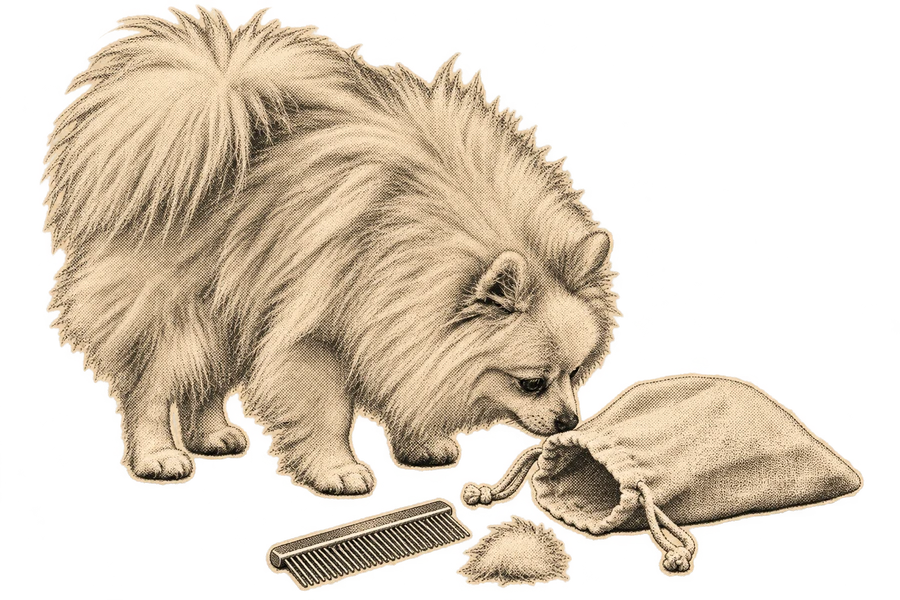
They have longer outer hair over a dense undercoat. PDSA advises brushing two or three times a week and more when they’re shedding. Part a small section so you can see what you’re doing. Work gently and have a good look behind the ears and where the harness goes; those bits don’t stay neat just because the back looks fine. Stop before the dog has had enough, rather than waiting for them to announce it. 438
Pomeranian notes / 04
The short coat-care list for a very long coat
Neat on top doesn’t mean you’ve made it to the undercoat.
| Coat job | Make it easier |
|---|---|
| Regular brushing | Small sections, short sessions, easy rewards. Ask a groomer to demonstrate if the comb won’t go through easily. |
| Mats | Get help if they’re tight or painful. Don’t cut blindly close to skin. |
| Pet trim | Ask a groomer familiar with double coats what is useful for this dog rather than ordering a haircut from a photograph. |
| New skin change | Patchy hair loss, soreness or scaling needs a vet’s opinion rather than just another wash. |
| Warm days | Use cooler outings and give the dog space to rest. Changing the haircut is not a heatstroke plan. 9 |
| What to check under the fluff | Part the coat to see the skin and check where straps cross. Get advice if you find soreness. 61131 |
| A groomer’s demonstration | Ask to see how they reach the undercoat and keep handling comfortable. 38 |
Temperament: the hall can sound a lot busier from down there
Some Poms greet you, have a look and go back to what they were doing. Others react to nearly everything on the landing. Find out when they bark and how quickly they can leave it alone. A dog who barks while looking out of the window may need a different setup from one who does it after you’ve gone. Moving a chair away from the window can be more use than repeatedly appealing to their better judgement. 210
Pomeranian notes / 05
Watch what happens around the front door
Give them a quieter place to hear the world from.
| What happens | What to try |
|---|---|
| Every passing sound gets a bark | Reduce the view or noise around the resting spot, and practise easy settling when it’s quiet. |
| Visitors loom over the dog | Ask them to sit down and let the dog choose whether to approach. |
| A dog starts avoiding touch | Check for pain or distress; don’t pick them up repeatedly to see if they’ve got over it. 11 |
Training: let the dog do the bit with the feet
Use the same reward-based skills you’d teach a larger dog: come back, walk on a slack lead and settle somewhere out of the way. Start recall indoors or in a secure space. Let a successful return earn a treat and sometimes another chance to sniff. If you only pick them up when you’ve called them back, they may learn there was a catch to the offer. 1213
Pomeranian notes / 06
Before you pick the dog up
Start with the bits you can practise today.
| Skill | First version |
|---|---|
| Recall | Call from a short distance in a safe place and reward a good return. |
| Handling | Reward a brief brush or harness touch. Let the dog pull away and reset if needed. |
| Front-door routine | Reward going to a mat away from the door. Use a gate while it’s a work in progress. |
| Toileting | Offer regular chances outside and reward them there. 14 |
Exercise: half an hour is a starting point, not a lap record
PDSA suggests around 30 minutes a day; the Royal Kennel Club lists up to 30 minutes. Let that help you plan, not decide when the dog has done enough. Split outings if that fits better, let them stop and sniff, and add a little floor-level play. If a puppy, older dog or dog with pain or breathing problems can’t do the same thing, speak to the vet rather than giving them one determined owner and a timer. 31
Pomeranian notes / 07
Change the walk to suit the dog
Leave the stopwatch at home if the dog’s struggling.
| Situation | Do this |
|---|---|
| New cough, reluctance or a skipping step | Stop and ask the vet about a change in comfort or tolerance. 15 |
| Warm conditions | Choose cool times, shade and shorter trips; call for help for breathing distress or collapse. 9 |
| Traffic or big dogs crowding in | Use a fitted lead setup and leave more room. Don’t force a greeting. |
| A healthy adult’s routine | PDSA’s roughly half-hour is a starting point, not an allowance to use up in one outing. 3 |
Home: a bed that doesn’t need a flying start
A flat can suit a Pom if there are regular outings, a quiet resting spot and a way to handle noise. Put a low bed somewhere the dog can choose to go. Check gaps in railings and doorways, and arrange decent footing where the dog slips. Don’t put them on a high sofa and then make them work out how to get down. If their knees or mobility give you concern, ask a vet about how to make things easier. 11615
Pomeranian notes / 08
Normal life close to the floor
Start with a low bed and no squeeze through the front door.
| Plan for | Check it works |
|---|---|
| Front door and balcony | Shut gaps and use a barrier if needed. Small doesn’t mean they can safely slip past you. |
| Time alone | Build up short absences while the dog stays comfortable; arrange cover if they don’t. 10 |
| Noise | Position the bed where the lift and door aren’t the main event. |
| Toilets | Have a practical way outside at the times the dog needs it. |
| Getting to bed | Choose a low, reachable rest spot instead of making the dog jump onto furniture every time. 215 |
| Visitors | Give the dog a clear route out of the hall. Ask visitors to sit and let the dog decide whether to come over. 1317 |
Kids and other pets: let the dog stay on the floor
Children should be shown how to sit for a gentle greeting and let the dog leave. No carrying them round, reaching into the bed or taking food away. Keep an adult close and attentive, or separate them. Another dog may be friendly but too boisterous for a Pom. Step in before play becomes lopsided, and give a cat a safe route out rather than holding either animal in place. 1718
Pomeranian notes / 09
Company that doesn’t crowd them
Set it up so the dog can walk away without being picked up.
| Introductions | Keep it practical |
|---|---|
| Children | Gentle floor-level games and a bed that’s off limits. |
| Other dogs | Space, pauses and somewhere the smaller dog can get out of the way. |
| Cats or small pets | Use barriers and actual history. Keep small pets physically separated. |
| Meals and chews | Set up quiet separate places; don’t leave a child in charge of mediating near food. 1718 |
Health: check movement, breathing and the mouth behind all the hair
Screening: The Royal Kennel Club’s current Pomeranian row is blank for Good Practice and lists BVA/RKC/ISDS clinical eye testing under Best Practice. Pomeranians are eligible for the Cambridge/RKC Respiratory Function Grading scheme, which assesses signs of BOAS; that is separate from what is currently listed against the breed in the Health Standard, and it does not test for every cause of a cough. Ask about both parents’ breathing and any knee checks, plus the actual eye results. The RKC’s Breed Watch Category 2 point for judges is closure of the fontanelle, an opening in the skull, in mature dogs over 12 months. It is a show-monitoring point, not a go-ahead to examine a puppy’s skull yourself. 19202122
Pomeranian notes / 10
Conditions, lifespan and breeding
Breeding schemes, what the studies counted and practical reasons to call the vet.
| What was measured | What it does and doesn’t say |
|---|---|
| Slipping kneecap, English primary care 2009–2014 | In a VetCompass study of 210,824 dogs overall, the Pomeranian group (1,040 dogs) had estimated diagnosed period prevalence 6.5% (95% CI 3.9–9.2). It includes existing and new cases, is not annual and is not a current UK-wide rate. 23 |
| Adjusted odds from the same study | Pomeranian OR 6.5 (95% CI 4.0–10.7) against crossbred dogs. That is a modelled odds ratio, not the percentage above or an individual prediction. 23 |
| UK multi-source longevity | Median survival 12.2 years (95% CI 12.0–12.5) across 2,941 Pomeranians, 1,170 recorded deceased. Not a date for a particular dog. 2425 |
| Whole-breed annual diagnoses | No Pomeranian-only UK chart of all common diagnoses was verified here. Don’t convert referral-clinic or non-UK data into a UK breed prevalence. |
| Breeding screening tier | Current Pomeranian entry |
|---|---|
| Good Practice | The breed-specific column is blank. 19 |
| Best Practice | BVA/RKC/ISDS clinical eye screening. 1922 |
| Separate scheme | Pomeranians can take the RKC/Cambridge respiratory grading. Its current availability is not the breed’s formal Health Standard tier and it does not check every cause of a cough. 1920 |
Eight problems or distinctions worth recognising
Slipping kneecap
Skipping for a few strides or repeatedly holding a hind leg up deserves an assessment. Other causes can look similar. Call urgently if they can’t put weight on the leg or are in severe pain. 2326
Tracheal collapse
A persistent dry, honking cough should be investigated. A cough isn’t enough to diagnose a collapsing windpipe, and a normal BOAS grade wouldn’t rule it out. Difficulty breathing, blue gums or collapse needs emergency help. 327
Upper airway obstruction
Noisy breathing at rest, unusual tiredness on an ordinary outing or difficulty recovering needs a vet check. Don’t accept struggling to breathe as a breed trait. Seek immediate help if there’s obvious distress. 2028
Gum and tooth disease
Bad breath, bleeding gums or a change in chewing are worth a check. Dogs can eat despite pain. Start a brushing routine with dog toothpaste when the mouth is comfortable; ask a vet nurse to show you. 29
Unexplained hair loss
Talk to your vet about spreading loss of coat, itch or skin change. Research on alopecia X in Pomeranians in the Netherlands and Belgium investigated risk indicators, not UK frequency. Don’t assume every bald patch is alopecia X or treat it yourself. 3031
New eye problems
A shut, painful, red or suddenly cloudy eye needs prompt advice. Screening is for breeding decisions; it doesn’t tell you what has happened to your dog’s eye now. 2232
Weight and exercise changes
Feel the ribs and waist instead of guessing from the coat. Ask the vet about unexplained loss or gain, or a new reluctance to exercise. Don’t reduce food to meet the show numbers. 6
Head development questions
If a breeder mentions an open fontanelle, ask for the veterinary findings and have your own vet interpret them. Breed Watch’s point for mature dogs is not a home test or a diagnosis for a pup. 21
Costs: the food bill is the small bit
PDSA’s breed profile lists £70 per month as a minimum. It isn’t a quote and does not tell you what a grooming appointment, dental work or an emergency will cost locally. Get actual prices. Check your insurance excess and what happens if a problem is already in the notes. If you’re budgeting for two brushes and ignoring the dog walker, you’ve been shopping, not budgeting. 333
Pomeranian notes / 11
Budget for more than food
Actual grooming and cover costs will matter more than the little bag of food.
| Allow for | What to price |
|---|---|
| Setup | Safe travel setup, fitted harness, bed and practical barriers. |
| Regular costs | Food and routine health care; find a groomer who is comfortable with a dense double coat. |
| Unplanned costs | Dental, eye or other treatment, insurance exclusions and out-of-hours provision. |
| Daytime cover | A sitter or walker if the dog can’t manage the time you’re away. |
| Monthly starting point | PDSA’s breed page puts it at at least £70 a month. It is not a local quote. 333 |
| Replacements and extras | Price the cost of another fitted harness, a new brush and a groom with the person you’ll actually use. 333 |
History: the royal lap came later
The Pom belongs to the spitz family, and the FCI lists the German Toy Spitz under its German Spitz standard. The Royal Kennel Club describes the Pomeranian as the smallest spitz and a favourite of Queen Victoria. That’s useful history, not evidence that today’s dog should live on somebody’s lap or that the smallest pup is the best one. They still use their ears, their nose and the bit of ground you let them walk over. 51
Pomeranian notes / 12
Before the royal lap
They still use their nose and ears the way a spitz does.
| What carried through | What it means now |
|---|---|
| Spitz coat and upright ears | Brush to the undercoat, give the dog a quiet place to rest and teach them what to do when a noise catches them. |
| A small companion dog | Provide company and choices without treating them as something to carry round all day. |
Bringing one home: have a walk before you buy the jumper
Ask a rescue what this dog does around a knock at the door, a brush, bigger dogs and being left. Walk together if possible. If buying, meet the mother with the pups where they were raised. Ask to see actual clinical eye results, what the vet found about the knees and whether anyone has asked about breathing. Watch the parents and pup move when they’re not being held. Don’t buy on “teacup”, an unusually flat face or a promise delivered only in the advert. A breeder should let you see how their dogs breathe at rest and after ordinary movement. 343519
Pomeranian notes / 13
Try an ordinary walk together
Ask about the things that happen after the advert ends.
| Before collection | First few weeks |
|---|---|
| Verify records and identity, line up your vet and agree who covers the daytime outings. | Get a gentle brush and short walks established. Look for changes in movement, breathing or appetite as the dog settles. |
| Ask about actual household behaviour and family health. | Set up a bed that’s easy to reach and build time alone in steps the dog can manage. |
Sources
- S1RKC: Pomeranian breed profile and historyUK registry and schemes · checked 20 November 2026
- S2Dogs Trust: Pomeranian breed profileUK charity · checked 20 November 2026
- S3PDSA: Pomeranian care and costsUK veterinary charity · checked 20 November 2026
- S4RKC: Pomeranian breed standardUK registry and schemes · checked 20 November 2026
- S5FCI: German Spitz standard 97, including PomeranianInternational registry · checked 20 November 2026
- S6PDSA: weight and body conditionUK veterinary charity · checked 20 November 2026
- S7Dogs Trust: fitting and introducing a harnessUK charity · checked 20 November 2026
- S8Dogs Trust: dog handlingUK charity · checked 20 November 2026
- S9PDSA: heatstrokeUK veterinary charity · checked 20 November 2026
- S10Dogs Trust: building time aloneUK charity · checked 20 November 2026
- S11PDSA: home health checksUK veterinary charity · checked 20 November 2026
- S12Dogs Trust: recall trainingUK charity · checked 20 November 2026
- S13Dogs Trust: settle trainingUK charity · checked 20 November 2026
- S14Dogs Trust: house trainingUK charity · checked 20 November 2026
- S15PDSA: limping and stiffnessUK veterinary charity · checked 20 November 2026
- S16Dogs Trust: preventing escapeUK charity · checked 20 November 2026
- S17Dogs Trust: dog and child safetyUK charity · checked 20 November 2026
- S18Dogs Trust: dogs and catsUK charity · checked 20 November 2026
- S19RKC: current breed-specific Health StandardUK registry and schemes · checked 20 November 2026
- S20RKC and Cambridge: Respiratory Function GradingUK registry and schemes · checked 20 November 2026
- S21RKC: Pomeranian Breed Watch Category 2UK registry and schemes · checked 20 November 2026
- S22BVA: clinical eye examinationUK veterinary scheme · checked 20 November 2026
- S23O’Neill et al.: patellar luxation in English primary carePrimary UK research · checked 20 November 2026
- S24McMillan et al.: longevity in UK companion dogsPrimary UK research · checked 20 November 2026
- S25Dogs Trust: UK longevity breed tablePrimary UK multi-source table · checked 20 November 2026
- S26Animal Trust: patellar luxationUK veterinary charity · checked 20 November 2026
- S27Cornell Veterinary Medicine: tracheal collapseVeterinary school guidance · checked 20 November 2026
- S28PDSA: breathing emergenciesUK veterinary charity · checked 20 November 2026
- S29PDSA: dental diseaseUK veterinary charity · checked 20 November 2026
- S30Utrecht research: risk indicators for alopecia X in PomeraniansPrimary Netherlands/Belgium research · checked 20 November 2026
- S31PDSA: skin problemsUK veterinary charity · checked 20 November 2026
- S32PDSA: eye problemsUK veterinary charity · checked 20 November 2026
- S33PDSA: general cost of dog ownershipUK veterinary charity · checked 20 November 2026
- S34Dogs Trust: adopting a dogUK charity · checked 20 November 2026
- S35Defra: buying a cat or dogOfficial UK guidance · checked 20 November 2026
