
Breed guide / Miniature Labradoodle
Living with a Miniature Labradoodle
A Miniature Labradoodle is a Labrador and Poodle cross described as a smaller type, often with Miniature Poodle ancestry. That doesn’t tell you how high they’ll stand or what the coat will be like when the puppy fluff goes. One will come back from a muddy walk needing a towel; another will need a comb and the patience to get half the verge out of their legs. Start with the dog you’ve actually got and the family records you can check. 12345
Jump to a section
The short version
Separate size from effort. A dog that fits under the kitchen table can still put quite a lot of weight behind the lead. Practise walking past one thing they want to reach before you try it through a whole row of people. Reward a loose lead early enough that they’re still listening. 267
Part the coat and check at the roots even if the back looks tidy. Ask a groomer to show you how to handle the hair under the harness. If you’ve got a dog who brings you socks, teach a calm swap rather than following them round the furniture to get one back. 358
Miniature Labradoodle notes / 01
Start with the dog you have
| Start with this | What to do |
|---|---|
| Size | Get the adult measurements or ask about adult relatives; “mini” is not a promise. 12 |
| Coat | Comb a small patch near the skin and get help with tight mats. 35 |
| Things they carry | Teach a swap using a safe toy rather than grabbing what the dog has. 8 |
| Records | Find out the actual ancestry and get the relevant results for both sides. 39 |
Miniature doesn’t mean Australian
Labradoodle describes Labrador and Poodle ancestry. Some dogs described as mini have a documented Labrador and Miniature Poodle as direct parents. Others are from later generations, and the label alone doesn’t identify a particular parent or generation. An F1 refers to the direct first cross. A later cross back to a parent breed is a different arrangement. 123
Australian Labradoodle describes developed lines with more family history behind them. A small dog or one born in Australia isn’t necessarily from those lines. Some clubs publish a miniature size band for their own Australian Labradoodles. Those bands don’t apply to every dog listed as a Miniature Labradoodle. Ask which line or parents are documented rather than deducing it from the coat. 34101145
Miniature Labradoodle notes / 02
Separate breeds
| Label | What it does and doesn’t tell you |
|---|---|
| Labradoodle | Labrador and Poodle cross ancestry; no lone size category follows from the name. 123 |
| Miniature Labradoodle | Informal smaller-size label. Ask which parent, variety and generation are documented. 23 |
| Australian Labradoodle | Developed lines. A club’s miniature band is specific to its standard. 4101145 |
Get the tape measure out before buying kit
The British Labrador standard and Miniature Poodle standard give quite different shoulder heights. They’re descriptions of the parent breeds, not two ends of a scale that gives you the puppy’s adult size. If size matters because of stairs or a carrier, ask how big both parents actually are. Look at related adult dogs where there are reliable records. 31213
For a dog you already have, measure them standing naturally. Check a harness again when the coat gets thicker or after a clip. Your vet can show you how to feel the ribs through the coat and avoid reading weight gain as “just a fluffy bit”. 5614
Miniature Labradoodle notes / 03
Fit the kit to the actual dog
| Reference only | What you can use it for |
|---|---|
| Labrador parent standard | Males 56 to 57 cm, females 55 to 56 cm at the shoulder; not a crossbreed forecast. 12 |
| Miniature Poodle parent standard | At least 28 cm and under 38 cm at the shoulder; not a Miniature Labradoodle band. 13 |
| The dog you’re fitting | Measure the dog you have. Use body condition alongside the scales. 614 |
The wet bits tell you more than the puppy photo
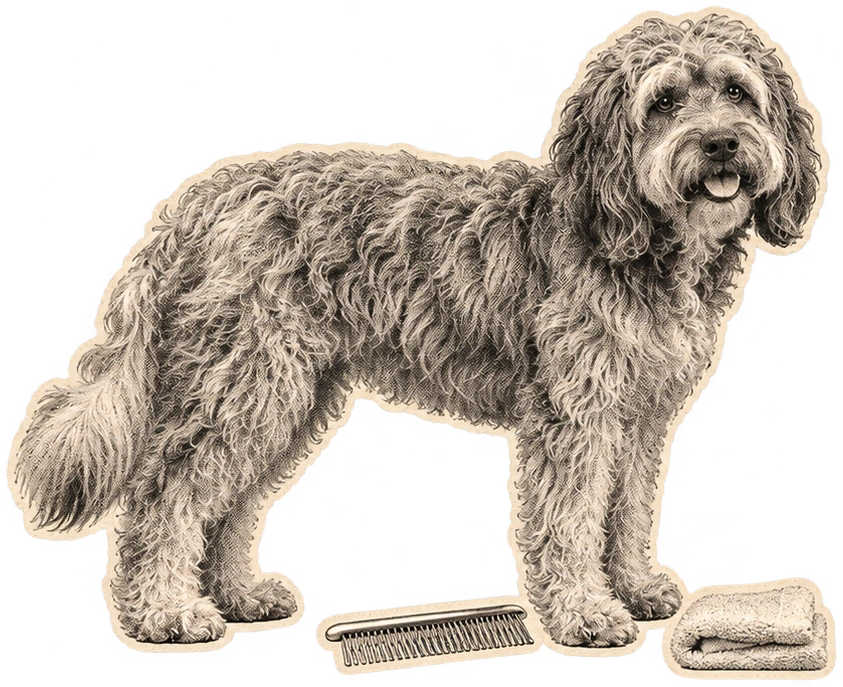
A Labradoodle coat can inherit different textures, even in different areas of the same dog. The coat around the neck and armpits can tangle while the back still looks fine. Part a little hair so you can see down to the skin. If the comb won’t pass comfortably or you’ve got a tight mat, ask the groomer rather than trying to snip it away. 23515
Dry the dog after a wet walk. Check the hair at the front of the legs. Paws that stay licked or sore after a long-grass walk are worth a vet call. A coat that looks low-shedding doesn’t guarantee anyone in the household will be fine with it. Allergens can come from saliva and dander as well as hair. 515161718
Miniature Labradoodle notes / 04
Check the wet bits
| Where or what | What helps |
|---|---|
| Harness line | Part the hair and check underneath for tangles and soreness. 515 |
| Legs and feet | Dry after wet walks and check for debris. Persistent licking needs checking. 1516 |
| Coat already matted | Ask a groomer or vet if the skin is sore; no scissors near the skin. 515 |
| Allergy at home | Get medical advice if someone reacts to dogs; don’t shop for a coat that promises no reaction. 1718 |
Let the dog show you how sociable they are
There’s no need to let them greet everyone to find out whether they’re friendly. If your dog rushes to people, practise passing at a distance and reward the moment they turn back. If they try to hide behind you, help them get away rather than asking a stranger to offer a hand and see what happens. 71920
For a dog who throws all four paws at the visitor, rehearse the quieter version when nobody is coming in. You’re allowed to close the dog behind a barrier while a delivery happens. It doesn’t need to turn into a training session at every knock. 202122
Miniature Labradoodle notes / 05
Give them room
Teach them to give things up before it’s your best sock
Use a toy they like and trade it for a reward. Return the safe toy from time to time. If every exchange ends with you putting something in a cupboard, you’re giving them a reason to take it somewhere you can’t reach. Don’t prise things out of their mouth if they’re guarding them. 822
Give them something else to do with their nose. Put part of their dinner where they can find it easily and build from there. A dog who gets overexcited chasing toys might stay much more settled searching for one. Finish while they’re still enjoying it, not when something has to be confiscated. 2223
Miniature Labradoodle notes / 06
Useful jobs for a normal day
The outing should suit the dog, not the size label
Choose activity by how your dog moves and how easily they recover. Let them sniff as well as walk. Plan a route with an easy way back, particularly with a growing pup or a dog getting used to exercise. You don’t need to reach a certain distance because someone said it’s a Labrador underneath. 2325
Use a lead near roads and livestock. If recall isn’t ready yet, practise on a suitable long line attached to a fitted harness in open space. New stiffness after a familiar outing is a reason to change the route. Let the vet find out why before you attempt to walk it off. 625262728
Miniature Labradoodle notes / 07
Keep the walk comfortable
| Situation | Better option |
|---|---|
| Busy route | Take space to pass and keep the lead short enough to manage safely. 67 |
| Quiet open space | Practise recall where you can prevent a run-off. 26 |
| Young dog | Build activity to suit the individual rather than matching an adult dog. 25 |
| New stiffness or limping | Seek veterinary advice rather than pushing the distance. 28 |
Teach the dog that the whole house isn’t their shift
Give them a bed that isn’t in the middle of the traffic. Reward them for settling there while you do something ordinary. If they follow each time you stand up, try getting up and sitting again while they stay put. You don’t have to keep them entertained whenever the kettle comes on. 2122
Teach time alone in small stages. Use a camera if you can and see what they do after the door closes. If they pace or call for you instead of settling, make the next absence shorter and ask for help if it keeps happening. A chewed cushion is information, not a grudge. 2930
Miniature Labradoodle notes / 08
A place to rest
Kids, cats and other dogs
Supervise children and dogs together and give your dog a resting spot where nobody goes to find them. If they bring a toy, let an adult do the swap rather than asking a child to wrestle it off them. A dog being little enough to lean over doesn’t mean that’s how they want to be greeted. 81931
Keep cats able to move away without passing the dog. With other dogs, start somewhere both can break away and don’t bring out favourite toys as part of the first meeting. If either dog wants space, let them have it. 193233
Get the actual health results from both sides
The November 2026 Royal Kennel Club Labrador row puts hips and elbows under Good Practice alongside clinical eyes and six DNA checks. Its Best Practice addition is HNPK DNA. The Miniature Poodle row has no Good Practice tests listed and puts clinical eyes and hips with prcd-PRA and osteochondrodysplasia (OC) DNA in Best Practice. If there’s a different Poodle variety or further ancestry, don’t assume the same list applies. Ask which breeding dogs were tested and whether the results match the documented ancestry. 39343536
There’s a large UK study of Labradoodles alongside two other crosses, but it does not give a separately verified Miniature Labradoodle rate for health conditions. The UK lifespan table doesn’t give a separate figure for Miniature Labradoodles either. Talk to your vet about the dog’s movement or eyes instead of using the report from a parent to explain a new limp or sore eye. 2836373839
Miniature Labradoodle notes / 10
Health conditions and screening
| Check | What to look for |
|---|---|
| Labrador Good Practice | Hips, elbows and clinical eyes plus CNM, EIC, MCD, prcd-PRA, SD2 and STGD DNA. 9 |
| Labrador Best Practice addition | HNPK DNA, in addition to Good Practice. 9 |
| Miniature Poodle Best Practice | Clinical eyes and hips plus prcd-PRA and OC DNA. No Good Practice tests listed in the November row. 935 |
| Other Poodle or mixed family | Get the appropriate breed and line results; don’t use a one-size screening checklist. 39 |
| Symptoms | A new limp or painful eye needs veterinary assessment whether screening was done or not. 2837 |
| Allergy | Don’t read “low shedding” as allergy clearance. 1718 |
| Lifespan and rate estimates | No separately verified Miniature Labradoodle estimate in the cited UK evidence. 3839 |
Budget for how they are now
Ask the groomer when they’d want to see the dog and what it costs for this coat. If you like the longer look, ask whether it’s realistic given what you can manage between appointments. You’re the one who’ll be getting grit out of the legs when the groomer is off on a Sunday. 51540
Check your vet’s routine prices and read what an insurance policy excludes. Work out who can keep the dog’s normal lead routine if you’re away. Somebody offering to help is useful. Somebody who knows why you don’t let the dog say hello to every person on the route is more useful. 674041
Miniature Labradoodle notes / 11
Budget beyond the food
| Budget line | Check this |
|---|---|
| Grooming | The actual coat, size and maintenance time between visits. 540 |
| Vet care | Routine costs and exclusions for anything already known. 40 |
| Equipment | Fit with room to move, not a default “mini” size. 6 |
| Backup walks | A walker willing to use the lead and greeting routine you’ve taught. 6741 |
A familiar cross with several family trees
The Australian guide-dog project behind the name originally crossed a Labrador and a Poodle. That history doesn’t make every later Labradoodle part of the same breeding programme. A genetic study compared first crosses with a small sample of developed Australian Labradoodles and found a greater Poodle contribution in the developed sample. It is not a family tree for your dog. 41042
The “Miniature” part normally describes intended size or the Poodle ancestry, not one formally recognised British breed. When you’re looking at a dog’s paperwork, where their particular parents came from is the useful bit. You can leave the rest to the people arguing over the perfect name. 2311
Miniature Labradoodle notes / 12
More than one family tree
| History point | What is documented |
|---|---|
| Original cross | Labrador and Poodle in the Australian guide-dog account. 442 |
| Later programmes | Some developed Australian Labradoodle lines; not all Labrador/Poodle crosses are in them. 410 |
| Smaller dogs | Miniature describes a size intention or known Poodle ancestry, not one standard outcome. 2311 |
Before and after bringing one home
Ask to see a puppy with its mum where they were raised. Check the health documents and find out which Poodle variety is actually on the family records. If the dog is already an adult in rescue, ask how the coat behaves when it gets wet and what the dog’s used to doing when a visitor comes in. 359204344
If they’re already on the sofa, start with the one bit of the day that could get easier. Try a coat patch after a calm walk. Teach the swap while you still have all your socks. Get the paperwork onto the vet record before you need to find it in a panic. 5892444
Miniature Labradoodle notes / 13
Ask for evidence you can use
| First questions | What to look for |
|---|---|
| Family records | Which Poodle variety and other ancestry are documented? 39 |
| Existing health evidence | Get named results for the actual dogs and ask the vet what they show. 3936 |
| Grooming and walks | Ask what the dog tolerates and where they become distracted. 5744 |
| Household allergies | Get advice before committing; no coat label makes a dog safe for everyone. 1718 |
Sources
- S1Royal Kennel Club explanation of Labradoodle and crossbreed namesSource · checked 21 November 2026
- S2Doodle Trust rescue experience with Labradoodle sizes and varied coat typesSource · checked 21 November 2026
- S3Royal Kennel Club crossbreed generations, care and parent screeningSource · checked 21 November 2026
- S4Original study comparing first cross and multigenerational Australian Labradoodle ancestrySource · checked 21 November 2026
- S5PDSA grooming and veterinary coat-care guidanceSource · checked 21 November 2026
- S6Dogs Trust comfortable lead walking and harness fitSource · checked 21 November 2026
- S7Dogs Trust walking around triggers and allowing distanceSource · checked 21 November 2026
- S8Dogs Trust using swaps rather than taking itemsSource · checked 21 November 2026
- S9Royal Kennel Club current Labrador and Miniature Poodle parent health rowsSource · checked 21 November 2026
- S10Australian Labradoodle Association of America on developed linesSource · checked 21 November 2026
- S11Royal Kennel Club recognised breeds listSource · checked 21 November 2026
- S12Royal Kennel Club Labrador Retriever standardSource · checked 21 November 2026
- S13Royal Kennel Club Miniature Poodle standardSource · checked 21 November 2026
- S14PDSA body condition and healthy weightSource · checked 21 November 2026
- S15PDSA at-home coat and skin checkSource · checked 21 November 2026
- S16PDSA grass seed symptoms and seeking helpSource · checked 21 November 2026
- S17Allergy UK pet allergens and reactionsSource · checked 21 November 2026
- S18Original comparative study of dog allergen in hairs, coats and homesSource · checked 21 November 2026
- S19Dogs Trust signs a dog wants spaceSource · checked 21 November 2026
- S20Dogs Trust visitor trainingSource · checked 21 November 2026
- S21Dogs Trust teaching a calm settleSource · checked 21 November 2026
- S22Dogs Trust positive reinforcement and rewardsSource · checked 21 November 2026
- S23Dogs Trust scent and enrichment activity guidanceSource · checked 21 November 2026
- S24Dogs Trust gentle handling practiceSource · checked 21 November 2026
- S25PDSA dog exercise adapted to life stage, size and fitnessSource · checked 21 November 2026
- S26Dogs Trust building recall with safe long-line managementSource · checked 21 November 2026
- S27UK Government Countryside Code guidance for dogs near livestockSource · checked 21 November 2026
- S28PDSA limping or stiffness and veterinary careSource · checked 21 November 2026
- S29Dogs Trust building time alone graduallySource · checked 21 November 2026
- S30PDSA separation distress and asking for behavioural helpSource · checked 21 November 2026
- S31Dogs Trust child–dog active supervision and restSource · checked 21 November 2026
- S32Dogs Trust safe cat introductions and escape routesSource · checked 21 November 2026
- S33Dogs Trust introducing dogs to resident dogsSource · checked 21 November 2026
- S34BVA canine clinical Eye Scheme scopeSource · checked 21 November 2026
- S35Royal Kennel Club osteochondrodysplasia DNA test scopeSource · checked 21 November 2026
- S36British Veterinary Association scope and limitations of health screeningSource · checked 21 November 2026
- S37PDSA painful or closed eyes and when to get adviceSource · checked 21 November 2026
- S38Original 2024 UK study of physical health in Poodle crossesSource · checked 21 November 2026
- S39Dogs Trust UK breed-level longevity tableSource · checked 21 November 2026
- S40PDSA cost of dog ownership and insurance basicsSource · checked 21 November 2026
- S41Dogs Trust choosing a suitable dog walkerSource · checked 21 November 2026
- S42Australian Labradoodle Association account of the foundation parent breedsSource · checked 21 November 2026
- S43RSPCA buying from a responsible breeder and meeting the motherSource · checked 21 November 2026
- S44Dogs Trust settling a rescue dog into a homeSource · checked 21 November 2026
- S45Australian Labradoodle Association UK own size bands, not a Miniature Labradoodle standardSource · checked 21 November 2026
