
Breed guide / Lurcher
Living with a Lurcher
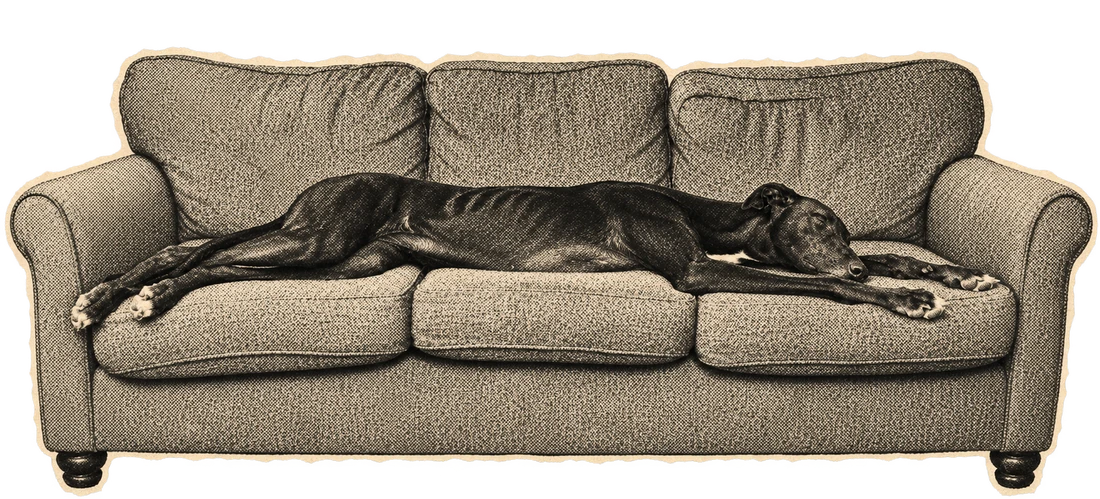
The longer the legs, the smaller the gap they’ll try to fit into on the sofa. Out on a walk, it’s worth knowing what makes those same legs move before you’ve even got the word “wait” out.
Jump to a section
The short version: the dog on the sofa is also the dog at the gate
You can live with a Lurcher for a week and think the biggest problem is getting your half of the blanket back. Then something moves on the far side of a hedge and you find out what your lead hand has been training for. Or yours might barely look up. Lurchers are sighthound crosses, often with the long frame and deep chest you’d expect, but there’s a lot of room between a dog that notices movement and one that can’t break away from it. Get to know the one in front of you. It makes the next walk, and that first conversation with a rescue, a lot easier. 12
Lurcher notes / 01
Start at the gate, not the sofa
The same dog can spend hours asleep and see a rabbit before you’ve blinked.
| Get these right first | What it looks like |
|---|---|
| Walks with room | You can spot likely distractions early, change direction and practise without needing the dog to get everything right. |
| A bit of dog-proofing | The gate latches, the harness fits when the dog backs up, and the bed’s long enough when the legs come out. |
| Useful observations | You know how your dog walks on paving, where they can relax and what makes the lead go tight. |
Names: Lurcher tells you something, just not the whole family tree
A Lurcher is usually a sighthound, such as a Greyhound, Whippet or Saluki, crossed with a different type of dog. A Collie or terrier is an example, not a requirement. Some are several generations of crosses. A specialist rescue may use Longdog for a cross between sighthounds. You’ll hear the words used loosely, especially when nobody has the parents’ records. There’s no single pedigree breed standard to measure a Lurcher against, and a lovely set of ears doesn’t establish who their parents were. 31
Lurcher notes / 02
Labels that don’t tell the whole story
A type name is useful; it doesn’t prove parentage.
| What the description says | What it can mean |
|---|---|
| Greyhound × Collie, for example | Ask whether this is documented parentage or somebody’s best guess. Even with both parents known, you’ll meet an individual dog. |
| Lurcher, ancestry unknown | Good enough to describe a type. Ask what’s actually been seen at home and out walking. |
| Longdog | Common specialist-rescue term for a cross of sighthounds. Not a height class, and not enough information to choose a harness. |
| Lurcher | A sighthound cross-type, not a purebred standard. 13 |
| Sighthound cross | A broader useful description when no detailed parentage is known. 3 |
| Smooth or rough | Describes the coat you can see, not a separate size class or an indication of behaviour. 13 |
| Rescue label | Ask which details are known from records and which are the foster carer’s observations. 38 |
Size: measure around the dog you’ve got
When you buy a coat, that long back can put you in one size and the chest in another. Take the measurements first. VetCompass gives a useful bit of context from UK practices in 2019: the adults with weights recorded under the Lurcher label had a median of 23.1 kg. There are plenty of ways for an individual dog to be bigger, smaller or a different shape. That number won’t tell you which part of the boot you’re about to lose or what a healthy weight feels like under your dog’s coat. 456
Lurcher notes / 03
The dog you can actually measure
A cohort median won’t fit a harness.
| A figure or a measurement | How to use it |
|---|---|
| 16,051 dogs labelled Lurcher among 2,237,105 dogs with a breed/type recorded | About 0.7% of the 2019 participating UK primary-care sample, not a present-day UK dog count or confirmed parentage. 4 |
| Observed adult weight, 2019 study | 23.1 kg median overall; 21.8 kg female, 24.6 kg male. The study defined adult recorded weights as those from 18 months. These are cohort medians, not weight goals or a size range. 4 |
| Shoulder height and adult size forecast | No standard range used here. Measure shoulder height, back length and chest as needed. A pup’s final size is uncertain, particularly with unknown parents. |
| Harness | Check fit while standing and moving. Ask the rescue or a fitter to show you why it can’t come off backwards; don’t try to find out on a pavement beside traffic. |
Coat: the scruffy one needs a look under the scruff
Some have a smooth coat that dries quickly. Others have enough beard to bring half the drinking bowl into the next room. Run a brush over the coat and have a look at the areas you don’t see from the sofa: under a harness, behind the ears and between the toes. If they’re thin-coated and getting cold on a wet walk, a properly fitted coat may make the outing more comfortable. If they’re shivering or keen to get home, turn round rather than pressing on because you’ve paid for the coat. 17
Lurcher notes / 04
Smooth and scruffy, different jobs
Look under the bit they’re wearing.
| Coat or care job | A practical check |
|---|---|
| Smooth or short coat | Brush as needed, look under straps for rubs and dry the dog after a wet walk, particularly if they feel the cold. |
| Rougher or longer coat | Check for tangles around the ears, legs and beard, and look for seeds in the feet. Ask a groomer what suits this coat if you’re unsure. |
| Buying a winter coat | Measure chest and back, check leg movement and make sure it works with the dog’s fitted walking gear. Take it off indoors if no longer needed. |
| Straps and coat | Check under webbing around chest and elbows for rubbing; change fit only on secure ground. 5 |
| Wet and cold days | Dry the dog and give them a warm place to rest. Ask a vet if cold tolerance changes unexpectedly. 728 |
| Pads and nails | Have a look after rough surfaces. Repeated discomfort needs checking rather than a new brush. 1325 |
| Coat isn’t a family tree | A scruffy face or smooth coat doesn’t establish the parents’ breeds. 13 |
Temperament: see where they can switch off
A dog that sleeps through the kettle might still have trouble with the doorbell. Another might walk nicely with a familiar dog and find a crowd of them at the park too much. If you’re looking at a rescue, ask for examples rather than “friendly” or “nervous” on its own. How close was the other dog? Could they take a reward or look back at the handler? What did they do when they got home? If your own dog changes suddenly, speak to the vet about pain or illness before assuming training has stopped working. 189
Lurcher notes / 05
Notice what sets them off
Build in more space before the lead goes tight.
| What you’re seeing | What to try next |
|---|---|
| Can glance and look away | Reward that and leave enough space to repeat it comfortably. |
| Staring, stiffening or surging on the lead | Make room and leave the situation. Next time start further away rather than waiting for a bigger reaction. |
| Won’t settle when you leave | Work from absences they can comfortably manage and arrange cover where possible. Ask for help if the distress continues. |
Training: learn the turn before you need it
Pick a quiet bit of pavement and make turning away with you worth doing. That’s where the cue belongs before you try it halfway down a path with something moving in the hedge. Same with recall: a decent result in an empty field is a decent result in an empty field. Build up in secure spaces, reward coming back, and sometimes let them return to an ordinary sniff. A suitable long line clips to a well-fitted harness, not the neck. Use it with room and keep it short enough to prevent a full-speed run into the end. Go back to a short lead around roads, livestock and anywhere the line could tangle. 102
Lurcher notes / 06
Turn, come back, take a breath
Practise the useful thing when it’s easy.
| Skill | A first session |
|---|---|
| Recall | Quiet secure ground, a cue and a reward they actually want. Gradually vary one thing at a time. |
| Walk past without greeting | Reward a check-in or a turn at a distance they can cope with. Step off the path or go another way if you need to. |
| Muzzle comfort if advised | Introduce a properly fitted basket muzzle slowly and positively, with room to pant and drink. Ask the rescue or behaviour professional about choice and fit. It doesn’t make an unsafe off-lead situation safe. 11 |
| Keep your dog occupied | Try a supervised scent search or other low-pressure game using part of their normal food. Give them somewhere quiet to settle afterwards. 12 |
Exercise: a long lead isn’t an off-lead licence
You can give the dog a decent outing without going to the busiest field and hoping for the best. A lead walk with time to have a sniff, a few easy training repetitions and a quiet route home are useful things in their own right. If a fit dog enjoys a run, use an enclosed space that actually suits them: have a look at the gaps, surface and gate before you unclip. Stop if you see a change in gait or they start struggling. The type is too varied for a daily stopwatch figure. 113
Lurcher notes / 07
Give the walk somewhere to go
Pick places that don’t require perfect recall.
| Where or when | What changes |
|---|---|
| Roads, livestock or wildlife | Keep control, give animals space and use a suitable lead where appropriate or required. Read signs and use the local guidance: England and Wales 14, Scotland 15, Northern Ireland 16. |
| Hired dog field | Check gates, fencing, ground and signs yourself. Ask when others are due and whether adjacent activity could be a problem. |
| Hot weather, new injury or old age | Alter the timing, pace, surface or length. Seek veterinary advice for a new limp or declining stamina rather than making up missed miles. 17 |
| Activity on an ordinary day | Choose a pace and length that suit the individual dog, with space for sniffing and rest. 113 |
Home: sort the latch before anyone brings a parcel round
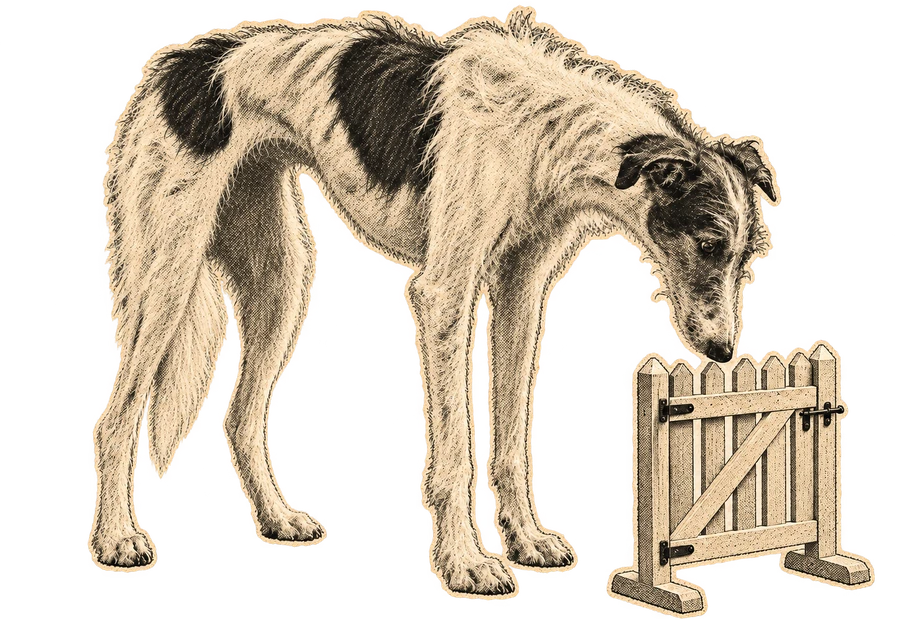
Have a look from the dog’s side of the gate. There might be a loose corner you can’t see from the drive, or a delivery spot that means you’re trying to hold the dog and sign for a parcel with the same hand. Put a barrier between those jobs. Indoors, lay a runner if the dog keeps slipping on the way to their bed, and make the bed big enough for a proper stretch. If they’ve always slept near people, being left in a new house may need some gentle practice, not a longer morning walk and a whole workday on their own. 181920
Lurcher notes / 08
A latch you can rely on
Keep the escape route shut and the sleeping route clear.
| Thing to check | What makes it work |
|---|---|
| Gate and fence | Check gaps, height, latches and where people open doors. Ask your rescue for its policy and what this dog needs; one fencing height is not a national rule or a guarantee. |
| Bed and floors | Room to stretch in a quiet spot, stable footing on the way there and no need to step round people to get out. |
| Time alone | Build up gradually while the dog is comfortable. If you can, check what happens in your absence rather than assuming no damage means no distress. |
| Front-door routine | Put a second barrier between the dog and a delivery if people tend to hold the door open. 18 |
| Feeding and resting spots | Give one safe, quiet route away from visitors or children around the bed and bowls. 2122 |
| Cold nights | Have a dry bed they can stretch out on and a route there without slipping. 1720 |
Kids, cats and other dogs: ask which cat, and where
If a rescue says a dog has lived round a cat, ask what that looked like. Were they separated by a gate? Could the cat leave whenever it wanted? Was this indoors with a familiar animal? A dog can manage one of those situations and behave differently when a cat runs across the garden. Never arrange a chase to see what happens. With children, have an adult actively supervise or separate them; give the dog somewhere to eat and sleep without being followed. 2122
Lurcher notes / 09
Ask what happens with this cat
A cat indoors and a cat running outside are two different questions.
| Household member | Useful question or action |
|---|---|
| Cats and small pets | Ask what’s actually been observed. Arrange protected routes and secure separation. If there’s a chasing history or no safe setup, don’t take a chance. |
| Another dog | Meet in space with both handlers able to move away. At home, give each their own eating and resting areas. |
| Children | Supervise properly, keep greetings calm and separate when adults are busy. No one needs to climb onto the sleeping dog to be friends. |
| Shared space | Make sure beds, food and high-value chews don’t force pets to pass one another. 2122 |
Health: learn the normal walk from your door
The most useful detail may be that the dog is fine on grass but still puts a foot down oddly on the way back across the pavement. Tell the vet what changed and on which surface, without making the dog repeat a painful movement. The list below is a set of things an owner can notice and act on. It isn’t a list of diseases every Lurcher is prone to. 13
Lurcher notes / 10
Conditions, lifespan and breeding
Use the vet records for what they actually measured.
| Evidence | What it does and doesn’t tell you |
|---|---|
| Bone cancer in a UK VetCompass cohort | Six osteosarcoma cases among 6,022 dogs recorded as Lurchers in 2016, around 0.10% of that cohort over one year. Adjusted odds ratio 2.74 versus the study’s broad crossbreed reference group (95% CI 1.18–6.34). A small case count and wide interval; neither is a lifetime estimate, a subtype estimate or a diagnosis. 23 |
| Pads and corns | A published referral case series documents painful corns in sighthounds. It can’t tell you how often Lurchers overall get them. 24 |
| Lifespan and screening | No universal lifespan estimate, illness-rate table or single parental screening scheme for all Lurchers. Known ancestry and family history can inform a vet discussion. Unknown parentage stays unknown; don’t treat a purebred parent’s risk figures or test list as this dog’s. 1 |
| Breeding question | What can be checked |
|---|---|
| One official screening tier for every Lurcher? | No. If the parents are documented, ask a vet which results or family history matter for those particular dogs. 13 |
| Parentage unknown | Leave it unknown; use actual veterinary records and care for this dog rather than borrowing another breed’s figures. 18 |
Eight useful health and welfare checks
Pad pain and corns
If a paw is sore repeatedly, or the dog walks differently on hard ground, ask the vet to check the whole limb and pads. A hard spot might be a corn but pain also has other causes. Don’t cut or dig at it. 2413
Cuts, grazes and torn nails
Look at the pads and nails after rough ground. A deep or large cut, heavy bleeding, severe pain or something embedded warrants immediate veterinary advice. Don’t pull out something stuck deep. 25
Weight and muscle
Long legs and a tucked waist don’t tell you whether their current weight is healthy. Feel for the ribs and check changes over time. Talk to the vet about unexplained weight or muscle loss and have them show you what to aim for. 6
Teeth and gums
Bad breath, sore gums, dropping food or chewing on one side are reasons to book a check. If the mouth is painful, don’t force brushing. Ask how to restart gently once it’s comfortable. This is general dog care, not a Greyhound statistic borrowed for this cross. 26
Getting too hot or too cold
Give weather a say in the walk. If it’s hot, go out in cooler conditions or skip the outing if needed. Abnormal heavy panting, weakness or collapse after heat or exertion can be an emergency: start cooling and contact a vet immediately. In cold wet weather, head home if they’re struggling; persistent shivering with lethargy or weakness warrants urgent advice. 2728
Stiffness, ongoing lameness or a painful lump
A lasting change in gait or a firm painful swelling needs a prompt vet check. Inability to bear weight or severe pain means call straight away. There are many possible causes; the bone cancer study is a reason not to put off an exam, not a reason to presume the worst. 2913
GDV, often called bloat
Particularly relevant to discuss if your dog has a large, deep chest, but any dog can be affected. Repeatedly trying to vomit without bringing anything up, with or without a swollen belly, is an emergency. Call the vet or out-of-hours service straight away. No reliable Lurcher-specific rate is asserted. 30
Distress when left
Repeated pacing, howling or panting when alone can be distress even if the house is intact. Arrange cover while assessing what the dog can manage and talk to the vet, especially if it’s a new change. Don’t leave them for longer to try to get them used to it. 31
Costs: get a quote for the dog, not the description
PDSA’s standard baskets were priced in 2024: £531 setup and £83 monthly for a medium dog; £560 and £116 for a large dog. These are general minimum planning figures, not Lurcher prices, and include routine care and insurance in the ongoing basket. They don’t include purchase, treatment after illness or injury, training, day care or special diets. If you’re adopting, ask what’s included and whether you’ll be able to use the equipment they already know. Dogs Trust currently lists £300 in England, Wales and Scotland and £287.50 in Northern Ireland for its own adoptions. Another rescue can charge a different amount. 3233
Lurcher notes / 11
Price the size and the routine
Budget from their normal week, not a purebred advert.
| Budget for | Check before assuming |
|---|---|
| The normal week | Food at their actual portion size, any walker or cover, and fitted gear. Get a local price for an enclosed field if that’s part of your routine. |
| The vet and the policy | Find the out-of-hours practice, and check exclusions, excesses and limits. Answer insurer questions accurately about known history and note what’s unknown. |
| The move in | Bed, gate or barrier, safe travel equipment and possibly a coat. Set aside money for adjustments after you’ve seen the dog at home. |
| Medium-dog planning basket | PDSA 2024 estimate: £531 setup, £83 per month. This is not a Lurcher-specific charge. 32 |
| Large-dog planning basket | PDSA 2024 estimate: £560 setup, £116 per month, with the same exclusions. 32 |
| Adoption | Dogs Trust’s current fee is £300 in Great Britain and £287.50 in Northern Ireland; ask a different rescue about its own fees or extras. 33 |
History: a working type that’s still a type
This was a working cross, used by people who wanted a dog that could pursue quarry by sight. The shape and the way some dogs notice movement make more sense with that history in mind. It doesn’t tell you whether your rescue ever worked, or how they’ll behave around a particular animal. If you want to give them something to do with you, a search game or a suitable enclosed run is a much better place to start than letting them chase wildlife. 334
Lurcher notes / 12
A working cross, not a date in a stud book
Useful history doesn’t tell you what your dog used to do.
| What the history supports | What stays unknown |
|---|---|
| Lurchers have been used as working dogs in Britain. No single foundation pairing or recognition date used here. | Parentage, past work and behaviour can’t be inferred from build, ear shape or rescue label. |
| Hare coursing events are prohibited; the legal frameworks differ. | Check current official guidance where you are, not a casual claim that the same hunting rules cover everywhere. England and Wales 35 · Scotland 36 · Northern Ireland 37 |
Bringing one home: ask to go on an ordinary walk
A rescue worker or foster carer can tell you where the dog slows down, what they do when a squirrel appears and whether they’ve been left alone in a house. Go on a walk together if it’s offered. Ask them to show you the harness, how they clip the lead and what they do if the dog tries to back out. In the first days, a bit of repetition is fine: the same quiet route, time to sniff, the same place to sleep. You can meet the extended family another time. If you already have one, the same questions are useful if the lead has become hard work or your weekday cover has changed. 8383
Lurcher notes / 13
Walk with them before you decide
Observed behaviour beats a best guess about the family tree.
| When | What to do |
|---|---|
| Before collection | Get veterinary and behaviour notes and agree a safe handover and travel setup. Ask what is observed, reported and unknown, particularly around other animals and time alone. |
| First few days | Register with a vet, update microchip keeper details, make the home secure and follow the rescue’s lead and handling guidance. Northern Ireland additionally has dog licensing. 3940 |
| If buying a puppy | Meet the pup with its mother where raised, verify records and ask your vet which tests are relevant to the documented parents. Be prepared to walk away if basic records or welfare checks are missing. 41 |
Sources
- S1Dogs Trust: Lurcher profileUK charity · checked 20 November 2026
- S2Dogs Trust: managing chasingUK charity · checked 20 November 2026
- S3Evesham Greyhound and Lurcher Rescue: breed-type distinctionsUK specialist rescue · checked 20 November 2026
- S4O’Neill et al.: 2019 UK dog demography, Table 1Primary UK cohort research · checked 20 November 2026
- S5Dogs Trust: fitting a harnessUK charity · checked 20 November 2026
- S6PDSA: weight and body conditionUK veterinary charity · checked 20 November 2026
- S7PDSA: winter coats for dogsUK veterinary charity · checked 20 November 2026
- S8Dogs Trust: choosing a rescue dogUK charity · checked 20 November 2026
- S9Dogs Trust: managing reactivityUK charity · checked 20 November 2026
- S10Dogs Trust: recall trainingUK charity · checked 20 November 2026
- S11Dogs Trust: positive muzzle trainingUK charity · checked 20 November 2026
- S12Dogs Trust: enrichmentUK charity · checked 20 November 2026
- S13PDSA: limping or stiffnessUK veterinary charity · checked 20 November 2026
- S14Natural England and Defra: Countryside CodeOfficial legal or government guidance · checked 20 November 2026
- S15Scottish Government: dog welfare and controlOfficial legal or government guidance · checked 20 November 2026
- S16NI Direct: dogs that worry livestockOfficial legal or government guidance · checked 20 November 2026
- S17PDSA: avoiding overheating on walksUK veterinary charity · checked 20 November 2026
- S18Dogs Trust: preventing escapeUK charity · checked 20 November 2026
- S19Dogs Trust: building time aloneUK charity · checked 20 November 2026
- S20PDSA: arthritisUK veterinary charity · checked 20 November 2026
- S21Dogs Trust: dogs and cats at homeUK charity · checked 20 November 2026
- S22Dogs Trust: dogs and child safetyUK charity · checked 20 November 2026
- S23O’Neill et al.: osteosarcoma in UK dogsPrimary UK cohort research · checked 20 November 2026
- S24Guilliard et al.: referral case series on paw cornsPrimary referral case series · checked 20 November 2026
- S25PDSA: cuts and grazesUK veterinary charity · checked 20 November 2026
- S26PDSA: dental diseaseUK veterinary charity · checked 20 November 2026
- S27PDSA: heatstroke first aidUK veterinary charity · checked 20 November 2026
- S28PDSA: hypothermiaUK veterinary charity · checked 20 November 2026
- S29PDSA: osteosarcomaUK veterinary charity · checked 20 November 2026
- S30PDSA: bloat and GDVUK veterinary charity · checked 20 November 2026
- S31PDSA: separation anxietyUK veterinary charity · checked 20 November 2026
- S32PDSA: cost baskets and methodsUK veterinary charity · checked 20 November 2026
- S33Dogs Trust: adoption process and feesUK charity · checked 20 November 2026
- S34UK Government: historical inquiry into hunting with dogsHistorical official report · checked 20 November 2026
- S35CPS: hare coursing in England and WalesOfficial legal or government guidance · checked 20 November 2026
- S36Legislation.gov.uk: Scotland hunting legislation explanatory notesOfficial legal or government guidance · checked 20 November 2026
- S37Legislation.gov.uk: NI Wildlife and Natural Environment Act section 38Official legal or government guidance · checked 20 November 2026
- S38Dogs Trust: helping a rescue dog settleUK charity · checked 20 November 2026
- S39GOV.UK: microchip rules for dogsOfficial legal or government guidance · checked 20 November 2026
- S40NI Direct: dog licensing and microchippingOfficial legal or government guidance · checked 20 November 2026
- S41Defra: buying a cat or dogOfficial legal or government guidance · checked 20 November 2026
