
Breed guide / Leonberger
Living with a Leonberger
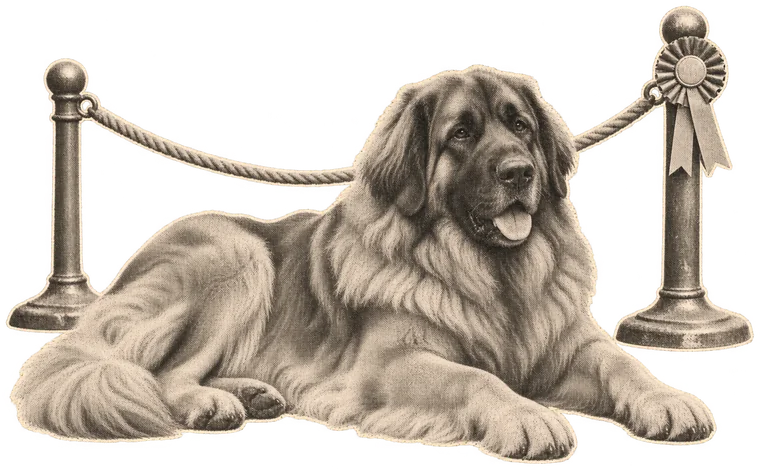
A Leonberger is a German giant with a black mask, a deep chest and a coat that can look nearly dry while it’s still wet underneath. The trick on a water walk is to plan backwards. Find a bank your dog can walk up on its own, make sure you can both get back to the car without slipping and give the thick bits of the coat a feel before whoever gets home first claims the sofa. Even a Leonberger that never gets in a lake needs the last two. 12345
Jump to a section
Look at the way out before letting them in
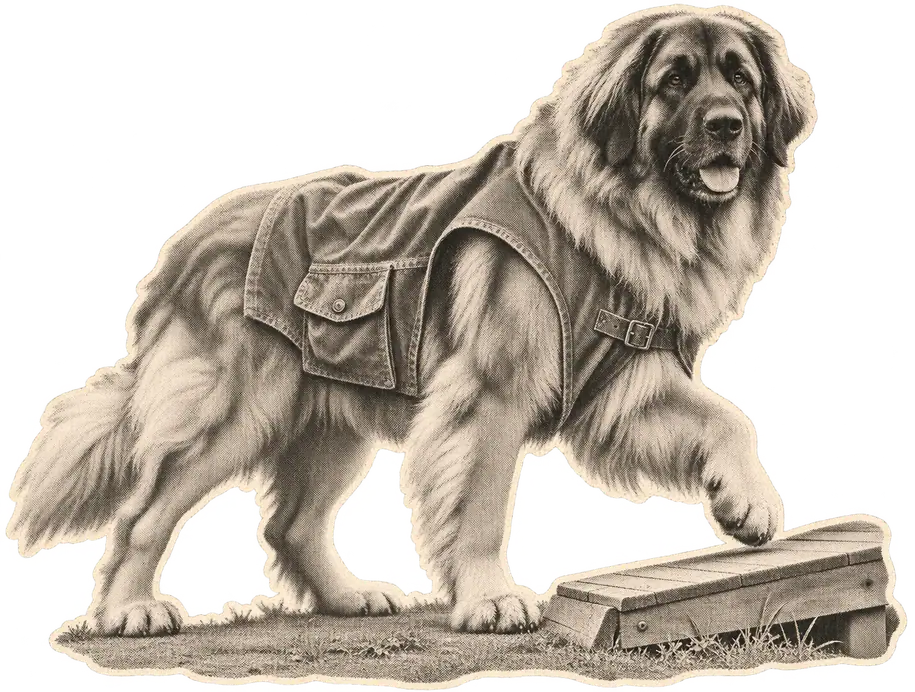
An easy splash can become an awkward extraction if the dog has to climb a steep bank. Look for a gradual, stable exit, not a bit of land you could jump onto yourself. Start in calm shallows and give the dog the choice to stay on land. Stay clear of currents, blue-green algae warnings and places where you can’t safely interrupt the outing. If your dog gets into trouble in the water, don’t go in after them. Call 999. 45
Leonberger notes / 01
Field notes
| Before the dog gets wet | Make this call |
|---|---|
| Only way out is a ledge or steep bank | Don’t let them enter there. Pick an exit that doesn’t need you to haul a giant dog out. 45 |
| Dog likes paddling but doesn’t choose to swim | Let them paddle. The name and size aren’t proof of swimming ability. 4 |
| You’d like to try organised working activities | Ask the Leonberger club about a supervised introduction for your dog, not a first session in deep water on your own. 56 |
The black mask belongs to this dog
Leonberger notes / 02
Field notes
The Royal Kennel Club describes a longish double coat in shades from gold to red or sandy, with a black mask. The mane is more pronounced in many males. The Leonberger has its own breed standard, not a long-haired edition of a St. Bernard or a Newfoundland. A mane isn’t a reason to ignore the body, legs or movement underneath it. 1278
Choose the grooming spot from the dog’s height
Leonberger notes / 03
Field notes
The UK standard gives 72–80 cm at the shoulder for males and 65–75 cm for females. It’s a reference, not a target. Set up grooming where the dog can stand and turn on a non-slip surface. Work a section while they’re comfortable and let them walk away. If you use a groomer, ask about access and the size of equipment, not just whether they have an opening. 191011
Dry the thick bits, not just the bit you can see
Leonberger notes / 04
Field notes
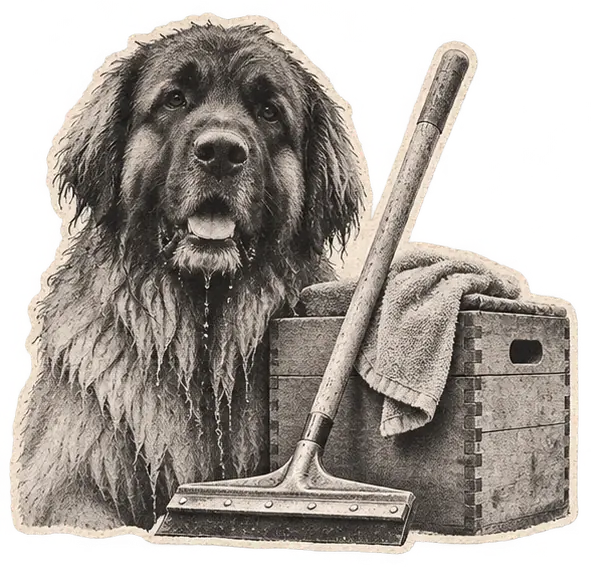
After a wet walk, press with an absorbent towel, part the coat and check behind the ears and through the breeches on the back legs. The surface can fool you. Set up a dry spot the dog will actually use, then check the skin and coat again if something still feels packed or damp. A persistent smell, sore patch or sudden burst of licking deserves a look; speak to your vet if it’s red, wet or painful. Don’t try to pull out a tight mat or slide scissors under it. 13491213
Practise leaving a narrow spot before you’re in it
Leonberger notes / 05
Field notes
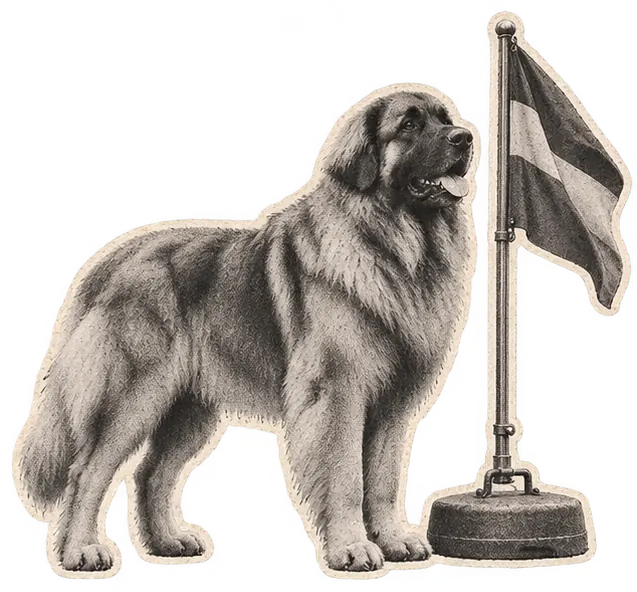
If a towpath, footbridge or gate makes it hard to pass, teach an easy turn away on wider ground. Do it with whoever usually walks the dog. On the real outing, turn before the lead is already tight and there’s no room to move. Don’t make a smaller person at the end of the lead the only thing stopping a large dog’s decision. 101415
A wet afternoon is not a training requirement
Leonberger notes / 06
Field notes
The Leonberger Club of Great Britain runs water and draught work. If your dog likes exploring but you don’t have safe water nearby, a search on land still gives them something to do. Start with an easy find and leave them space to return with the toy. A growing, older or sore dog doesn’t have to pull or swim to earn a day off. 561617
Notice whether the same walk feels harder
Leonberger notes / 07
Field notes
Pick pace and terrain by the dog’s age, fitness and health. In warm weather, go somewhere cooler at a safe time or skip the outing. If your dog now takes longer to get up, changes how they use a leg or regularly can’t finish an easy route, get it checked. A short video of a natural walk can be useful; don’t repeat stairs or a hard route to get the shot. 3171819
Don’t make the boot the only way to move a sore dog
Leonberger notes / 08
Field notes
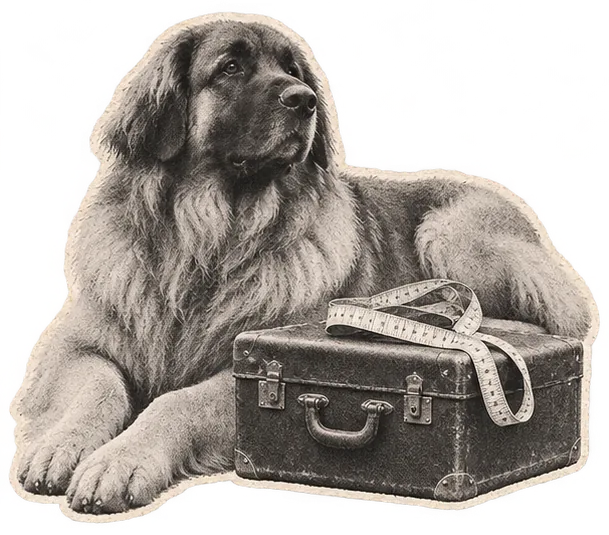
Check how your dog travels when well: room to turn, a suitable restraint, a safe entrance and an exit they can use without a jump. Introduce a stable ramp if it suits the dog. Save the out-of-hours number and ask your own practice how it would want a very large dog transported if they couldn’t walk. If that actually happens, call before trying to get them up a ramp. 11192021
Leave a route around the dog
Leonberger notes / 09
Field notes
Look at where the dog likes to lie when the house is busy. If the only route upstairs is over the dog’s legs, move things about so nobody has to climb over them. Set up greetings where a child can stand clear and the dog has a place to move away. Separate when you can’t supervise. Nobody needs to prove a Leonberger is ‘gentle’ by leaning all over it. 92223
The family tests and a new symptom are different jobs
Leonberger notes / 10
Field notes
| UK Royal Kennel Club tier | What the Leonberger row lists |
|---|---|
| Good Practice | Hips, elbows, BVA/RKC/ISDS eye screening and gonioscopy. The breed profile also advises prioritising genetic diversity. 224 |
| Best Practice | Complete the Good Practice work, plus DNA tests for LPN1, LPN2, LPPN3 and LEMP. Check the name and actual result for each test, not just a bundle marked “clear”. 2242526 |
The research labs behind the tests describe different inherited conditions that can look similar, and the tests don’t account for every case of polyneuropathy. If you notice a changed bark, altered gait or newly noisy breathing, tell your vet rather than deciding which DNA label explains it. Likewise, gonioscopy examines an aspect of the eye linked to glaucoma risk; it doesn’t diagnose a new sore eye from a breed screening certificate. 25262728
Emergency: Repeated retching without bringing anything up or sudden abdominal swelling can signal a twisted stomach (GDV). Don’t wait for a swollen belly to become obvious. Get immediate veterinary help. Struggling to breathe or collapsing also needs emergency veterinary help. 2930
The Dogs Trust UK study estimated a median lifespan of 10.0 years (95% CI 9.5–10.3) from 676 Leonbergers, including 321 deaths. It describes that cohort; it is not a prognosis for a particular dog. 3132
Price big-dog care that fits your household
Leonberger notes / 11
Field notes
Price a proper grooming appointment before you need one in a hurry. Ask any walker or boarding provider what they’d do with a full-sized dog on a narrow path, and how they’d manage their transport. Check whether insurance has an excess, a percentage contribution or a lifetime limit. The out-of-hours plan matters more than a cheap initial quote. 39203334
Leonberg is the place; the lion story isn’t a pedigree
Leonberger notes / 12
Field notes
The international standard places the breed in Germany and describes its connection with the town of Leonberg and the lion on the town’s crest. It records older farm use and gives a traditional account of how the breed developed. That’s useful background, not a confirmed recipe for making a Leonberger today. 12735
Ask to see the grown-up version
Leonberger notes / 13
Field notes
A puppy doesn’t show you the size that has to get through your kitchen or the coat you’ll be brushing. Meet an adult if you can, and watch it stand, turn and walk naturally. If buying, see the puppy with its mother where it was raised and match dated results to the named parents. If rehoming, ask how that dog handles grooming, cars and family space, and which bits haven’t been seen. 292024363738
Sources
- S1Royal Kennel Club Leonberger breed standard, coat and dimensionsSource · checked 21 November 2026
- S2Royal Kennel Club profile and pre-breeding screening breakdownSource · checked 21 November 2026
- S3PDSA Leonberger veterinary breed careSource · checked 21 November 2026
- S4PDSA water safety including unsuitable water and rescue precautionsSource · checked 21 November 2026
- S5Leonberger Club of Great Britain working activitiesSource · checked 21 November 2026
- S6Leonberger Club of Great Britain 2026 water test rulesSource · checked 21 November 2026
- S7FCI Leonberger origin and breed recordSource · checked 21 November 2026
- S8Royal Kennel Club separate UK breed entriesSource · checked 21 November 2026
- S9PDSA grooming guidanceSource · checked 21 November 2026
- S10Dogs Trust introducing handling graduallySource · checked 21 November 2026
- S11PDSA advice on movement aids and non-slip flooringSource · checked 21 November 2026
- S12PDSA recognising sore wet skin patchesSource · checked 21 November 2026
- S13PDSA coat and skin checks at homeSource · checked 21 November 2026
- S14Dogs Trust making room around triggersSource · checked 21 November 2026
- S15Dogs Trust harness fit and useSource · checked 21 November 2026
- S16Dogs Trust safe scent gamesSource · checked 21 November 2026
- S17PDSA exercise by fitness, age and healthSource · checked 21 November 2026
- S18Dogs Trust adjusting exercise in warm weatherSource · checked 21 November 2026
- S19PDSA limping or stiffnessSource · checked 21 November 2026
- S20Dogs Trust safe travel and restraintsSource · checked 21 November 2026
- S21PDSA pet first aid and what to do for a collapseSource · checked 21 November 2026
- S22Dogs Trust children and dogsSource · checked 21 November 2026
- S23Dogs Trust preparing for visitorsSource · checked 21 November 2026
- S24Royal Kennel Club current central Good/Best PracticeSource · checked 21 November 2026
- S25University of Minnesota Veterinary College research lab interpretation and limitationsSource · checked 21 November 2026
- S26University of Bern comparative genetics LPN research and interpretationSource · checked 21 November 2026
- S27Original CNTNAP1 variant study, selected study populationsSource · checked 21 November 2026
- S28Royal Kennel Club eye and gonioscopy schemesSource · checked 21 November 2026
- S29PDSA GDV urgent signsSource · checked 21 November 2026
- S30PDSA emergency veterinary care for breathing difficultySource · checked 21 November 2026
- S31Dogs Trust research team’s original breed cohort resultSource · checked 21 November 2026
- S32McMillan et al., original UK lifespan study and methodsSource · checked 21 November 2026
- S33Dogs Trust choosing a dog walkerSource · checked 21 November 2026
- S34PDSA ownership costs and vet planningSource · checked 21 November 2026
- S35FCI official standard’s historical accountSource · checked 21 November 2026
- S36RSPCA puppy buyer advice, including seeing the motherSource · checked 21 November 2026
- S37UK Leonberger club puppy buyer adviceSource · checked 21 November 2026
- S38Dogs Trust questions during rehomingSource · checked 21 November 2026
