
Breed guide / Labradoodle
Living with a Labradoodle
A Labrador-Poodle cross whose size and coat depend on the dog you get. What to do about the muddy walks, the knots behind the ears and the allergy promise nobody can make.
Jump to a section
The dog beneath the coat
A Labradoodle is a Labrador–Poodle cross, and the name can put a fairly substantial dog on the end of your lead. You might get one that likes to retrieve, one that wants to investigate the whole verge, or one that does both and brings you the verge. Make room for a dog that wants daily activity and may need more coat care than the puppy fluff suggests.12
If you already own one, start with what happens in your house. Part the coat behind an ear and look down to the skin. See whether your dog can walk a short stretch without hauling you towards the next smell. Check whether they can settle when you stop entertaining them. Those are useful facts about your dog; the generation printed on the paperwork won’t do the work for you.234
A low-shedding coat doesn’t make a dog allergy-safe. If a member of your household has a known or suspected allergy, discuss it with their clinician before committing. Don’t use a brief visit with a puppy as medical clearance.56
Labradoodle notes / 01
Who this works for
Get to know the dog, not the coat promised in the advert.
Suits
- Someone who has time for walks and short training sessions, and is happy to find out what the individual dog enjoys.
- A home that can keep up with hands-on coat checks and pay for professional grooming if it needs it.
- An owner prepared to ask for health records for both parental lines rather than buying a label.
Doesn’t suit
- A household relying on an allergy guarantee or an exact adult size.
- A routine in which a dog must cope alone for long periods without gradual practice or help.
- Anyone who wants a lower-maintenance coat than a Labrador’s without first seeing how this dog’s coat behaves.
The main practical trade-off is uncertainty: the name tells you which breeds started the cross, not how its coat, size or behaviour will turn out.125
First cross, backcross or something else
An F1 normally means a Labrador crossed directly with a Poodle. F1b usually describes a first-generation cross bred back to a parent breed, while F2 normally describes two F1 parents. Ask which parent breed a backcross uses. A neat-looking label is no substitute for the history of the two dogs involved, and it doesn’t predict how a puppy’s adult coat will behave.178
Australian Labradoodle can refer to an established multigeneration line. A genomic study of sampled Australian Labradoodles found predominantly Poodle ancestry and evidence of contributions beyond the two foundation breeds. It would be a mistake to apply that ancestry mix to every UK dog advertised as a Labradoodle.7
Labradoodle notes / 02
Names and generations
Ask what each parent actually is.
| Field | Detail |
|---|---|
| Display name | Labradoodle; this guide concerns the named Labrador Retriever-Poodle cross and its documented descendants.1 |
| Direct parent breeds | Labrador Retriever and Poodle; verify Standard, Miniature or Toy where relevant.18 |
| F1 / F1b / F2 | Common breeder shorthand, not a quality, allergy or health certification. Ask for the actual parentage.78 |
| Multigeneration | Ask which dogs and breeds occur in the line, especially if described as Australian Labradoodle.7 |
| UK recognition | No RKC Labradoodle breed standard identified; parent breed standards exist. Do not infer a pedigree breed’s show registration from a crossbreed label.8 |
| FCI / AKC | No separate standard verified for the named cross here. |
| Vulnerable native breed / Breed Watch | Not applicable as an RKC breed classification for this cross. |
| UK legal status | Labradoodle is not a named prohibited dog type. General dog-control rules still apply; legal type depends on the dog’s features, not the name.9 |
Find out how big the parents are
A Labradoodle from a Standard Poodle line and one from a smaller Poodle line needn’t grow to the same size, and two puppies from one litter can differ. Ask to see the parents’ adult size and look at mature relatives if available. Plan for the larger plausible dog when you choose the crate or work out whether you’d be able to lift them into the car.18
UK vet records put the median adult weight at 24.7 kg for dogs recorded as Labradoodles in 2019. That gives a useful sense of scale, but the sample doesn’t set an ideal weight or distinguish every generation or Poodle variety. Ask your vet to show you how to assess body condition as this particular dog grows.102
Labradoodle notes / 03
Build and observed weights
Mini is a sales description until you know what it refers to.
| Field | Detail |
|---|---|
| Height | No verified UK population height range or universal size standard. |
| Weight | No cross-wide healthy range established; condition and trend matter.210 |
| Adult female median | 23.0 kg.10 |
| Adult male median | 26.5 kg.10 |
| Adult combined median | 24.7 kg.10 |
| Population | 21,802 dogs recorded as Labradoodles in 2019 UK primary-care records, across all ages; not the measured adult-weight count.10 |
| Measurement | Individual adult summaries based on records from age 18 months. Published 2023; not an estimate within named size varieties.10 |
Use a complete diet for their age and weigh portions if you need to manage intake. Food used in training is still food, even if the dog was particularly convincing about earning it.2
The comb needs to get past the top layer
Some Labradoodles have a relatively straight coat; others are wavy or curly. Low visible shedding is possible, but it isn’t a promise. In a denser coat, brushing the surface can leave knots underneath. Part it with your fingers and work in short sections with a suitable comb, checking behind ears and where the harness sits. Ask a groomer to show you which tools suit the coat you have.237
If there’s a tight mat against the skin or the dog is sore, don’t reach for scissors or pin them down to get it over with. Get help from a groomer or vet, depending on what the skin looks like and how comfortable the dog is. Teach them to accept a few seconds of handling while the coat is still easy to manage.311
Allergy isn’t a count of hairs on the sofa. A study measured Can f 1, a major dog allergen, and found no difference in airborne levels between the groups studied. Homes with Labradoodles had lower levels in sampled floor dust, but that doesn’t establish lower exposure in every home or fewer allergic symptoms. Talk to an allergy clinician about your circumstances.56
Labradoodle notes / 04
Coat, grooming and allergies
A coat can shed less and still need more looking after.
| Field | Detail |
|---|---|
| Coat types | Straight, wavy or curly; appearance and grooming needs vary.27 |
| Length and texture | No universal cross standard. Ask about the adult coat rather than planning around puppy fur. |
| Colours | Dogs Trust gives examples including black, chocolate, cream and silver; examples aren’t an official colour standard.2 |
| Shedding | Variable; no non-shedding guarantee.57 |
| Grooming | Check down to the skin where the coat tangles. Establish frequency with a groomer who has seen your dog.311 |
| Professional grooming | Denser coats may need regular appointments. Obtain a quote for the dog’s actual size and coat, including matting policies. |
| Allergy | No hypoallergenic guarantee; Can f 1 measurements are not clinical outcomes.56 |
| Ear handling | Check for change or discomfort; don’t put cotton buds or unprescribed drops down the ear canal.12 |
Watch the dog when nothing's happening
A Labradoodle can inherit interests associated with both sides of the cross. A dog keen to retrieve can make good use of a toy, but it doesn’t follow that every one has an easy off-switch. Watch what they do when play stops and when a stranger arrives, and ask about what they’ve actually learnt in the home.24
Give them somewhere to retreat when people come round. If jumping up is the issue, practise a calm arrival with someone who can follow the plan rather than rehearsing the usual performance on every visitor. A sudden change in behaviour can mean pain or distress; contact the vet if you’re concerned.34
Labradoodle notes / 05
Behaviour in daily life
An adult's observed habits are worth more than a breed promise.
| Field | Detail |
|---|---|
| Temperament | No single cross-wide profile verified; assess the dog, parents and rearing environment.8 |
| Vocality | No reliable Labradoodle-specific barking-frequency measure verified. |
| With strangers | Ask about individual behaviour; a dog choosing to approach isn’t a request for everyone to crowd them.4 |
| Likely interests | Searching and retrieving are options to try, not guaranteed inherited behaviours.2 |
| New behavioural change | Consider pain or distress and get veterinary advice rather than assuming it’s personality.4 |
Teach loose lead before the dog has adult leverage
A Labradoodle who finds the entire pavement interesting can pull hard once they’ve grown. Practise a few loose-lead steps somewhere quiet. Reward those steps and use permission to go and sniff as part of the walk, instead of asking them to ignore everything until you get home.413
Start recall in a secure place and add distractions gradually. For practice in suitable open space, attach a long line to a well-fitting harness; near traffic or livestock use a short lead. A dog that brings you a toy in the kitchen hasn’t yet shown you what they’ll do when a squirrel gets involved.14
Rehearse the grooming you’ll actually need: a touch of the comb, a small part of the coat and a pause. Reward calm handling. If something suddenly hurts, deal with that first rather than trying to train through it.311
Labradoodle notes / 06
Training and rewards
The first useful wins happen on the same short stretch.
| Skill | Practical approach |
|---|---|
| Difficulty | No cross-wide training score. Use rewards the individual cares about.13 |
| Recall | Begin in secure surroundings and add distractions only as the dog succeeds.14 |
| Motivators | Food, toys or permission to sniff; test what works for this dog.13 |
| Loose lead | Practise before the environment gets busy, and reward a slack lead.13 |
| Handling | Teach short, low-pressure sessions before a long groom is needed.3 |
A walk is also a chance to use their nose
A Labradoodle needs regular activity, but there isn’t a defensible single daily minutes figure for this cross. Adult size, fitness and health all matter. Start with walks the dog can finish comfortably and include time to sniff. A slow stretch of hedge can do more for the dog than for your step count.215
Add activities your dog actually enjoys, such as finding a toy or following a short trail of their usual food. For puppies, older dogs or a dog recovering from illness, ask the vet how to adapt the routine. Stop for new lameness or unusual breathlessness and seek urgent help for difficulty breathing.15
Labradoodle notes / 07
Daily activity
Fit the work to the dog rather than setting a breed stopwatch.
| Field | Detail |
|---|---|
| Daily time | No verified cross-wide prescription; tailor to age, fitness and health.15 |
| Intensity | Observe comfort, gait and recovery; no universal mileage or pace.15 |
| Mental work | Sniffing, short training and supervised toy or food searches.213 |
| Free running | Secure surroundings and dependable recall are more useful than a blanket off-lead assumption.14 |
| Restrictions | Avoid strenuous walks in heat; adapt for growth, injury or illness with veterinary guidance.15 |
Give the wet dog somewhere to go
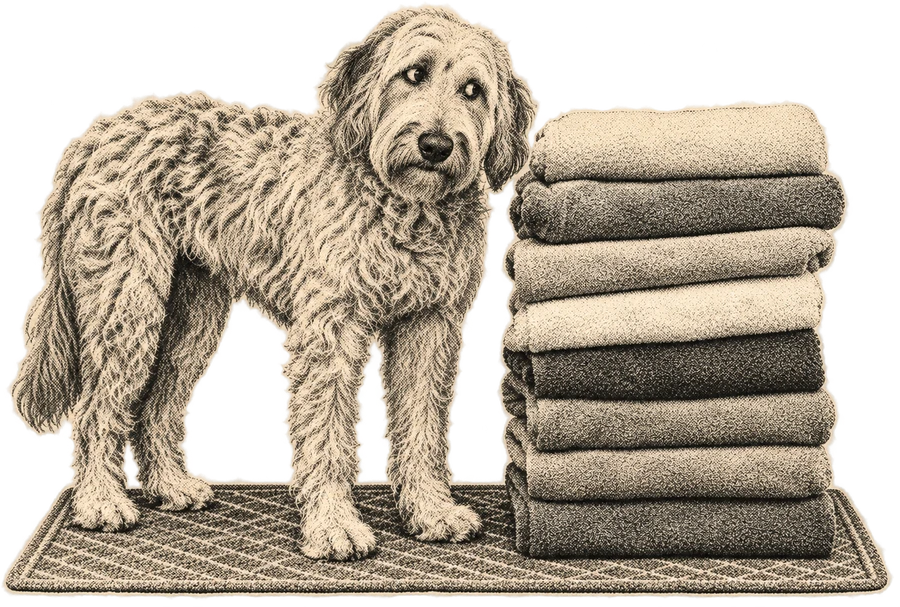
An adult Labradoodle may need more space to turn and rest than the puppy photos suggest. A flat can work if the individual dog has appropriate daily exercise and a way out for toilet trips. Having a garden makes that trip shorter; it isn’t a substitute for a walk. Put a washable mat near the door to keep the wet coat from being dried on the largest piece of furniture you own.215
Give the dog a quiet resting area and teach short periods alone while they’re comfortable. A camera can help you notice pacing or barking that starts after you leave. If you see distress, cut back the practice and arrange company for longer absences; don’t keep adding minutes because the clock says they’re due.16
Labradoodle notes / 08
Home, rest and time alone
Sort the routine before the dog has to work it out.
| Field | Detail |
|---|---|
| Home size | No cross-specific minimum. Allow for the likely adult size and comfortable rest. |
| Garden | Handy but no universal requirement; secure access matters more than size.2 |
| Town or country | Either can work for an individual dog with suitable walks and managed distractions. |
| Alone time | No Labradoodle-specific maximum established; build up gradually and make a care plan.16 |
| Heat tolerance | No reliable cross-specific threshold; adjust activity and weather exposure.15 |
| Cold tolerance | No reliable cross-specific threshold; wetness, coat and health all matter. |
| Rest | Provide a place the dog can reach and leave without being disturbed.17 |
A good family fit takes more than a label
A grown Labradoodle can knock a child over without any intention of hurting them. Supervise actively, teach calm behaviour and separate them if you can’t give the interaction your attention. Leave the dog alone while they eat or sleep, and make their retreat a place children don’t follow them into.17
Ask how the dog behaves with animals of the size and age already in your household. Introduce a cat gradually and give it dog-free routes and a way to retreat. Keep small animals securely separated; no breed label establishes that a chase won’t happen.18
Labradoodle notes / 09
Children, dogs, cats and small pets
Ask what this dog has actually experienced.
| Household member | Practical check |
|---|---|
| Children | Active supervision and separation when needed; assess observed behaviour.17 |
| Other dogs | Assess individual compatibility and use gradual introductions.4 |
| Cats | Controlled meetings and safe, dog-free routes; no breed-wide guarantee.18 |
| Small pets | Secure physical separation; no verified universal compatibility. |
| First-time owner | Possible with willingness to train, groom and plan for adult size. Editorial judgement, not a safety score. |
Health evidence without the sales pitch
A Labradoodle that starts shaking its head, scratching an ear or flinching when you touch it needs a veterinary check. Discharge or a strong smell can be signs of an ear problem. Don’t try left-over drops: the treatment depends on what the vet finds. Ask about causes and follow-up if it keeps coming back.12
New lameness or difficulty getting up also deserves assessment. A group comparison can’t tell you whether a particular limp is a joint condition. Contact an emergency vet for collapse or difficulty breathing; a suspected emergency shouldn’t wait for you to identify the condition.19
Labradoodle notes / 10
Conditions, screening and warning signs
Being a cross doesn't make a puppy immune to either parent's conditions.
This is general information about the cross, not veterinary advice about your dog. If you’re worried about your dog’s health, speak to your vet.
What the UK owner survey found
Bryson and colleagues’ 2024 study used a 2023 UK questionnaire asking owners about the previous year. Among 9,402 dogs in the full project were 583 Labradoodles, 927 pooled Poodles and 2,099 Labradors. Dogs were under five. These group totals are not the denominators for every disorder. This was a cross-sectional owner survey, not a clinical-record study or lifetime follow-up.1
Across 57 disorder comparisons, no significant difference was detected in 50 comparisons with pooled Poodles and 52 with Labradors. That isn’t proof of equivalence or a blanket health advantage. The models adjusted for measured factors, but survey selection, young dogs and owner reporting still matter. Pooled Poodle comparisons don’t establish what happens with every Poodle variety or generation.1
Otitis externa
Inflammation of the external ear canal. In the survey, adjusted odds were 1.80 times those for Labradors (95% CI 1.38–2.34). Versus pooled Poodles the odds ratio was 1.18 (0.88–1.59); that comparison wasn’t statistically significant.112
A separate VetCompass study of UK primary-care records in 2016 estimated one-year recorded prevalence in Labradoodles at 17.71% (95% CI 12.36–24.19) and adjusted odds 2.95 times its general crossbred reference group (95% CI 1.96–4.46). Those clinical-record figures aren’t the survey results; the comparator differs. Neither study identifies what is causing an individual dog’s symptoms.20
Joint disorders
The owner survey found lower adjusted odds of reported hip and/or elbow dysplasia versus Labradors (0.37; 95% CI 0.17–0.81), and of patellar luxation versus pooled Poodles (0.24; 95% CI 0.10–0.58). That doesn’t remove the need for appropriate parent screening, and the combined hip/elbow outcome does not separately establish the odds for either joint. These are not lifetime probabilities.18
Lifespan
No reliable standalone UK Labradoodle survival estimate verified for this guide. The McMillan UK study treats named crosses such as the Labradoodle within a wider crossbred grouping. Don’t reuse the whole group’s median, a parent breed’s number or an average of the parents as a prediction for this dog.21
Conformation welfare
There is no single standard shape for this named cross. Judge practical function, not a look: comfortable movement, eyes clear of coat, and skin and ears that can be checked and cared for. Heavy grooming needs or chronic symptoms deserve attention, not a premium for a particular appearance.3812
Parent health screening
| Parent or line | Ask for |
|---|---|
| Labrador | Identifiable hip and elbow scores, clinical eye result and current relevant Labrador DNA tests, checked against the RKC parent-breed row.22 |
| Standard Poodle | Current matching RKC results. Examples include hip and eye screening plus DNA tests for prcd-PRA, rcd4-PRA and vWD1; check the current tiers.22 |
| Miniature Poodle | Matching row, which includes clinical eye examination, prcd-PRA and additional relevant tests, including OC and hips in the published matrix.22 |
| Toy Poodle | Check the Toy row, including prcd-PRA, rather than copying a Standard Poodle list.22 |
| Backcross or multigeneration | Ask a vet or screening specialist which tests are relevant to the actual parents and underlying lines; ask for both parents’ records, not just ancestors’ certificates.822 |
A DNA panel cannot replace a clinical eye examination or hip assessment. Ask what a genetic result means for that pairing; screening doesn’t guarantee a healthy puppy. The RKC parent rows guide this discussion; they aren’t a single Labradoodle certification or a licence to breed.822
Breeding rules
No Labradoodle-specific RKC mating rule verified. Follow applicable general welfare and licensing requirements and ask a vet to interpret results before breeding. In an advert, “health checked” may only refer to a general exam; ask which condition, what test and which dog was tested.822
Price the coat you might actually get
Ask a local groomer for two quotes if the puppy’s adult coat is uncertain: the shorter maintenance job and the denser coat that needs more time. Ask what’s included and what happens if the coat is matted. A low purchase price won’t help much if your care routine depends on an appointment you can’t afford to repeat.
PDSA’s general minimums for setup are £415 for a small dog, £531 for a medium dog and £560 for a large dog. Its ongoing minimums are £69, £83 and £116 a month respectively. Use the band that fits the dog, not the one implied by a seller’s “mini”. The model includes insurance and routine care but not purchase or treatment for illness or injury.23
Labradoodle notes / 11
UK budget
Start with routine costs and add the parts the estimate excludes.
| Item | Budget note |
|---|---|
| Setup | PDSA band by size £415–£560; not a Labradoodle price.23 |
| Ongoing routine | PDSA minimum £69–£116 monthly across the three bands.23 |
| Purchase/adoption | Excluded; no reliable nationwide Labradoodle purchase range verified. |
| Grooming | Get local quotes by size, coat and frequency; no verified breed-average charge. |
| Insurance | Included in the broad model; check limits, excess and exclusions for the actual dog.23 |
| Illness/injury | Excluded. Ask about examination or referral costs as part of care planning.23 |
| Walkers/boarding | May cost extra; ask how they handle lively dogs and coat care. |
If a treatment bill is difficult, speak to the veterinary practice about available options and eligibility for assistance. Don’t delay urgent care to compare prices.1923
How a working idea became a sales promise
The RVC paper traces the modern Labradoodle’s reputation to Australian guide-dog work. The aim was a dog that could work with a client whose household had a dog allergy. That’s a reason for trying the cross, not evidence that all dogs sold under the name are suitable for allergic people.15
Later breeders developed multigeneration Australian Labradoodle lines. Genetic work on sampled dogs from those lines found much more Poodle ancestry than a simple half-and-half account would suggest. A breeder describing one of those lines should be able to explain its documented ancestry.7
Labradoodle notes / 12
From guide-dog work to named cross
An origin story doesn't validate every claim made today.
| Point | Detail |
|---|---|
| Foundation cross | Labrador Retriever and Poodle.1 |
| Modern origin account | Australian guide-dog work, documented in research background; no claim that nobody crossed the dogs before it.1 |
| Later lines | Australian Labradoodle genomic study concerns sampled multigeneration dogs, not the whole market.7 |
| Allergy claim | Originating aim and modern advert are not proof of low clinical allergy risk.56 |
Ask what you'll be living with
Ask to see the puppy with its mother where it was raised and request both parents’ identifiable screening records. Find out which Poodle variety and generation are involved, and see what the breeder knows about adult relatives. Ask them to show you how the coat is handled. A person describing the coat as maintenance-free should be able to explain what looking after it actually involves.3824
For an adult rescue, ask how the dog manages grooming, walks, visitors and short absences. Find out about previous ear trouble or ongoing care and arrange for records to reach your vet. If a household member has an allergy, seek clinical advice before making a decision rather than asking a breeder to predict their reaction.612
Labradoodle notes / 13
Bringing a Labradoodle home
Adult size, coat and health records are more useful than a generation badge.
Questions worth asking
- What are both parents, and which dated results belong to them?
- What do adult relatives weigh, and what happens to their coat between grooms?
- Has this dog shown discomfort during grooming or needed treatment for ear problems?
- What’s been observed around children, other animals and when left alone?
First arrangements
Agree a food and toilet routine, set up a quiet bed and plan the first vet and grooming visits. Give everyone the same lead and settling rules, and leave space for your dog to get used to the house before meeting the whole street.31624
Sources
- L1Bryson et al. Doodle Dilemma 2024, primary UK owner surveyReference · checked 20 November 2026
- L2Dogs Trust Labrador and Labradoodle guidanceReference · checked 20 November 2026
- L3Dogs Trust dog handlingReference · checked 20 November 2026
- L4Dogs Trust canine body languageReference · checked 20 November 2026
- L5Vredegoor et al. 2012, Can f 1 measurementsReference · checked 20 November 2026
- L6Sheffield Children’s NHS Foundation Trust pet allergyReference · checked 20 November 2026
- L7Parker et al. 2020, primary Australian Labradoodle genomic studyReference · checked 20 November 2026
- L8RKC crossbreed breeding guidanceReference · checked 20 November 2026
- L9GOV.UK prohibited dog typesReference · checked 20 November 2026
- L10O’Neill et al. 2023, primary VetCompass 2019 demography, Table 1Reference · checked 20 November 2026
- L11Blue Cross dog grooming guidanceReference · checked 20 November 2026
- L12PDSA ear infections in dogsReference · checked 20 November 2026
- L13Dogs Trust loose lead walkingReference · checked 20 November 2026
- L14Dogs Trust recall trainingReference · checked 20 November 2026
- L15PDSA exercising dogsReference · checked 20 November 2026
- L16Dogs Trust learning to spend time aloneReference · checked 20 November 2026
- L17Dogs Trust dogs and childrenReference · checked 20 November 2026
- L18Dogs Trust dogs and catsReference · checked 20 November 2026
- L19PDSA first aid for difficulty breathingReference · checked 20 November 2026
- L20O’Neill et al. 2021, primary VetCompass 2016 otitis externaReference · checked 20 November 2026
- L21McMillan et al. 2024 UK longevity, crossbred group discussionReference · checked 20 November 2026
- L22RKC Health Standard for Labrador and Poodle varietiesReference · checked 20 November 2026
- L23PDSA cost methodology and size-band estimatesReference · checked 20 November 2026
- L24RKC visiting the breederReference · checked 20 November 2026
Five original AI-generated black-and-white editorial photographic cutouts. The props are visual jokes; the dogs illustrate some of the variety within the cross.
