
Breed guide / Greyhound
Living with a Greyhound
What to do when the walk stops dead, where they can have a proper run and which little changes are worth a call to the vet.
Jump to a section
The dog that stops the walk
A Greyhound can spend most of the afternoon asleep and still spot a rabbit before you’ve seen the hedge move. That’s the bit I’d tell you about first. If you want every walk to be off lead, you’ll have a much better time with a different dog. If you’re happy with a lead on the usual walk and somewhere properly fenced for a run, you’ve got a much better setup. 207308
I’d make room for a bed where nobody has to step over them, too. That matters more than what the estate agent calls a big garden, especially if your dog startles when they’re woken. 204
Greyhound notes / 01
Who this works for
A Greyhound can spend much of the day asleep, but you’ll want a plan for what happens when something small runs across its path.
Suits
- A household that can give a new dog a predictable routine
- Someone who is happy to walk on lead and use a secure field for runs
- A home where the dog has a bed nobody disturbs
Doesn’t suit
- Someone who wants every walk to be off lead
- A home where the dog would have to share free access with rabbits or other small animals
- A household that expects a newly retired racer to manage stairs and time alone from day one
The biggest downside: The deep chest carries a GDV risk; larger, long-legged body types also have an observed association with bone cancer, not proof of a single causal feature. S104S301S109S300
Why everyone calls them a sighthound
They were bred to hunt with their eyes. That’s what sighthound means, and it tells you more about how your walk might go than the filing does. The Royal Kennel Club puts them with the Hounds; the international registry puts them with the short-haired Sighthounds. 300302303
You’ll also see Greyhounds on the list for vulnerable-breed competitions. The Royal Kennel Club registers so few itself that it lets them enter, but its own breed page doesn’t call them vulnerable. There are Greyhounds on other registers, so don’t take the club’s numbers as a headcount. 300306
Greyhound notes / 02
Breed registers and names
| Display name | Greyhound |
|---|---|
| Country of origin | Great Britain S302 |
| Original purpose | Hunting by sight, including hare coursing. S302 |
| Size class | large S300 |
| Breed watch category | 1 S300 No breed-specific points singled out for judges; not a guarantee of health. |
| Vulnerable native breed | No S300S306 RKC A–Z says No. Starred in the vulnerable table for competition eligibility; substantial numbers exist outside RKC registration. |
| UK legal status | no breed specific restriction S307 Greyhound is not a listed banned type. General dog-control rules still apply; legal type assessment is not determined by a breed label alone. |
Recognition
- RKC: recognised; Greyhound; Hound; standard last updated 1 August 2025. S300S301 Recognition year not established from the consulted RKC pages.
- FCI: recognised; GREYHOUND; Group 10, Section 3: Short-haired Sighthounds; standard no. 158; recognised 1955; standard last updated 8 September 2026. S302S303 Definitive acceptance 23 April 1955; English PDF issued 6 October 2026.
- AKC: recognised; Greyhound; recognised 1885. S304
How big are we talking?
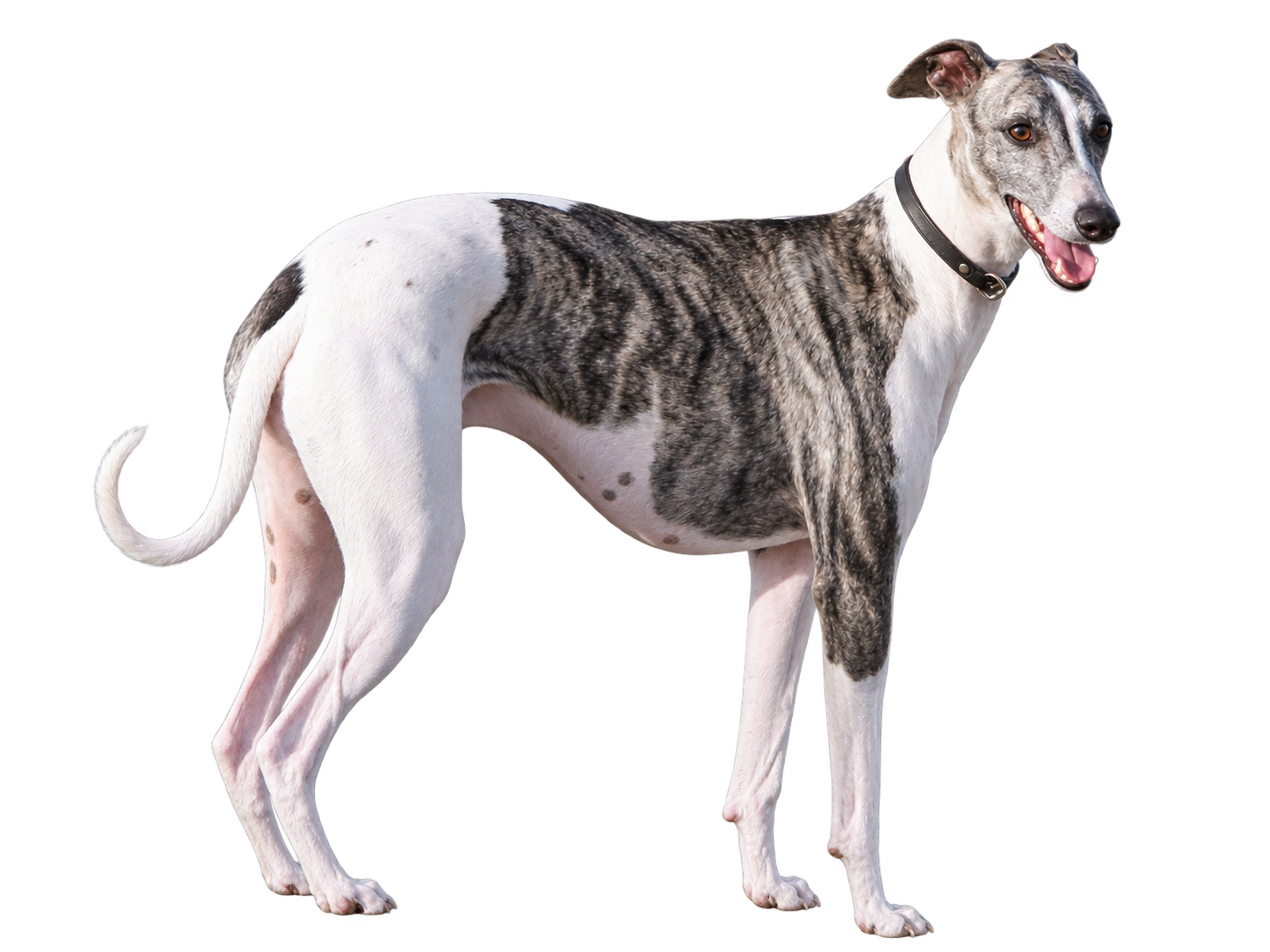
The UK show standard puts the males at 71 to 76 cm at the shoulder and the females at 69 to 71 cm. The international standard starts the females at 68 cm. That gives you an idea of the size of dog you’re dealing with; nobody’s asking you to get the tape measure out. 301302
The middle adult weights in one UK vet study were 27.7 kg for females and 32.5 kg for males. Those were the dogs in the study. If you’re trying to work out what yours should weigh, ask your vet to show you what to feel for around the ribs and waist rather than feeding to somebody else’s number. 305313
Greyhound notes / 03
Size and weight figures
| Head type | dolichocephalic S312 Long-faced classification; this is not a clinical assessment of an individual dog. |
|---|---|
| Build | Muscular, deep-chested and long-legged, with a tucked-up abdomen and gently arched loin. S301 |
| Distinctive features | Long head and neck, Small rose-shaped ears, Deep chest S301 |
| Tail | Long, tapering and low-set, normally carried low with a slight curve. S301 |
Heights
Weights
- Female: 27.7 kg (measured population median) S305 UK VetCompass 2019, Table 1. One median, not a range; adult weights recorded after 18 months. Not an individual target.
- Male: 32.5 kg (measured population median) S305 UK VetCompass 2019, Table 1. One median, not a range; adult weights recorded after 18 months. Not an individual target.
The brush won’t take long
A quick brush once a week is what PDSA recommends. The coat’s short, but Dogs Trust still calls the shedding moderate, which is worth knowing before you buy a black jumper to sit on the floor in. While you’ve got the brush out, check the skin and claws. It’s easy to miss the dewclaws because they don’t touch the ground. 308309314
Blue’s on the Royal Kennel Club’s list, as are red and brindle. If somebody wants extra for a “rare” colour, I’d still ask about the parents’ health and what they’re like to live with. The colour list only tells you what the club registers. 300301
Blue Cross recommends brushing their teeth daily with dog toothpaste. If their mouth hurts or there’s already tartar, ask the vet to take a look. 310
Greyhound notes / 04
Coat colours and grooming checks
| Types | short S300 |
|---|---|
| Length | short S300 |
| Texture | Fine, lying close to the body. S301 |
| Colours standard | Black, Black Brindle, Blue, Blue Brindle, Blue Brindle White Particolour, Fawn, Red, Red Brindle, White, White & Black, White & Black Brindle, White & Blue, White & Brindle, White & Fawn, White & Red, White & Red Brindle, White & Blue Brindle S300 |
| Shedding | moderate S314 Dogs Trust describes the coat as short with moderate shedding. The Royal Kennel Club notes shedding without grading it S300. |
| Grooming frequency | weekly S300S308 |
| Professional grooming | Not known. RKC and PDSA specify weekly grooming but do not state whether a professional is needed; Blue Cross permits home or professional grooming without a Greyhound-specific requirement. |
Colour health notes
Care tasks
- Check skin, eyes and ears. frequency: During regular grooming. Notice parasites, irritation or other changes early; these are checks, not a prescription for routine ear cleaning. S309
- Check claws, including dewclaws. frequency: Regularly; trim according to wear and veterinary advice. Spot overgrowth; dewclaws do not wear against the ground. S309
- Brush teeth with dog toothpaste. frequency: Daily, built up gradually. Reduce plaque accumulation. Pain, inflammation or established tartar need veterinary assessment. S310
The lean and the upside-down nap
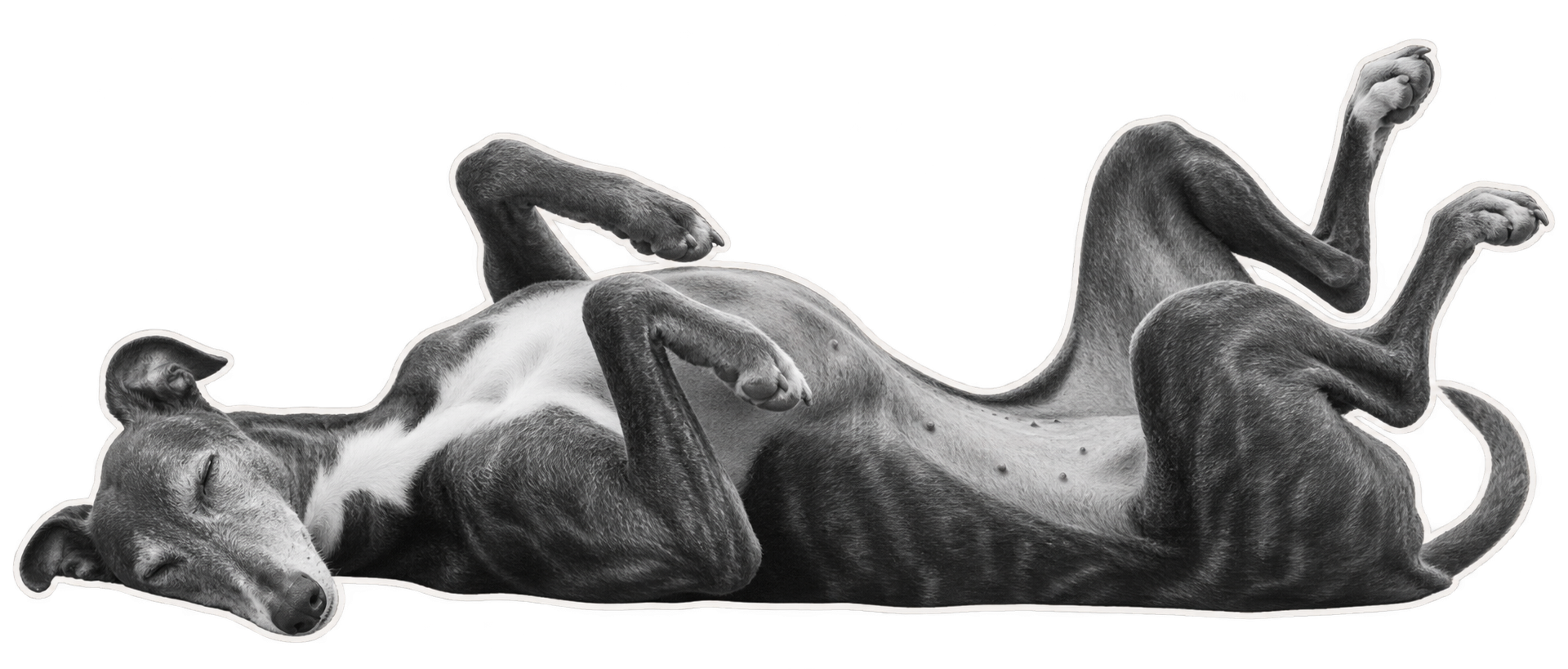
If your Greyhound leans on your leg or goes to sleep with all four feet in the air, Battersea describes both. That second one is called roaching. Some dogs also frighten easily if you touch them while they’re asleep. Call their name from a little way off instead of reaching over to wake them. 210204
The show standard says gentle and even-tempered. It doesn’t tell you if the one in front of you barks at the door or wants strangers fussing over them. In a big study across dogs, breed explained about 9% of the differences in behaviour. I’d put more weight on what somebody who’s spent time with your dog has seen them do. 301202
Greyhound notes / 05
Breed and behaviour notes
| What the breed standard asks for | intelligent, gentle, affectionate, even-tempered S301 |
|---|---|
| Vocality | Not known. PDSA, Dogs Trust and Battersea Greyhound pages checked. Quietness during prey pursuit is not a general barking-frequency measure; no supported classification found. |
| With strangers | Not known. RKC standard, PDSA and Battersea checked. Battersea describes initial distance in some ex-racers, not a breed-wide response to unfamiliar people. |
What the breed was bred to do
Things that can trip you up
When all four feet say no
When a Greyhound stops in the middle of a walk and won’t budge, pulling harder is a poor bet. Forever Hounds Trust sees it when dogs are overwhelmed or scared. Give them a bit of room and try heading the other way. If a noise or a busy stretch is doing it every time, work up to it rather than dragging them through it. 215314
Practise coming back somewhere enclosed. A dog who comes straight back for a bit of chicken in the kitchen still hasn’t been tested against a rabbit, and Greyhound Trust Hall Green says trained dogs can still chase. I’d spend at least as much time getting a relaxed walk on the lead as chasing the perfect recall. 207314
Training notes
When they plant their feet
Give them some room and try heading the other way.
| Level | moderate S205 Classified from reported need for patience and consistency in retired racers; not an experimentally measured breed rating. |
|---|---|
| Recall | high risk off lead S207 Training does not remove the chase risk; secure surroundings remain important. |
| Motivators | Food rewards, Toys, Praise S314 Dogs Trust advises finding the reward the individual prefers; these are options, not breed-wide preferences. |
Common challenges
A sprint doesn’t make them a hiking dog
Two 20-minute walks is the Greyhound Trust’s suggestion; PDSA says about an hour a day and the Royal Kennel Club says up to an hour. I wouldn’t time it to the minute. If yours is just off the track, build up the distance. A dog that used to race can still need time to get used to a long walk, and an enclosed field gives them somewhere safe to have a run. 208308300205
A coat can help on cold walks. The short fur doesn’t make hot weather safe, so cut back in the heat, and ask the vet what exercise makes sense for a growing dog or one recovering from an injury. If the walk’s shorter, try hiding some of their usual food for them to sniff out at home. 209214211314
Exercise figures and activities
Built for a sprint
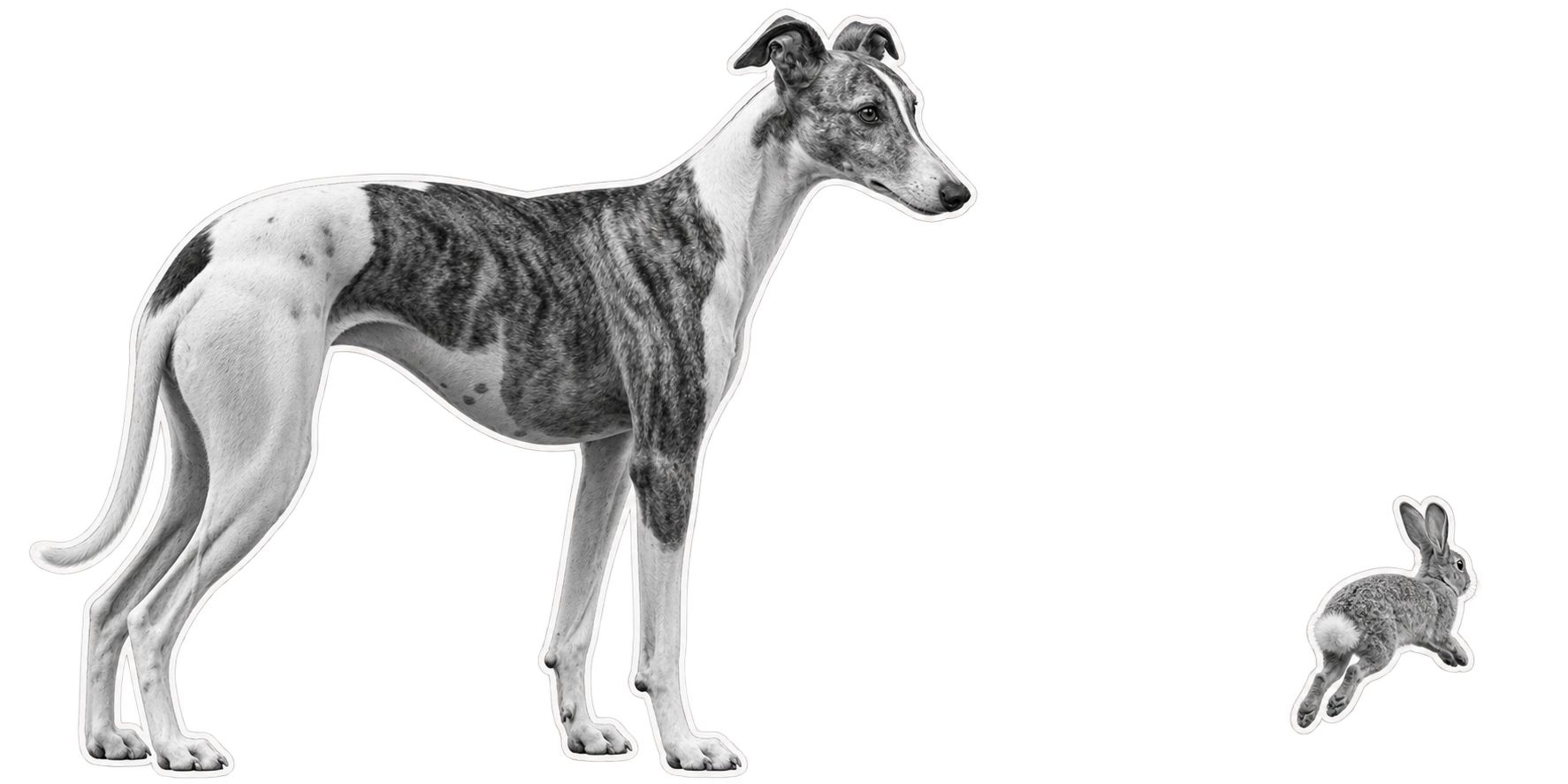
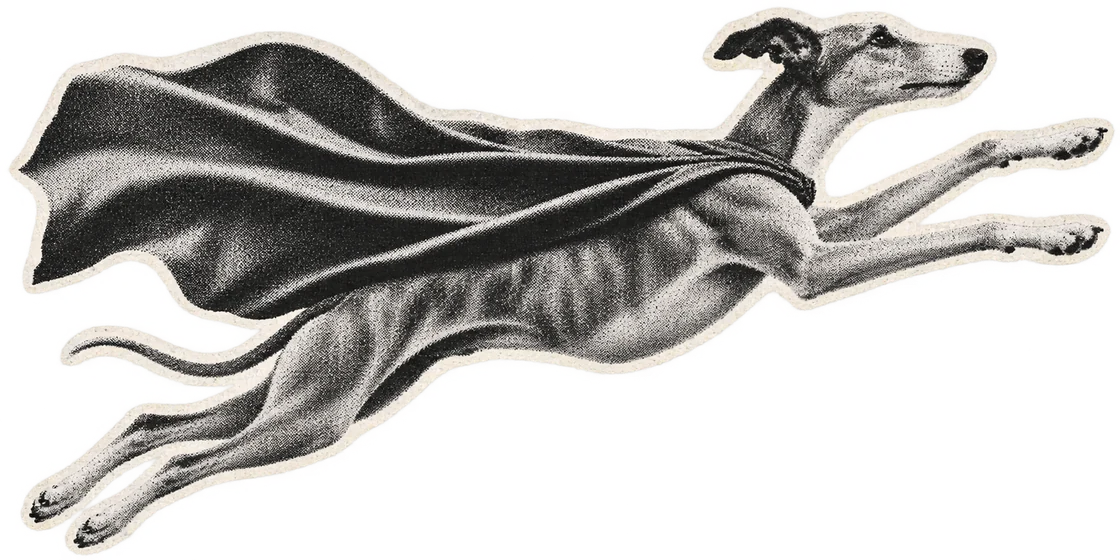
Build up longer walks gradually, and use a securely enclosed space for a run.
| Daily minutes | up to 60 S300 Registry upper band, not a universal target. PDSA says about an hour; Greyhound Trust suggests two twenty-minute walks. |
|---|---|
| Registry band | Up to 1 hour per day S300 |
| Intensity | moderate S314 Dogs Trust describes Greyhounds as usually moderately active, with short bursts of activity. |
| Mental work | Supervised food puzzle, Scent trail using food from the daily allowance S211 General Dogs Trust enrichment options linked from its Greyhound guide; adapt to the individual. |
Restrictions
- Adjustment after racing. Build walking activity gradually rather than assuming sprint fitness supplies endurance. S205
- Chase risk. Use contained exercise space because regaining attention during pursuit can be difficult. S308
- Growth, injury or illness. Exercise needs differ with age and health; veterinary advice should guide adaptations. S314
- Cold weather. PDSA says Greyhounds feel cold quickly and need shorter exposure and a suitable coat. S209
- Heat-related illness. Greyhounds had higher adjusted odds than Labrador Retrievers in a study of UK primary-care records from 2016. S214
The washing machine can be a bigger deal than the walk
A newly retired racer might never have had to walk up stairs or nap next to a washing machine. Battersea suggests starting in a quiet room. If the stairs are a sticking point, put the bed and water downstairs rather than making the dog go up for either. The house rules, including where to go to the toilet, may take time too. 205314
A dog that sleeps while you’re on the sofa hasn’t necessarily learnt to be on their own. Start with short spells apart and make them shorter again if the dog gets upset. There’s no good Greyhound-specific number for time alone; if they’ve spent time in a foster home, ask how long they actually managed. 212
Greyhound notes / 08
Home and time alone
| Home size | Large house S300 |
|---|---|
| Garden | Large garden S300 |
| Town or country | Either S300 |
| How long you can leave them alone | Not known. Dogs Trust time-alone guidance and PDSA/Battersea Greyhound pages checked. Gradual individual assessment is advised; no Greyhound-specific maximum duration verified. |
| Heat tolerance | poor S214 Classified from higher adjusted odds of heat-related illness than Labrador Retrievers in 2016 UK primary-care records, not a measured safe temperature. |
| Cold tolerance | poor S209 Classified from PDSA stating that Greyhounds feel cold much faster and need a warm coat and shorter cold-weather exposure; not a temperature threshold. |
What you might notice at home
Kids, cats and other dogs
A Greyhound can live with children, but ask what the dog has done around kids the same age as yours, not whether someone ticked “good with children”. Stay close and pay attention while they’re together, and give the dog a place they can go where the kids won’t follow. 208213
Greyhounds can live with dogs of other breeds. With a cat, a rabbit or other small pets, tell the rescue exactly who lives with you and ask what they’ve actually seen from that dog. One calm introduction does not establish that it’s safe to leave them together. If this is your first dog, ask the rehoming team to talk you through the lead setup and how to manage introductions. 207308
Greyhound notes / 09
Matching notes
| Children | generally suitable with supervision S208 Trust breed-level guidance, not a promise about an individual. Any dog and any child need supervising. |
|---|---|
| Other dogs | variable S314 Dogs Trust explicitly describes individual differences; Hall Green reports many live with other breeds following careful introductions. |
| Cats | high chase risk S308 Strong pursuit instinct; individual exceptions require assessment, not a breed-wide safety guarantee. |
| Small pets | high chase risk S308 Chase instinct is relevant around smaller pets; do not infer safety from affectionate behaviour with people. |
First time owners
Our call: suitable with caveats.
When to ring the vet
Call an emergency vet if your dog is trying to be sick and nothing comes up, their belly swells, or they collapse or show signs of severe distress. Greyhounds have deep chests, which puts them at higher risk of GDV, where the stomach swells and can twist. 109301
Don’t wait for them to stop eating before asking your vet to look at their teeth. In one set of UK vet records, 39% of 2,715 Greyhounds had gum disease recorded in 2016. In a separate study, they had 2.58 times the adjusted odds of crossbreeds. That doesn’t tell you whether either figure has changed since. 111100105
Get a persistent limp or a hard, painful swelling checked rather than putting it down to an old racing injury. Corns on the pads can make walking painful, but a limp on its own won’t tell you the cause. Bone cancer was recorded in 0.62% of Greyhounds during one year of UK vet data, with adjusted odds 11.93 times those of crossbreeds. That’s not a lifetime risk. 104110114
Heat needs taking seriously: one UK study put their adjusted odds of heat illness at 4.26 times a Labrador’s. The wider health notes below cover the other conditions and the Royal Kennel Club’s recommended DNA test. If you’re wondering how long they live, a 2024 study put the median at 11.5 years; a separate vet study found the middle age at death was 11.4 years. The studies measured it differently. 214308300102106115100
Greyhound notes / 10
Health studies, tests and warning signs
This is general information about the breed, not veterinary advice about your dog. If you’re worried about your dog’s health, speak to your vet.
Conformation welfare
The deep chest carries a GDV risk; larger, long-legged body types also have an observed association with bone cancer, not proof of a single causal feature. S104S301S109S300
- Deep chest. Deep-chested dogs have increased susceptibility to the emergency stomach condition GDV. S301S109
- Large, long-legged build. Associated with greater osteosarcoma risk in observational research. This does not establish that the standard itself causes cancer in an individual dog. S104S301
What the standard says. The RKC standard specifies a “deep chest” and “Forelegs, long and straight”; departures are judged with regard to health and welfare.
What the registry has done.
- Breed Watch category 1; no breed-specific points of concern are listed. This is not a claim that the breed has no health risks. S300
Our view. Do not dismiss a serious risk because the dog looks athletic. Equally, do not turn an association into a claim that every Greyhound is unhealthy or that a particular shape inevitably causes cancer.
Conditions
Gastric dilatation volvulus (GDV)
- Link to the breed: Caused or worsened by the breed’s shape
- Evidence: No prevalence or odds figure verified.
- What it is: An acutely swollen and twisted stomach. Deep-chested dogs are more susceptible; this is an emergency.
- What owners may notice: Repeated retching without bringing up food; Swollen abdomen; Distress or collapse.
- Welfare impact: severe. Typical onset: not known.
- Sources: S308S109
Osteosarcoma
- Link to the breed: Predisposed: more likely than in other dogs
- Evidence: 11.93 times the odds (95% CI 7.82 to 18.21), compared with: crossbred dogs; adjusted odds, not lifetime probability. Measured in: UK VetCompass primary care, 2016; Greyhound annual recorded prevalence 0.62% (95% CI 0.43–0.87)..
- What it is: Aggressive bone cancer; a limp alone is not a diagnosis.
- What owners may notice: Persistent painful lameness; Hard painful limb swelling.
- Welfare impact: severe. Typical onset: not known.
- Sources: S104S110
Greyhound neuropathy (GN)
- Link to the breed: Inherited; gene identified
- Evidence: No prevalence or odds figure verified.
- What it is: Recessive NDRG1-associated nerve disease, progressing in the first year.
- What owners may notice: Muscle weakness; Exercise intolerance; Abnormal hopping gait.
- Welfare impact: severe. Typical onset: birth or puppy.
- Screening: DNA test GN; Royal Kennel Club Best Practice. Review both parents’ results together.
- Sources: S102
Von Willebrand’s disease
- Link to the breed: Named by veterinary charities or the registry; no figure verified
- Evidence: No prevalence or odds figure verified.
- What it is: A bleeding disorder named for the breed by PDSA; a UK breed frequency was not established here.
- What owners may notice: Excessive bleeding.
- Welfare impact: variable. Typical onset: not known.
- Sources: S308
Progressive retinal atrophy
- Link to the breed: Named by veterinary charities or the registry; no figure verified
- Evidence: No prevalence or odds figure verified.
- What it is: Inherited retinal degeneration flagged by PDSA, progressing towards blindness; breed prevalence not established here.
- What owners may notice: Difficulty seeing in dim light; Progressive loss of vision.
- Welfare impact: severe. Typical onset: not known.
- Sources: S308
Periodontal disease
- Link to the breed: Predisposed: more likely than in other dogs
- Evidence: 2.58 times the odds (95% CI 1.75 to 3.8), compared with: crossbred dogs; adjusted odds. Measured in: Random sample of 22,333 UK primary-care dogs in 2016; Greyhound recorded prevalence 32.21%, a different sample from S100..
- What it is: Disease affecting the tissues supporting the teeth; it can be painful without obvious food refusal.
- What owners may notice: Bad breath; Red or bleeding gums; Pain or difficulty eating.
- Welfare impact: variable. Typical onset: not known.
- Sources: S105S111
Lifespan estimates
- 11.4 years, median age at death. S100 UK primary-care Greyhounds with recorded deaths in the 2016 study. Sample: 474. Caveat: Deaths-only median, not life expectancy at birth. The cohort does not isolate racing history or represent every Greyhound population.
- 11.5 years (95% CI 11.4 to 11.6), median survival. S106S115 UK multi-source McMillan study: 3,964 Greyhounds alive or deceased, including 3,025 deceased. Sample: 3964. Caveat: Kaplan–Meier median survival includes censored living dogs. Multi-source sampling differs from a primary-care deaths-only median; the two estimates must not be averaged or read as a time trend.
- 11.8 years, median age at death. S100 Female Greyhounds among recorded deaths in the 2016 UK study. Caveat: Sex-specific deaths-only median from the same study; not an independent lifespan survey or a prediction for a female puppy.
- 11.2 years, median age at death. S100 Male Greyhounds among recorded deaths in the 2016 UK study. Caveat: Sex-specific deaths-only median from the same study; not an independent lifespan survey or a prediction for a male puppy.
- 10 years, registry band minimum. S300 RKC breed profile: over 10 years. Caveat: The number encodes the lower boundary of an open-ended registry band, not an exact estimate, minimum guarantee or measured median.
Health tests
- DNA test: Greyhound neuropathy (GN) (best practice). Screens for: Greyhound neuropathy. Ask the breeder for: Both parents’ identifiable DNA result certificates and an explanation of their pairing. A carrier is not an affected dog; check the intended mating, not just a claim of being health tested. S300S102
Breeding restrictions
- The RKC breed page lists no additional breed-specific registration restrictions. General registry rules still apply. S300
See a vet signs
- Repeated unproductive retching, abdominal swelling, severe distress or collapse: contact an emergency vet immediately. Do not wait for all signs to appear. S109
- A new or persistent limp, painful swelling or suspected fracture needs veterinary assessment; these signs do not identify a specific cause. S110
- Bad breath, bleeding gums or difficulty eating merit a dental check; absence of obvious signs does not exclude disease. S111
- Heat- or exercise-associated collapse, marked distress or rigidity needs urgent veterinary attention. S308S214
What you’ll actually pay for
PDSA’s breed page starts at £105 a month. Its separate large-dog guide starts at £116, though that’s not just Greyhounds. Neither includes treatment for illness or injury. I wouldn’t give you a puppy price or an insurance premium we couldn’t verify. 308402
Before ordering three versions of the same bit of kit, ask what comes with the dog. The Greyhound Trust sends theirs home with a collar, lead and muzzle. If there’s an old injury or a dental problem, ask the insurer what they’ll exclude and get it in writing before you pay. 403100406
Greyhound notes / 11
Cost notes and exclusions
| Price basis | UK PDSA breed and general budget pages accessed 19 November 2026. The Greyhound profile has no stated costing date; it is a published minimum, not a live quote. The general estimate is for large dogs across breeds and not a Greyhound estimate. |
|---|---|
| Buying a puppy (£) | Not known. PDSA, Battersea and Royal Kennel Club breed or rehoming pages do not provide a dated Greyhound puppy purchase price. Advert listings were not used. |
| Getting set up (£) | Not known. PDSA gives a large-dog figure on its general costs page, not a Greyhound figure. The Greyhound Trust lists what it includes, not the set-up cost of keeping this breed. |
| Monthly (£) | 105 or more S308 Undated published minimum accessed 19 November 2026; excludes veterinary treatment for illness or injury. |
| Lifetime (£) | Not known. The PDSA Greyhound page lists what it includes but gives no breed-specific lifetime total. PDSA’s separate range is for large dogs of multiple breeds. |
| Typical insurance premium per month (£) | Not known. PDSA and Greyhound Trust were checked. No dated independent UK Greyhound-specific premium was available; do not use private or insurer marketing data. |
What to budget for with a Greyhound
- Escape-resistant walking kit and a properly fitted basket muzzle where recommended. Battersea describes fitting walking kit to a Greyhound; the Greyhound Trust provides starter equipment for dogs it homes. Check sizing and what is supplied. S403S205
- Dental assessments and treatment. The UK VetCompass cohort frequently had dental disease recorded. Ask what existing issues or dental treatment would be excluded; price varies by dog and policy. S100S406
From coursing to the track
The Greyhound we know today was developed in Britain for hunting by sight. There are much older pictures of dogs with that same outline, and the international registry mentions a possible Middle Eastern ancestry. A dog drawn on a wall isn’t a family tree, which is why you’ll hear different versions of where the breed started. 302
There’s a firmer paper trail here: the British breed club records a coursing club at Swaffham in 1776 and the first stud book in 1882. Track racing took off in 1926, the Derby followed a year later, and the show dog went in a different direction. The Royal Kennel Club describes it as bigger and heavier than the racing dog. 311300303
Greyhound notes / 12
Dates and records
Timeline
- 1776. Public coursing club established at Swaffham, according to the UK breed club. S311
- 1882. National Coursing Club published the first Greyhound Stud Book. S311
- 1926–1927. Track racing expanded in 1926; the first Greyhound Derby followed in 1927. S311
- 23 April 1955. FCI definitive recognition. S303
- 6 October 2026. FCI published the English edition of the standard valid from 8 September 2026. S303
Disputed or unverified
- Ancient Egyptian hound depictions establish the exact ancestry of the modern Greyhound.. status: unsourced. FCI discusses ancient similarities and possible origins, not a verified continuous pedigree. S302
If you’re bringing one home
With a retired racer, ask what the rehoming team has actually seen: how the dog handled stairs, what happened around small dogs, and what they walked them in. The Greyhound Trust matches dogs locally and does a home visit first. That’s a good time to explain where you’ll walk the dog and who else lives there. 403205
With a puppy, ask for both parents’ Greyhound neuropathy DNA results and the names you need to check them. The Royal Kennel Club puts that test in its Best Practice tier. Ask about health problems in the wider family as well, and walk away if you cannot see the puppy with its mum or the breeder won’t show you the results they’ve said they have. 300102308407
Greyhound notes / 13
Breeder and rescue checks
What to ask the breeder
Reasons to walk away
Rescue routes
Sources
- S100O'Neill et al. (2019). Greyhounds under general veterinary care in the UK during 2016: demography and common disorders.Peer-reviewed research · checked 19 November 2026
- S102Royal Kennel Club. DNA test: Greyhound neuropathy (GN).Registry or official body · checked 19 November 2026
- S104Dog breeds and conformations predisposed to osteosarcoma in the UK: a VetCompass study (2023).Peer-reviewed research · checked 19 November 2026
- S105Epidemiology of periodontal disease in dogs in the UK primary-care veterinary setting (2021).Peer-reviewed research · checked 19 November 2026
- S106McMillan et al. (2024). Longevity of companion dog breeds: those at risk from early death.Peer-reviewed research · checked 19 November 2026
- S107Teng et al. (2022). Life tables of annual life expectancy and mortality for companion dogs in the United Kingdom.Peer-reviewed research · checked 19 November 2026
- S109PDSA. GDV (gastric dilatation volvulus) in dogs.Veterinary or welfare charity · checked 19 November 2026
- S110PDSA. Osteosarcoma (bone cancer) in dogs.Veterinary or welfare charity · checked 19 November 2026
- S111PDSA. Dental disease in dogs.Veterinary or welfare charity · checked 19 November 2026
- S112British Veterinary Association. Canine Health Schemes.Registry or official body · checked 19 November 2026
- S114Anis et al. (2016). Identification of canine papillomavirus by PCR in Greyhound dogs.Peer-reviewed research · checked 19 November 2026
- S115Dogs Trust (2024). McMillan et al. lifespan research: life expectancy for 155 breeds and crossbred group, Greyhound row.Peer-reviewed research · checked 19 November 2026
- S202Morrill K et al. Ancestry-inclusive dog genomics challenges popular breed stereotypes. Science. 2022;376:eabk0639. Primary abstract accessed via PubMed.Peer-reviewed research · checked 19 November 2026
- S204Battersea. Sleep startle in dogs. Updated 26 June 2026.Veterinary or welfare charity · checked 19 November 2026
- S205Battersea. Rehoming a retired Greyhound.Veterinary or welfare charity · checked 19 November 2026
- S207Greyhound Trust Hall Green. Frequently asked questions.Veterinary or welfare charity · checked 19 November 2026
- S208Greyhound Trust. All about Greyhounds.Veterinary or welfare charity · checked 19 November 2026
- S209PDSA. Does my dog need to wear a coat on winter walks? 28 October 2019.Veterinary or welfare charity · checked 19 November 2026
- S210Battersea. Adopting a greyhound: what you need to know. Updated 30 June 2026.Veterinary or welfare charity · checked 19 November 2026
- S211Dogs Trust. Enrichment activities to keep your dog entertained.Veterinary or welfare charity · checked 19 November 2026
- S212Dogs Trust. Helping your dog get used to spending time alone.Veterinary or welfare charity · checked 19 November 2026
- S213Dogs Trust. Getting a dog when you have children.Veterinary or welfare charity · checked 19 November 2026
- S214
- S215Forever Hounds Trust. Freezing on walks and how to respond.Veterinary or welfare charity · checked 19 November 2026
- S300Greyhound: Breeds A to Z, characteristics, colours, Breed Watch and screening.Registry or official body · checked 19 November 2026
- S301Greyhound breed standard, updated 1 August 2025.Registry or official body · checked 19 November 2026
- S302FCI Standard No.158 Greyhound, English edition 6 October 2026; official valid standard 8 September 2026.Registry or official body · checked 19 November 2026
- S303Greyhound (158): FCI breeds nomenclature and recognition dates.Registry or official body · checked 19 November 2026
- S304Breeds by Year Recognized, updated 1 January 2026. Recognition information only.Registry or official body · checked 19 November 2026
- S305Dog breeds and conformations in the UK in 2019: VetCompass canine demography and some consequent welfare implications. PLOS ONE 18:e0288081, Table 1 and methods.Peer-reviewed research · checked 19 November 2026
- S306Vulnerable native breeds: registration table and starred-breed qualification.Registry or official body · checked 19 November 2026
- S307Controlling your dog in public: Banned dogs.Registry or official body · checked 19 November 2026
- S308Greyhound breed information: coat care.Veterinary or welfare charity · checked 19 November 2026
- S309How to groom your dog: short coats, routine checks and nail care.Veterinary or welfare charity · checked 19 November 2026
- S310Dog dental care, reviewed 3 October 2024.Veterinary or welfare charity · checked 19 November 2026
- S311About the Greyhound: UK breed history and racing development.Breed club · checked 19 November 2026
- S312Who’s top dog? French Bulldogs and Cockapoos claim top spot for the UK’s most popular puppies: skull classifications.Registry or official body · checked 19 November 2026
- S313Keeping your dog’s weight in check: body condition and veterinary advice.Veterinary or welfare charity · checked 19 November 2026
- S314Dogs Trust. Greyhound: shedding, everyday care and health.Veterinary or welfare charity · checked 19 November 2026
- S402PDSA. The cost of owning a dog: UK estimates by size.Veterinary or welfare charity · checked 19 November 2026
- S403Greyhound Trust. Homing process for retired racing Greyhounds.Veterinary or welfare charity · checked 19 November 2026
- S406PDSA. Pet insurance guide: policy types and exclusions.Veterinary or welfare charity · checked 19 November 2026
- S407The Royal Kennel Club. Visiting a breeder: what to see and check.Registry or official body · checked 19 November 2026

