
Breed guide / Goldendoodle
Living with a Goldendoodle
A Goldendoodle has Golden Retriever and Poodle ancestry. That tells you who’s in the family, not how tall your dog will get or whether a comb will go through their coat after a wet walk. If you’re choosing one, meet the adults and ask what they’re actually like to live with.
Jump to a section
The short version: get to know the coat and the dog
A Goldendoodle can have loose waves or tight curls, and two dogs with the same name on the vet’s records can need quite different grooming. Part the coat behind the ears and under the harness. If the top looks fine but the comb won’t move through underneath, that’s the bit to sort out. Then find out whether your dog can come back when someone throws a ball nearby and whether they can take themselves off for a nap after the walk. Those are worth more than anything printed on a puppy advert. 123
Goldendoodle notes / 01
Get to know the dog in front of you
| Start here | What to do with it |
|---|---|
| Coat | Look and feel underneath, especially at rub points. Ask a groomer to show you the coat this dog actually has. |
| Space | Fit the kit to the dog, not the word “mini” on the listing. |
| Daily life | Practise quiet greetings, coming back and being comfortable without you in the room. |
| Taking one on | Ask for parentage and health records, and watch the individual dog recover after ordinary excitement. |
Names: the letters aren’t a coat warranty
Goldendoodle is a name for a cross, not a UK pedigree breed standard. A first cross has a Golden Retriever parent and a Poodle parent. Later dogs can come from two Goldendoodles or from a pairing back to one of the parent breeds. People use labels such as F1 and F1b for those pairings, but ask them to tell you who the two actual parents were. There’s more to learn from that answer than from a whole paragraph about the premium teddy-bear finish. 456
Goldendoodle notes / 02
Read the family tree, not the advert
| Name on the listing | What you can and can’t take from it |
|---|---|
| Goldendoodle | Golden Retriever and Poodle ancestry; the name alone does not verify the family tree. |
| First cross / F1 | One parent of each breed when the ancestry is documented. |
| F1b / backcross | Usually an F1 paired back to a parent breed; ask which one, and check the records. |
| Later generation | Ancestry still matters. Ask for the actual pairing over any shorthand. |
| “Mini” or “standard” | An advert might refer to the Poodle parent or the size the seller expects. These are not RKC Goldendoodle size classes. |
| Royal Kennel Club | No Goldendoodle Breed Register standard. Eligible crosses can use the separate Activity Register. 7 |
| Coat labels | “Fleece” and “teddy bear” tell you less than parting the hair on an adult and having a proper look. |
Size: measure the back of the car before you buy a crate
Poodle variety is useful information, and so is seeing a grown sibling from the same pairing if there is one. Even with that, a puppy’s adult frame isn’t something you can order. If yours is already grown, measure them rather than picking kit off a parent-breed chart. The boot needs room for the dog to get in and travel securely, and a harness should fit against the body without pinching under all that hair. Thick fur can make a perfectly ordinary dog look as wide as an armchair. 8910
Goldendoodle notes / 03
Fit the kit to the dog
| Measurement | Useful answer |
|---|---|
| Adult height | No verified UK cross-specific reference range used here. Measure your adult and ask for measured parent heights when choosing a pup. |
| Adult weight | No defensible UK population range found. Use the dog’s own weight trend and body condition, with veterinary input. |
| Chest and harness | Measure the actual dog, check after trimming, and look for rubbing at the points where the harness moves. |
| Transport | Measure the space and the dog, then check the restraint or crate fit. 11 |
| Handling | Think about narrow stairs, a high car sill and whether you could safely move the dog if unwell. |
Coat: the comb has to get past the surface
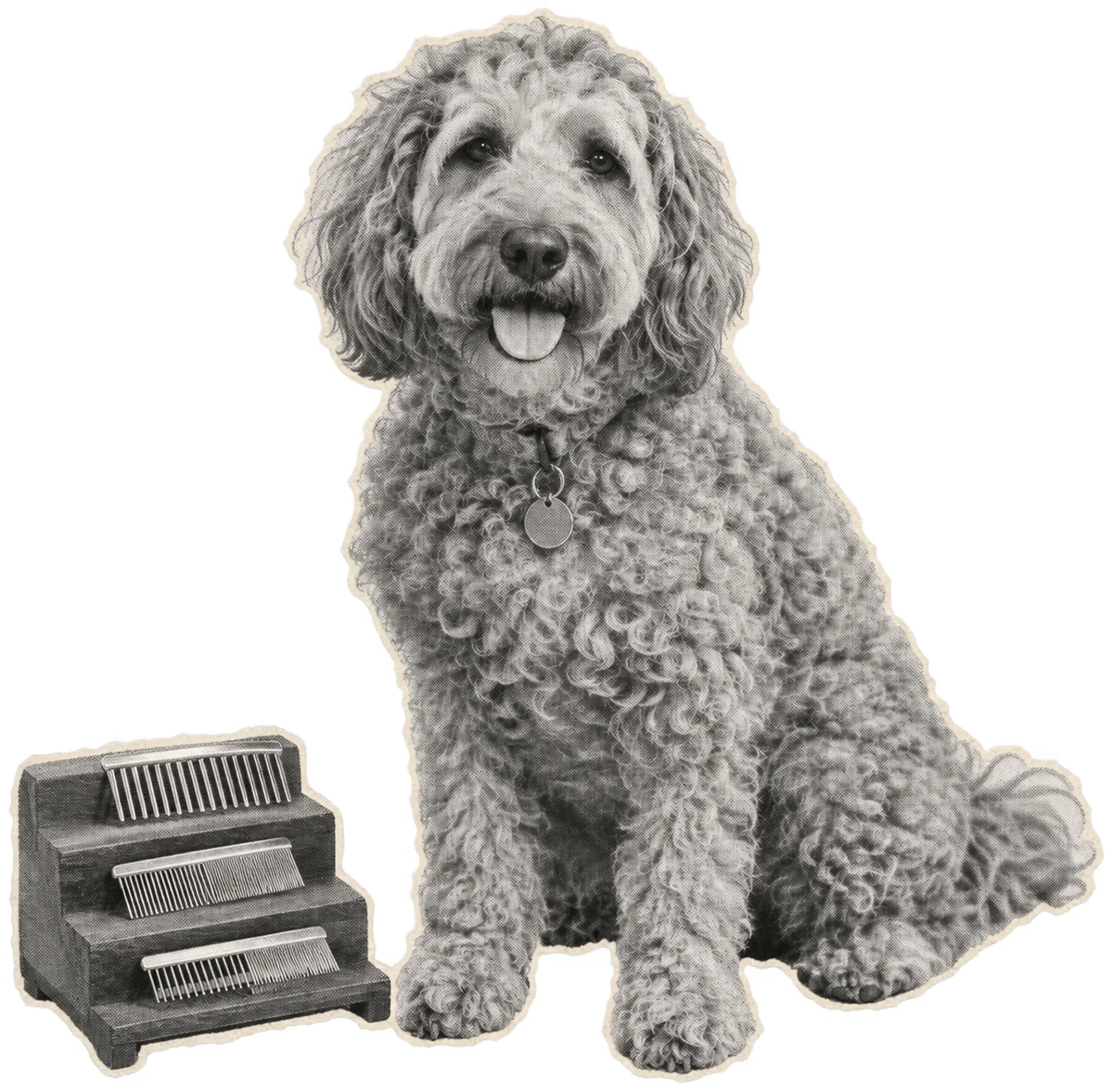
Brush through a small section so you can see what’s going on close to the skin. Follow with a comb where it’s comfortable; don’t tug a knot until the dog gives up objecting. Behind the ears and under the elbows can be a different job from the back. A coat can also change as a puppy grows, so revisit what’s working instead of booking the same haircut for the next fifteen years on day one. If you want a longer coat, ask the groomer to show you how much work it takes to keep this dog comfortable. 212
Goldendoodle notes / 04
Look under the top of the coat
| What to check | Why it matters |
|---|---|
| Texture | Loose waves, straighter areas and tighter curls can all occur. Treat the coat in front of you. |
| Under the surface | Part the hair in small sections. A smooth-looking back does not mean the base of the coat is clear. |
| Rub points | Look behind the ears, under the collar and harness, in the armpits and around the legs and tail. |
| After a wet walk | Dry and check the coat where hair bunches or kit rubs. |
| Groomer | Ask for a realistic appointment interval and what you can comfortably do in between. There’s no one Goldendoodle timetable. |
| Matted coat or sore skin | Get help with a tight mat instead of digging at it yourself. Ask a groomer, or a vet if the skin is sore. |
| Shedding and household dust | How much loose hair you see varies. Buying a curlier dog is not a reliable way to manage a person’s dog allergy. The published allergen study tested other groups, not Goldendoodles as a separate group. 13 |
Temperament: watch what happens after hello
A dog hurtling towards visitors might be delighted, worried or just well practised at getting to the front door before anybody else. Watch the rest of the encounter. Can they turn away, take a breath and get back to whatever they were doing? If you’re choosing a dog, meet them somewhere ordinary and ask what they do when nobody is trying to sell you how friendly they are. Research on other common Poodle crosses does not make predictions about this one. 814
Goldendoodle notes / 05
What happens after hello
| Watch for | Better evidence than a label |
|---|---|
| After a greeting | How long before the dog can disengage or quietly do something else? |
| Handling | Do they relax when a familiar person checks an ear or touches a paw? What happens when they can opt out? |
| Alone | Ask what has been observed, including quiet periods, pacing or vocalising after people leave. |
| Around noise | Can they move away and recover? What’s different outside the puppy visit? |
Training: practise with the brush put down
If the brush has become an argument, make the first exercise smaller. Put it down, let the dog choose to come over, and reward one bit of calm handling they can cope with. The same principle works at the front door: practise the mat with no visitor there, so it means something before there’s a parcel and a dog both trying to come through the gap. Reward walking past a person as well as greeting one. 315
Goldendoodle notes / 06
Practise the easy version first
| Skill | A useful way in |
|---|---|
| Grooming cooperation | Short, easy sessions with choice and breaks. Change the plan if the dog stiffens or tries to leave. |
| Four paws by the door | Rehearse with no one arriving; have a gate or space ready when they do. |
| Recall | Start somewhere easy, use a long line on a well-fitted harness where appropriate, and increase distraction gradually. |
| Giving things up | Teach a good swap in play. If the dog guards objects, get qualified help instead of reaching in. |
Exercise: give the nose a turn
A walk can be a sniff, some easy movement and a chance to practise passing things without joining in. You don’t have to keep throwing the ball just because somebody brought you one. If your dog enjoys carrying or searching, hide a suitable toy in safe grass and see what they make of it. Build walks to suit the dog’s age, joints, fitness and recovery. Goldendoodle isn’t an exercise prescription. 1617
Goldendoodle notes / 07
Make room for sniffing
| Who or where | What to plan |
|---|---|
| Adult | Daily opportunities to move, sniff and choose, paced by how this dog copes and recovers. |
| Growing puppy | Build gentle activity gradually. Don’t set a mileage target based on an adult cross. 18 |
| Older or sore dog | A change in gait, enthusiasm or recovery deserves a veterinary conversation rather than being trained through. |
| Livestock, roads or weak recall | Use a secure lead and a route they can handle. An open gate is not a recall test. |
| After grass or woodland | Check the coat and skin after the walk; ears and between the toes are easy to miss. 19 |
At home: put the towel where the dog comes in
A towel in the airing cupboard is impressive storage and absolutely no use when a wet dog walks straight past you. Put the kit by the door and keep a place to lie down clear of the through-traffic. Plan what happens when you need to leave, too. A dog following you into the kitchen isn’t a diagnosis. How they actually cope after you leave tells you more. 202122
Goldendoodle notes / 08
A home that suits this dog
| Home job | What helps |
|---|---|
| Wet entry | Mat, towel and a quiet chance to dry off before another greeting. |
| Rest | A bed away from visitors and traffic where nobody needs to move the dog. |
| Flat and stairs | Think about toileting access, lifts, neighbours and how the individual copes with corridor encounters. |
| Leaving | Build up absences they can handle. Ask about observed behaviour, not a promised number of hours. |
| Work days | Sort a sensible walk and toilet plan that fits this dog; a closed garden door doesn’t make one. |
| Surfaces and gates | Non-slip routes and a barrier at a busy entrance can help, particularly with a large or older dog. |
Children, cats and other dogs: make room to leave
A soft face doesn’t tell you whether a dog likes being grabbed round the neck. Give kids one rule they can actually use: if the dog walks away, let them go. With a cat, start with separation and a route out for the cat, then take it at their pace. If the dog has never lived with one, say so. “Fine at the meet” is useful information about that meet, and no more. 2324
Goldendoodle notes / 09
Give everyone a way out
| Household member | Practical check |
|---|---|
| Children | Actively supervise; separate when the adult cannot watch. Keep meals, chews and sleep undisturbed. |
| Cat | Go slowly with a barrier and safe escape routes, and stop if the dog fixates or pursues. |
| Resident dog | Ask about greetings, rest and resources, and give both dogs their own space. |
| Visitors | Offer a quiet place and reward staying there. Let the dog choose whether to come over. |
Health: ask about the measured risks, not the sales pitch
There is specific UK evidence to put in the notes for a Goldendoodle, but it covers particular things, not a full health forecast. Ask about hips and find out what screening was done in both lines. Make coat checks a habit. A dog that is unwell after a tick, keeps shaking its head or starts moving differently needs advice about that symptom, whatever the parents’ paperwork says. 2526
Goldendoodle notes / 10
Goldendoodle health evidence and screening
Recorded health conditions and study limits
| Evidence | What it does and doesn’t tell you |
|---|---|
| Recorded ticks, UK VetCompass | O’Neill et al. (2024) used records from 905,553 dogs seen at 887 UK clinics in 2016. In the 2014–18 window, the Goldendoodle estimate was 5.14% (95% CI 1.90–10.83), accounting for the subsampled case review. Only six confirmed Goldendoodle cases appear in Table 1; this is an imprecise estimate, not an annual rate or a count of ticks found at home. 27 |
| Comparative tick odds | Adjusted OR 2.63 (95% CI 1.17–5.91) versus the study’s non-designer crossbreed group, not versus all dogs and not 2.63 times any one dog’s probability. The study does not establish why a particular dog picked up ticks. 27 |
| BVA Goldendoodle hip scoring | In the 2025 table, 87 submitted over five years, 11 of those in 2025; five-year median 11, range 0–55. These are scheme scores from submitted dogs, not the proportion with clinical hip disease or a guaranteed safe score. 28 |
| Overall illness and lifespan | I did not find a representative UK all-condition or lifespan estimate isolated for Goldendoodles. The RVC 2024 three-cross health paper excludes this cross. The 2024 UK survival table does not separately report it. Neither a parent-breed average nor a pooled crossbreed figure fills the gap. 2930 |
Eight things worth noticing
Ticks
Part the coat after relevant outings and check areas you don’t normally brush. Ask your vet what’s appropriate for your area and call if the dog becomes unwell after a tick. 19
Hips and movement
Mention a new change in rising, jumping or gait to your vet; a gait change does not diagnose dysplasia. 31
Ears
Repeated head shaking, changed smell, discharge or an ear the dog suddenly won’t let you touch merits prompt veterinary advice. 32
Skin hidden by the coat
Notice persistent licking, redness, changes in smell or soreness under hair. You can describe the changes without guessing the cause. 33
Eyes
A sore or closed eye merits prompt help; gradual trouble finding their way in lower light is also worth mentioning. Parent DNA and eye tests cannot rule out all eye disease. 34
Weight and body condition
Follow the dog’s trend and ask for a hands-on assessment if you are unsure. Grooming changes the outline you see, not the dog’s condition. 10
Teeth and mouth
Mention a new change in chewing, dropping food or reluctance to have the mouth touched. A mouth that still lets a dog eat can still be sore. 26
Swollen abdomen or repeated unsuccessful attempts to vomit
Call an emergency vet immediately. These are general canine warning signs; we found no reliable Goldendoodle-specific rate. 35
Screening and breeding records
| Line and official UK scheme | What to request from the breeder |
|---|---|
| Golden Retriever | RKC Good Practice lists GR_PRA2 DNA, elbows, hips, eyes and gonioscopy. Best adds GR_PRA1 DNA and ICT-A DNA. 36 |
| Standard Poodle | RKC lists prcd-PRA, PRA(rcd4), vWD1 DNA, eye screening and hips under Best Practice. Its separate import and overseas-sire PRA registration rules are for Standard Poodles, not a Goldendoodle guarantee. 37 |
| Miniature Poodle | RKC lists prcd-PRA and osteochondrodysplasia DNA, eye screening and hips under Best Practice. 38 |
| Another variety or two crossbred parents | Establish the actual ancestry on both sides and check the current breed-specific tables and your vet’s advice on relevant testing. Don’t substitute Miniature results for Toy, or use the adverts as a test list. 396 |
| Documentation | Ask for the dated, named results and actual scores, not just “vet checked”. A DNA panel, a joint score and an eye exam answer different questions. |
Costs: ask the groomer what’s in the quote
Ask for the price and interval for a dog with this coat and at this adult size. If the quote’s for a quick tidy, check what a full groom costs. Then write down what your insurance would pay towards another visit for the same problem, not just what it costs this month. The dog has probably found the most expensive towel in the house by now, so check that too. 40
Goldendoodle notes / 11
Quote the grooming separately
| Cost | UK planning reference or question |
|---|---|
| Small-dog comparator | £415 setup and £69 monthly in PDSA’s 2024 generic price basket. |
| Medium-dog comparator | £531 setup and £83 monthly; not a quote for the cross. |
| Large-dog comparator | £560 setup and £116 monthly. Use actual adult size to work out which comparison is closest. |
| Grooming | Separate local quote. The PDSA basket excludes professional grooming. |
| Vet and insurance | Basket includes insurance, not illness and accident bills. Check excess, contribution and ongoing cover on the specific policy. |
| Purchase or adoption | No verified national Goldendoodle price used. Ask what’s included. |
| Walking, training or care | Put actual local numbers beside the routine, particularly if nobody is home for much of the day. |
History: both sides had proper jobs
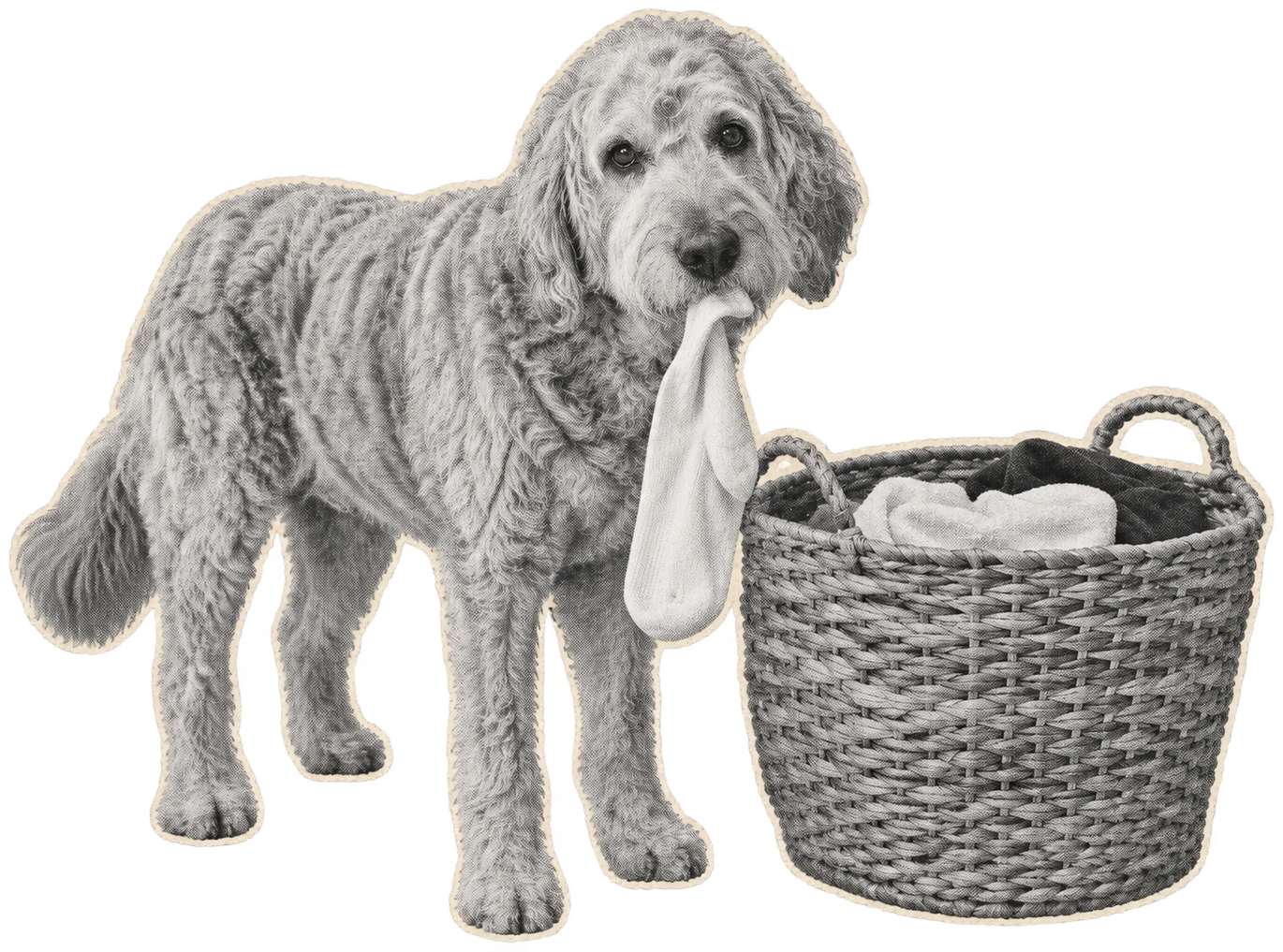
Golden Retrievers are retrievers; Poodles were also bred as water retrievers, according to the Royal Kennel Club. A Goldendoodle doesn’t have to swim to do justice to the family. If yours would rather stay dry and pull a toy out of the washing pile, you’ve still got a game. The modern cross was already represented in UK puppy-buying research covering 2019–20. That tells us people were choosing the dogs then, not who first made the cross or why yours carries half the laundry about. 363741
Goldendoodle notes / 12
Two ancestors with jobs
| Historical fact | What it means now |
|---|---|
| Golden Retriever and Poodle origins | Different lines of dogs bred to retrieve. Neither guarantees a love of water, carrying or strangers in the cross. |
| UK 2019–20 buying survey | Goldendoodles were 50 of 1,575 designer-cross puppies in that survey, about 3.2% of that sample. Not 3.2% of UK dogs. |
| Foundation date and creator | Not pinned to a reliable contemporary source here. This isn’t needed to judge the adult in front of you. |
Bringing one home: ask to see what the coat does
If you’re adopting, ask the rescue how the dog copes with brushing and how they react when somebody leaves. Ask them to show you how much hair the comb actually has to go through. If you’re buying a pup, see it with its mother where it was raised, ask who the Poodle-side adults are, and get the named health results. Get the actual answer to “Will it be all right with our cat?” If it’s “we don’t know”, work with that rather than pretending they said yes. 424344
Goldendoodle notes / 13
What to ask before you decide
| When | Specific next check |
|---|---|
| Before deciding | Verify ancestry and screening as far as possible. Ask what size, grooming and behaviour have actually been observed, especially in an adult dog. |
| At home | Register with a vet, update microchip keeper details and let the dog find their feet before meeting everybody. |
| Once settled | Get a coat-care demonstration for this texture, check the fit of the harness and practise one calm departure. |
Sources
- G1Dogs Trust on the crossReference · checked 20 November 2026
- G2PDSA on groomingReference · checked 20 November 2026
- G3Dogs Trust puppy trainingReference · checked 20 November 2026
- G4Golden Retriever Club of America on Goldendoodle variationReference · checked 20 November 2026
- G5Goldendoodle association’s generation terminologyReference · checked 20 November 2026
- G6Royal Kennel Club crossbreeding guidanceReference · checked 20 November 2026
- G7Registration routesReference · checked 20 November 2026
- G8RKC crossbreed variationReference · checked 20 November 2026
- G9Dogs Trust harness fitting and trainingReference · checked 20 November 2026
- G10PDSA on body-condition monitoringReference · checked 20 November 2026
- G11Dogs Trust on safe transportReference · checked 20 November 2026
- G12Basic canine coat-variation researchReference · checked 20 November 2026
- G13Original allergen researchReference · checked 20 November 2026
- G14Original RVC behaviour study and cross criteriaReference · checked 20 November 2026
- G15Dogs Trust recallReference · checked 20 November 2026
- G16PDSA exercise guidanceReference · checked 20 November 2026
- G17Dogs Trust enrichmentReference · checked 20 November 2026
- G18PDSA puppy exerciseReference · checked 20 November 2026
- G19PDSA on ticksReference · checked 20 November 2026
- G20Dogs Trust settling inReference · checked 20 November 2026
- G21Dogs Trust time aloneReference · checked 20 November 2026
- G22Dogs Trust separation signsReference · checked 20 November 2026
- G23Dogs Trust on dogs and childrenReference · checked 20 November 2026
- G24Dogs Trust dog and cat introductionsReference · checked 20 November 2026
- G25BVA hip schemeReference · checked 20 November 2026
- G26PDSA home health checksReference · checked 20 November 2026
- G27Original paper, Fig. 3 and Table 1Reference · checked 20 November 2026
- G28BVA canine hip statistics 2025, p. 4Reference · checked 20 November 2026
- G29RVC study populationReference · checked 20 November 2026
- G30Dogs Trust UK survival tableReference · checked 20 November 2026
- G31PDSA hip dysplasiaReference · checked 20 November 2026
- G32PDSA ear infectionsReference · checked 20 November 2026
- G33PDSA itchy skinReference · checked 20 November 2026
- G34PDSA eye signsReference · checked 20 November 2026
- G35PDSA emergency signsReference · checked 20 November 2026
- G36Golden Retriever testsReference · checked 20 November 2026
- G37Standard Poodle testsReference · checked 20 November 2026
- G38Miniature Poodle testsReference · checked 20 November 2026
- G39RKC Health StandardReference · checked 20 November 2026
- G40PDSA UK minimum costsReference · checked 20 November 2026
- G41UK puppy-buying studyReference · checked 20 November 2026
- G42Defra buyer guidanceReference · checked 20 November 2026
- G43Dogs Trust rehoming policyReference · checked 20 November 2026
- G44GOV.UK microchippingReference · checked 20 November 2026
Five original generated editorial photo-first newspaper cutouts. The generated photographs and their print treatments do not document clinical examples.
