
Breed guide / English Cocker Spaniel
Living with an English Cocker Spaniel
An affectionate, busy little gundog who wants to be involved. Living with a Cocker means making time for their nose, their coat and the training that helps them settle at home.
Jump to a section
A little gundog with a lot going on
An English Cocker Spaniel is a small British gundog bred to find and flush game. You’ll see it on walks when they pick up a scent, and at home when they’ve got something in their mouth and want to show you. They can be affectionate, lively companions, but their size makes it easy to underestimate the time they need. Along with walks and company, you’ll be doing regular grooming and teaching them how to settle when there’s nothing going on. 3
Working and show lines tend to be bred with different things in mind, so ask what the parents are actually like at home. Ask how they behave after excitement, what they are like around the house and how much activity they are used to. A first-time owner who enjoys learning can do well with a suitable Cocker; someone who needs a dog to spend most of the day alone will have more to arrange. 34
If you already have one, you’ll know how long a short walk can take when a hedge needs investigating. Allow some time for sniffing where it’s safe, then practise moving on with you. At home, start with whichever part of the routine is difficult at the moment, whether that’s putting the lead on or drying their ears.
English Cocker Spaniel notes / 01
The deal you’re making
Walks, company, grooming and time to learn.
| Good fit | You enjoy regular walks, short training games, grooming and a dog who wants to be involved. |
|---|---|
| Think again if | Your dependable plan is an empty house all day, a quick lap of the block and occasional weekend heroics. |
| Ask about the actual dog | Working, show or mixed lines; health records; settling; handling; time alone; and behaviour around children or other animals. |
| First useful change | Put a towel, rewards and the walking kit beside the same door. Make the return home a routine rather than an ambush. |
Which Cocker are we talking about?
In Britain, “Cocker Spaniel” usually means the English Cocker covered here. The American Cocker is a different breed. A Cockapoo is a cross, so this guide is not a prediction of everything a Cocker–Poodle cross will inherit.
Working breeders concentrate on what the dog can do in the field, while show breeders aim for the breed standard. You’ll often see differences in the coat, ears and build, so it’s worth finding out which lines your dog comes from. 3
Ask the breeder or rescue how the dog’s background is likely to affect the care you can offer. A show-line puppy can still be an energetic handful. A working-line adult may have lovely house manners that somebody spent time teaching.
English Cocker Spaniel notes / 02
Know which dog you mean
English, American, working and show are worth sorting out.
| Registered name | Spaniel (Cocker) in the Royal Kennel Club; English Cocker Spaniel internationally. 1314 |
|---|---|
| Origin | Great Britain. 14 |
| Original work | Gundog used to hunt woodcock. 13 |
| UK group | Gundog. 13 |
| Size category | RKC: small; PDSA: medium. These are different guides, not contradictory measurements. 132 |
| Breed Watch | Category 1: no additional breed-specific judging points currently flagged. Not a certificate of health. 13 |
| Vulnerable native status | No, in the RKC profile. 13 |
| Legal position | Not named in the GOV.UK banned-type list. Legal type depends on characteristics, not simply a label; ordinary dog-control duties still apply. 15 |
How big is an English Cocker?
A Cocker fits comfortably into many smaller homes, although you still need room for a bed where they can rest undisturbed. When buying travel equipment, measure your own dog rather than relying on a box labelled for medium breeds.
The Royal Kennel Club standard gives approximate adult heights of 39–41 cm for males and 38–39 cm for females, with a weight of about 13–14.5 kg. Those are breed-standard descriptions, not a target weight for every living Cocker. Your dog’s frame, muscle and body condition matter more than landing on a number. 1
Fit a harness to the individual in front of you, checking that it does not rub behind the forelegs or restrict comfortable movement. Recheck growing puppies rather than waiting until the straps look obviously tight. For the car, measure the space your dog needs to lie, turn and sit comfortably in the restraint system you choose.
If your dog has drifted heavier, take that information to your vet rather than deciding they must be big-boned under all the feathering.
English Cocker Spaniel notes / 03
Size without the guesswork
Breed standards and actual adult weights tell you different things.
| Adult male standard | Approx. 39–41 cm at the withers. 1 |
|---|---|
| Adult female standard | Approx. 38–39 cm at the withers. 1 |
| Standard weight | Approx. 13–14.5 kg; an ideal-standard description, not a universal healthy-weight prescription. 1 |
| Body condition | Ask your veterinary team to demonstrate a body-condition check and agree an individual target if needed. |
| Kit fit | Measure neck, chest and back; allow normal movement and check for rubbing after walks. |
| Build and head | Compact, sturdy body and square muzzle in the UK standard. 1 |
| Ears and tail | Low-set feathered ears; natural tail slightly curved and proportionate. 1 |
| Observed adult weights | UK 2016 records: overall median 15.05 kg, males 16.14 kg, females 13.80 kg. Recorded population measurements, not ideal-weight recommendations. 5 |
Looking after the coat and ears
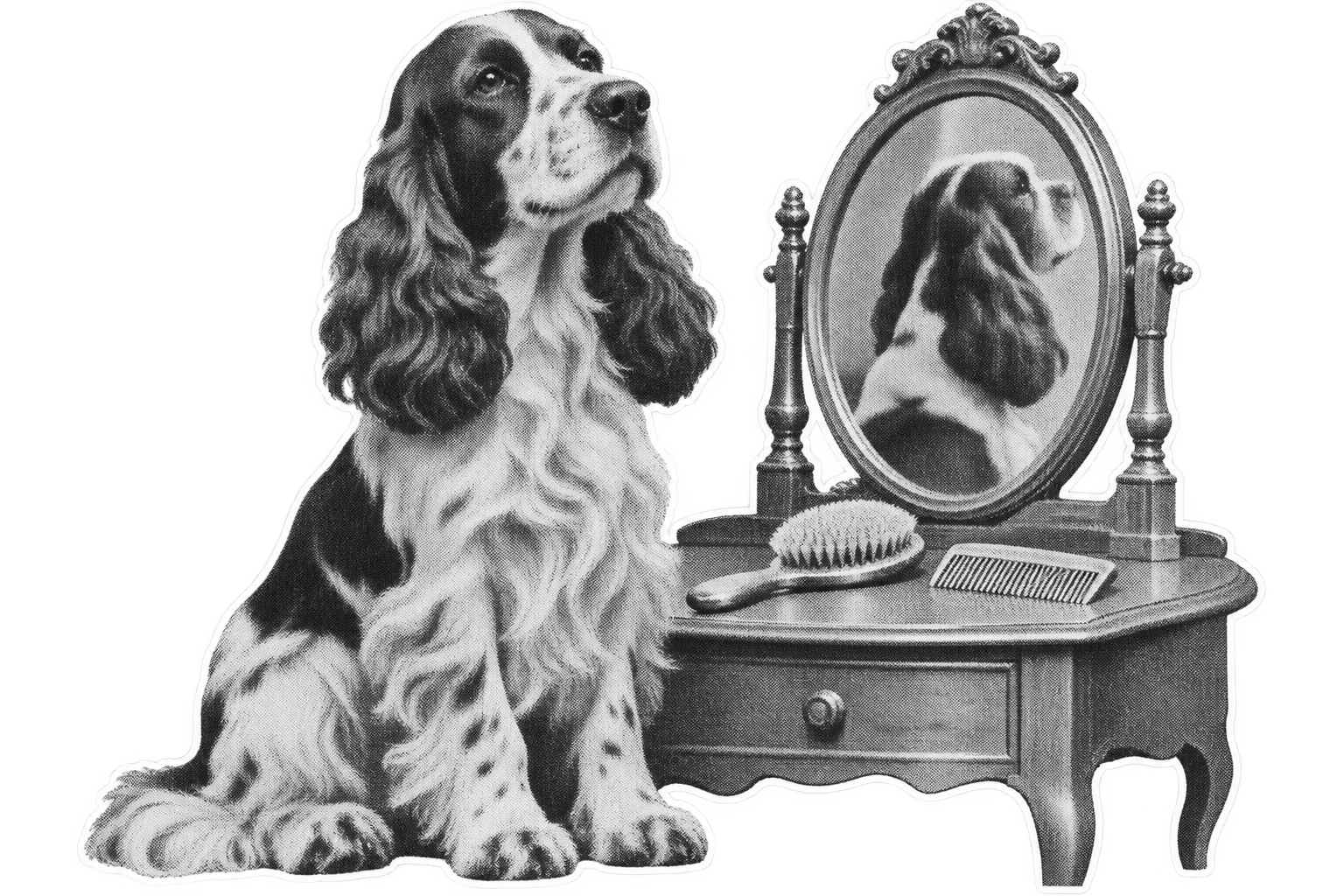
A Cocker’s feathering can bring half a footpath home. A smooth-looking back can hide tangles underneath. Get used to checking the places you don’t see in a flattering photo: behind the ears, armpits, legs and under the tail.
If combing a knot is pulling at the skin, stop and get help. Do a little at a time, and ask a groomer to deal with established mats, especially near sensitive skin.
Show and working coats can demand different amounts of work. Discuss the actual coat with a competent groomer rather than choosing a schedule from somebody else’s dog. If you want a longer look, ask what you will need to do between appointments. If you want a practical trim, ask how they will keep the dog comfortable and what it will change. 34
Have a look at the ears, but don’t start poking inside them. Smell, discharge, scratching or head shaking are reasons to speak to your vet, not instructions to dig about with a cotton bud. 10
There’s something quite impressive about a dog who can come back from a walk wearing most of it. You brush the lovely silky ears, admire your work, and then find the bit of hedge tucked underneath. Keep the towel by the door; walking through the house looking for one gives them time to dry themselves on your furniture.
English Cocker Spaniel notes / 04
The grooming reality
Check the feathering as well as the parts you can see easily.
| Texture | The standard calls for a silky, flat coat, not a curly one. 1 |
|---|---|
| Furnishings | Feathering on legs and body; working lines often carry less coat. 14 |
| Colours | Solid, parti-colour and roan combinations are recognised. Examples include black, golden, liver, black-and-white and blue roan; see the full standard rather than judging from an advert. 1 |
| Shedding | Yes; no reliable breed-wide quantity established. 13 |
| Routine grooming | The RKC recommends daily grooming. Adjust tools and sessions to the dog’s actual coat. 13 |
| Professional help | Ask a groomer about the actual coat, matting and your intended trim; no universal appointment interval verified. |
| Ears | Pain, smell, discharge or repeated shaking need a vet. Avoid cotton buds inside the ear. 10 |
| Allergies | No hypoallergenic guarantee; meet dogs and seek medical advice if household allergy is a concern. |
| Colour is not clearance | A fashionable colour does not replace health or temperament checks. The profile’s Colour Watch category concerns registration patterns, not an individual health diagnosis. 13 |
Affectionate, lively and sometimes a bit much
The standard paints a cheerful, affectionate, lively dog, and plenty of owners will recognise that description. It does not mean your own dog wants a stranger to scoop them up, a child to climb into their bed or somebody to take a chew out of their mouth. 1
Give a sociable dog the same choices you would give a shy one. Let them approach, pause during fuss and notice whether they come back for more. A Cocker who follows you everywhere may be enjoying your company; one who cannot settle when you leave needs help with that situation rather than a joke about being clingy.
If your dog starts guarding something, chasing them round the kitchen can turn a manageable moment into a much bigger one. Dogs Trust advises avoiding confrontation and getting appropriate support. Arrange a veterinary check for a new behaviour change, especially if the dog seems uncomfortable when touched. 8
You may find alarming breed headlines online. Recorded behaviour in veterinary records is not a prophecy about your puppy. Ask for help with the behaviour you are seeing, particularly if anyone could get hurt.
English Cocker Spaniel notes / 05
Read the dog, not the reputation
Pay attention when your dog wants some space.
| Social does not mean available | Let the dog move away from greetings and give visitors a simple rule: invite, don’t crowd. |
|---|---|
| Settling matters | Notice calm behaviour as well as the entertaining tricks. Have a comfortable place where nobody bothers them. |
| Guarding | Avoid grabbing, chasing or punishment. Separate safely and seek veterinary and qualified behaviour support. 8 |
| Sudden change | Arrange a veterinary assessment rather than assuming a temperament problem. |
| Research boundary | A record of aggression is not a diagnosis of “rage syndrome” or proof that coat colour determines character. 5 |
Training around the things they want to do
If you chase your Cocker when they pick up a sock, they may come back for another game the next time the laundry is out. Put tempting laundry away and teach a calm exchange before you need it in a crisis.
Start with skills that make ordinary life less fiddly: responding to their name, coming towards you, walking with a loose lead, dropping an object, standing for handling and resting on a mat. Keep sessions brief and stop while the dog is still interested.
Practise a recall where the dog can succeed, then add difficulty gradually. Expect to need more practice when there are game birds or other distractions nearby. Use a safely managed long line or enclosed space while you build reliability, and keep away from livestock and wildlife situations you cannot control. 16
For a dog bred to use its nose and work with a person, searching for a safe toy can make more sense than repeatedly telling them not to sniff. You could try reward-based gundog classes or simple scent games at home. Choose a trainer who explains their methods and makes room for the dog to learn without fear. 3
The sock problem gets awkward when you’re trying not to laugh. Your Cocker has something you want, you’re following them, and from their end it looks as though you’ve finally joined in. Shut the laundry basket before they get another chance to rehearse it. You can teach the swap with something you’re less emotionally attached to than the last clean pair.
English Cocker Spaniel notes / 06
Skills you’ll use every day
Practise where your dog can still pay attention to you.

| Recall | Practise in easy places; reward generously; avoid calling only when the fun is about to end. |
|---|---|
| Drop / exchange | Teach with safe, low-value items and a reward. Do not turn valuable objects into a grabbing contest. 8 |
| Lead walking | Reward the position you want before the lead tightens. Change the environment if it is currently too difficult. |
| Handling | Practise collar, ears, feet and brief stillness as separate skills. |
| Stop and seek help | Guarding, fear, bites or escalating conflict need professional support rather than harder corrections. |
Exercise that gives them time to sniff
You don’t have to keep marching along for the whole walk. Choose somewhere safe to let your Cocker sniff and explore without being hurried.
PDSA gives at least an hour’s daily exercise as an adult breed guide, spread through the day, alongside play and mental activity. That is a starting conversation, not a stopwatch requirement for a puppy, a dog recovering from illness or an older dog with painful joints. Ask your vet about the individual dog when health or development affects what is appropriate. 2
A practical day might contain a quieter sniffing walk, some training within another outing, a short search game and a proper opportunity to rest. Adapt the day to what your dog can comfortably do and recover from.
Repeated ball throwing is easy to organise, but don’t make exhaustion your only settling strategy. You still need to teach the quiet bit. And if the weather is dreadful, shorten or adapt the outing for the dog in front of you, then do something useful indoors.
A sniffing walk can involve a surprisingly long relationship with one patch of grass. You’ve looked at the view, answered a message and started wondering whether there’s planning permission involved; the dog is still busy. Build a little of that into the outing where you can. If you’re late, take the less interesting route rather than getting cross that your spaniel has noticed spaniel things.
English Cocker Spaniel notes / 07
Planning daily activity
Include quieter activity and time to rest.
| Adult guide | PDSA: at least 1 hour daily, divided through the day, with additional play and mental engagement. Individual needs vary. 2 |
|---|---|
| Useful variety | Sniffing, safe searching, controlled retrieving, training and relaxed exploration. |
| Puppies / older dogs | Use age- and health-appropriate activity; get individual veterinary guidance rather than applying adult targets. |
| Wildlife and livestock | Use a lead and choose routes where you can keep everyone safe. |
| Afterwards | Allow sleep and quiet. Persistent restlessness is a reason to examine the routine, not automatically add another run. |
| Registry category | RKC says up to 1 hour/day, while PDSA says at least 1 hour. These broad guides are not identical; use individual health, comfort and behaviour to plan care. 132 |
Fitting a Cocker into life at home
Have a backup for times when you cannot get home or your usual dog care falls through. It helps if that person already knows the dog and their routine.
Start with short absences your dog can cope with, and build from there. A camera can help you see whether they actually settle rather than simply going quiet when the key turns. If they panic, bark continuously, pace or damage exits, get advice instead of leaving them longer to see if they give up.
Put the bed away from people walking through and use a gate if you need to separate part of the room. Keep food and dangerous objects out of reach, and leave a towel where you come in from walks. A secure garden helps, but it does not replace walks or company.
If you rent, check the actual agreement and how you will manage noise, shared access and muddy entrances.
If yours likes to follow you about, you may discover that going upstairs now counts as a group activity. They can be sound asleep until you move, then suddenly there’s a spaniel behind you wondering what we’re all doing next. Enjoy the company, but give them chances to stay comfortably where they are too. You should be able to fetch a jumper without organising an expedition.
English Cocker Spaniel notes / 08
Company, rest and time alone
Arrange cover for the days you cannot be there.
| Alone-time plan | Build from calm, short absences; arrange help for times beyond what your dog can manage. |
|---|---|
| Backup cover | Name the person or service who can help if your normal routine fails. |
| Quiet space | An undisturbed bed, particularly important when visitors or children are around. |
| Practical house kit | Towels, washable bedding, safe storage and gates where useful. |
| When to get help | Distress during absences is a welfare issue, not naughtiness to punish. |
| Home / garden guide | RKC lists small house, small/medium garden and either town or country. The care routine still matters. 13 |
| Heat and cold | No validated breed-specific safe temperature established here. Adapt exposure to weather and the individual dog. |
Children and other animals
A family dog is still a dog with teeth, feelings and a need for sleep. Children need an adult to manage the interaction, not a reminder to “be gentle” shouted from the next room. When you cannot actively supervise, use a safe separation arrangement that the dog is comfortable with.
Teach children to leave the dog alone while eating, sleeping or enjoying a chew, and let the dog choose whether to join in. A child cannot be responsible for noticing every subtle sign of discomfort. Keep watching even if previous interactions have gone well.
If you have another dog, ask how the Cocker has got on with dogs before and get help planning the introduction if you need it. With cats, keep exits and dog-free space available and do not assume a wag means the chase is friendly. Small pets need secure physical separation; a spaniel’s interest in moving animals is not something to settle with a hopeful introduction.
If you are adopting, tell the rescue exactly who lives at home and who visits regularly. An honest match may mean waiting for a different dog.
English Cocker Spaniel notes / 09
Managing life together
Ask about the individual dog’s experience before bringing them home.
| Children | Active adult supervision, or safe separation. Never rely on breed reputation. |
|---|---|
| Meals and rest | No disturbing the dog’s food, bed or chews. |
| Other dogs | Assess the individual, use managed introductions and protect access to rest and resources. |
| Cats and small pets | Ask for known history; provide secure separation and escape options. Never assume compatibility. |
| If conflict appears | Separate safely and get professional help; do not ask the animals to sort it out. |
The ears are obvious. Don’t forget the teeth.
The most useful health habit is noticing changes early. A head shake, a sore mouth, an eye held partly shut or a dog who no longer wants their usual walk tells you more about today’s care than a reassuring breed description.
UK VetCompass research is useful here, but its numbers need their labels. The descriptive study used a population of 10,313 English Cockers in a 2016 veterinary database, then manually reviewed 2,318 dogs for disorders. The percentages below concern recorded disorders in that year, not the chance your puppy will develop each problem over a lifetime. Some problems never reach a vet or never make it into a record. 5
A separate comparative analysis sampled 2,510 English Cockers and 7,813 other dogs. It found substantially higher adjusted odds for some conditions, including dry eye. An odds ratio is neither a percentage of affected dogs nor a personal forecast. The studies use the same care year; they are not proof of a trend between publication dates. 6
Before buying a puppy, also ask about screening. Parent tests help inform breeding decisions for particular inherited problems, but they cannot certify that a puppy will never be ill. Ask for named results for the actual parents and discuss anything unclear with your vet. You’ll find the current Royal Kennel Club screening recommendations below. 7
English Cocker Spaniel notes / 10
Health findings and screening
Know the common problems and what the numbers actually say.
| Recorded periodontal disease | 20.97% of 2,318 reviewed English Cockers in 2016. Annual recorded prevalence, not lifetime risk. 5 |
|---|---|
| Recorded otitis externa | 10.09% in the same reviewed sample and year. 5 |
| Recorded obesity | 9.88% in the same reviewed sample and year. 5 |
| Longevity estimate | Median age at death 11.44 years; IQR 9.46–13.47. Not a mean, a puppy forecast or a remaining-life calculation. 5 |
| Comparative dry-eye finding | Adjusted odds ratio 7.64 versus non-English-Cockers (95% CI 4.33–14.14); not 7.64% affected. 6 |
| Good Practice screening | DNA tests prcd-PRA and AMS. 7 |
| Best Practice screening | Includes Good Practice, plus AON, FN, BVA/RKC/ISDS clinical eye screening, gonioscopy and hip screening. 7 |
Conditions worth understanding
Periodontal disease
Disease of the tissues supporting the teeth can cause pain and tooth loss. Bad breath, bleeding gums or changed chewing deserve a veterinary assessment; continuing to eat does not establish that the mouth is comfortable. Ask your veterinary team about toothbrushing and a suitable preventive routine. A dental chew does not replace an examination or treatment of existing disease. 17
Otitis externa
Inflammation of the outer ear canal may cause scratching, shaking, smell, discharge or pain. Cockers’ ears deserve regular observation, but symptoms have several possible causes and need diagnosis. Contact your vet if you suspect infection. Do not use another dog’s drops or repeatedly treat a recurring problem without investigating the cause. 10
Dry eye (keratoconjunctivitis sicca)
Insufficient tear production can leave the eye inflamed and painful, sometimes with thick discharge. Diagnosis requires a veterinary examination and tear testing; treatment is often long-term. Contact your vet promptly about a red, painful or partly closed eye rather than assuming it is a harmless bit of sleep. 9
Obesity
Obesity was commonly recorded in the descriptive sample, but the percentage cannot tell you your own dog’s healthy weight. Ask for a body-condition assessment and an individual feeding plan if weight is creeping up. Include treats and training rewards when describing intake. Do not crash-diet a growing, ill or older dog based on a breed-standard number. 52
Anal sac problems
Scooting, persistent licking around the bottom or discomfort may indicate anal sac trouble, but these signs are not a diagnosis. A vet can check for blockage, infection and other causes. Repeated problems warrant a plan for the underlying issue rather than routine squeezing at home. 18
Hip dysplasia and joint pain
Abnormal hip development can lead to pain and arthritis. Limping, stiffness or reluctance to move should be assessed rather than labelled laziness. Hip screening informs breeding decisions; it is not a prediction that a particular puppy will remain pain-free. No robust Cocker-specific UK prevalence figure is used here. 197
Progressive retinal atrophy (prcd-PRA)
An inherited retinal disease can progressively impair vision. The breed club describes night-vision difficulty progressing to blindness, with variable onset. The DNA test addresses a particular inherited variant; it is not a substitute for a clinical eye examination or a test for every cause of blindness. No current UK breed-wide prevalence is established here. 2120
FN, AON and AMS
Familial nephropathy (FN), adult-onset neuropathy (AON) and acral mutilation syndrome (AMS) are named inherited conditions with DNA testing listed for Cockers. The relevant result concerns a specific variant, not a clean bill of health for the entire dog. Current UK breed-wide disease frequencies are not established here. Ask your vet to interpret symptoms or test results, not an advert’s “all clear” claim. 207
Lifespan: what was actually measured
The 11.44-year median above came from 116 recorded deaths; 108 had a known cause, a different denominator. The interquartile range describes the middle half of the recorded ages at death. It is not a guaranteed normal range, and a living older dog’s remaining life cannot be obtained by subtracting their age from it. 5
Screening and breeding decisions
The tiers above are recommendations in the checked Health Standard. DNA results, clinical eye examinations, gonioscopy and hip assessment answer different questions. Match results to the registered parents and check dates and any retesting advice. The current breed profile lists no additional breed-specific registration restriction, but general registration rules and responsible breeding duties still apply. 713
When to contact a vet
Painful eyes, a new limp, ear pain, persistent digestive signs, unusual thirst or a sudden behaviour change need veterinary advice. Severe breathing difficulty, collapse or rapidly worsening illness is an emergency. This is general information, not a diagnosis or a treatment plan for your dog.
What you’ll need to budget for
After buying or adopting your dog, you’ll need to pay for food, routine care and any grooming or dog care you cannot do yourself. A dog who needs regular professional coat care and somebody to visit during the day can cost rather more than the food bill suggests.
PDSA quotes a minimum of £80 a month for a Cocker on its breed page. Treat that as a published basic estimate, not a quote for your household or a promise about 2026 local prices. Ask your own vet, groomer, insurer and care provider what the services you need actually cost. 2
When comparing insurance, read the excess, any percentage contribution, annual or condition limits, exclusions and what happens to an ongoing condition at renewal. Check whether you might have to pay the vet before the insurer reimburses you, and plan how you would cover that bill.
A cheap advert is not a saving if the seller cannot show you where the puppy has been raised or answer sensible questions. And “we’ll do all the grooming ourselves” only belongs in the budget if you are realistically willing and able to learn it.
English Cocker Spaniel notes / 11
Regular costs and the less predictable ones
Price the care you need locally before committing.

| Published starting estimate | PDSA: minimum £80/month. It is not a personalised or all-inclusive quotation. 2 |
|---|---|
| Routine costs | Food, preventive veterinary care, insurance or emergency planning, grooming and replacement kit. |
| Time-away costs | Walker, sitter, boarding or other dependable cover; get local quotes before committing. |
| One-off costs | Safe travel equipment, beds, gates if needed, training and initial health appointments. |
| Insurance questions | Limits, exclusions, excess, co-payment, pre-existing conditions and continuing cover for chronic illness. |
| Puppy / adoption price | No verified current breed-wide UK figure. Obtain an actual quote and check what is included. |
| Setup and lifetime total | No Cocker-specific contemporary total verified. Do not multiply a minimum monthly estimate into a guaranteed lifetime budget. |
| Insurance price | No dependable breed-wide premium. Age, history, cover and location affect your quote. |
Before the sofa, there was the undergrowth
Cockers worked through cover to find and flush game for a handler, and their name comes from hunting woodcock. That helps explain why your pet Cocker can be so absorbed in a smell, even when you thought you were just popping out for a walk. 13
The Cocker Spaniel Club was founded in 1902. Its history records the growth of shows and the organisation supporting the breed, while today’s club still has working and show interests as well as health and rescue responsibilities. Those different priorities help explain why two dogs described as Cockers can arrive with rather different coats and expectations. 11
Searching for a toy or learning to retrieve can give a pet Cocker something they enjoy doing with you. Keep them under control around wildlife and livestock while you work on their training.
English Cocker Spaniel notes / 12
Why the nose gets a vote
Their working background is still relevant at home.
| Original work | A working gundog background, including searching cover and flushing game. 3 |
|---|---|
| Name connection | Associated with woodcock. 13 |
| UK parent club | The Cocker Spaniel Club founded in 1902. 11 |
| Modern distinction | Working and show breeding priorities differ, with variation within and between lines. 3 |
| Useful takeaway | Give the nose and brain appropriate work; do not expect a small dog to have small interests. |
Ask the awkward questions before you fall in love
Before you go looking, write down the life you can genuinely offer. Include the workday, the travel, the grooming and the person who will take over if you are ill. Be honest about how much of your routine you can change.
For a puppy, see the actual environment and ask to meet the mother with the litter. Ask why the pairing was made, what the parents are like to live with and what experience the puppies have had. Get the registered names and relevant health results, then check them rather than accepting “health tested” as a complete answer. The current screening tiers are in the health panel. 7
For an adult rescue, ask what is known and what remains unknown: time alone, handling, guarding, other animals, children, veterinary treatment and support after adoption. The Cocker Spaniel Club has a rescue scheme; a breed-specific route can be useful alongside established general rescues. 12
Keep the first days quiet enough for the dog to get used to the house and the people living there. Agree the routine before they arrive, including where they will sleep and who will take them out.
English Cocker Spaniel notes / 13
Questions for breeders and rescues
Check the records and ask how the dog behaves at home.
| Before paying | Verify seller or rescue identity, the dog’s identity and the actual arrangements. Do not let urgency replace checks. |
|---|---|
| Parent evidence | Ask for results matched to the named parents, dates and explanation of any breeding implications. 7 |
| Daily-life questions | Settling, handling, time alone, exercise, grooming, household animals and known behaviour history. |
| Written handover | Diet, medical and vaccination records, microchip details, contract and ongoing support. |
| First-week plan | Quiet routine, safe travel, secure exits and a veterinary registration/health check appropriate to the dog. |
Sources
- E1Royal Kennel Club: Cocker Spaniel breed standardUK breed standard · checked 20 November 2026
- E2PDSA: caring for a Cocker SpanielUK veterinary charity · checked 20 November 2026
- E3The Cocker Spaniel Club: frequently asked questionsUK parent breed club · checked 20 November 2026
- E4Battersea: working and show CockersUK animal welfare charity · checked 20 November 2026
- E5VetCompass: demography and disorders of English Cocker Spaniels (2023)Primary UK veterinary-record research; 2016 data · checked 20 November 2026
- E6VetCompass: English Cocker Spaniel disorder predispositions and protections (2024)Primary UK comparative research; 2016 data · checked 20 November 2026
- E7Royal Kennel Club Health Standard: Spaniel (Cocker)Current UK screening recommendations · checked 20 November 2026
- E8Dogs Trust: resource guarding food and toysUK behaviour guidance · checked 20 November 2026
- E9PDSA: dry eye in dogsUK clinical guidance · checked 20 November 2026
- E10PDSA: ear infections in dogsUK clinical guidance · checked 20 November 2026
- E11The Cocker Spaniel Club: club historyPrimary breed-club history · checked 20 November 2026
- E12The Cocker Spaniel Club: rescue informationUK breed rescue · checked 20 November 2026
- E13Royal Kennel Club: Cocker breed profileUK primary guidance · checked 20 November 2026
- E14FCI: English Cocker SpanielInternational registry · checked 20 November 2026
- E15GOV.UK: banned dog typesUK government · checked 20 November 2026
- E16Dogs Trust: recall trainingUK primary guidance · checked 20 November 2026
- E17PDSA: dental diseaseUK primary guidance · checked 20 November 2026
- E18PDSA: blocked anal glandsUK primary guidance · checked 20 November 2026
- E19PDSA: hip dysplasiaUK primary guidance · checked 20 November 2026
- E20Royal Kennel Club: DNA testingUK primary guidance · checked 20 November 2026
- E21The Cocker Spaniel Club: health and welfareUK primary guidance · checked 20 November 2026
Five AI-generated editorial illustrations, not documentary photographs. Props are comic inventions; the dogs are depicted as English Cocker Spaniels.
