
Breed guide / Cavachon
Living with a Cavachon
What it’s like to live with a Cavalier King Charles Spaniel and Bichon Frise cross, from the comb behind the ears to which health paperwork actually matters.
Jump to a section
The short version
A Cavachon is a small companion dog with a Cavalier King Charles Spaniel on one side and a Bichon Frise on the other. There’s a reason people go looking for that combination: they want a dog that can come along for the walk, come home for the sofa and fit into a normal-sized life. What you don’t get is an order form for which bits of each parent turn up. The ears might look like one parent, the coat might behave like the other, and the dog might still look at a wet field and think you’ve finally put together a decent afternoon. 1
The best bit of living with a Cavachon can be how easily a small companion fits around you. The bit people miss is how much of that good company you help build. You still have to teach them what to do when you take a phone call, go out without them or put a comb through an ear that’s been dragged through a hedge. It’s a pet dog, not something you buy to complete the sofa.
If yours already lives with you, the best things you can learn this week are what their normal walk looks like, whether the coat is clear all the way to the skin and what they really do in the first few minutes after you leave. None of those answers comes from the name on the vet record.
Cavachon notes / 01
The jobs that come with the company
A comb, a walk and a spell on their own are all part of it.
| Quick question | What’s useful |
|---|---|
| What is it? | A Cavalier King Charles Spaniel and Bichon Frise cross. 1 |
| Does the name predict the grown dog? | No fixed coat, size, daily walk length or temperament comes with the label. |
| Big recurring jobs | Keep up with coat care, provide actual walks, practise relaxed time apart and keep routine veterinary checks. |
| Health paperwork that matters | Ask what each parent was tested for, by which scheme, and when. 45678 |
Cavachon, not Cavapoo
The Bichon Frise is the second parent here. A Cavapoo has a Poodle parent instead. That matters when you’re looking up what screenings to ask for, not just when the receptionist wants to know what to put on the form. A Cavalier King Charles Spaniel is also not the same breed as a King Charles Spaniel. You want the health page for the long name, not the one the search box has helpfully decided you meant. 1234
If you’re told a puppy is F1, ask if that means a direct mating between two documented purebred parents, then look at who those dogs are. If a seller uses the Cavachon label for a later generation or a backcross, get the actual family tree. None of that is a recipe for a pet that’s exactly half one parent in appearance or behaviour. If yours is a rescue and the mix is an educated guess, there’s nothing to fix: keep what you know in the record and let the vet assess the dog in front of them.
Cavachon notes / 02
Cavachon isn’t Cavapoo
The name says something about ancestry, not how the dog will turn out.
| Label | What it tells you |
|---|---|
| Cavachon | The named Cavalier King Charles Spaniel × Bichon Frise cross. Ask about actual ancestry. 1 |
| Cavapoo | A different cross with Poodle ancestry. 1 |
| F1 | Common shorthand for a direct first-generation cross; ask to see actual parents and records. |
| “KC parents” | At most a claim about the parents; not evidence of health screening or of a Cavachon breed standard. 234 |
| Parents named, not shown | Ask what supports the names; the coat cannot prove ancestry. 130 |
| Cavalier King Charles Spaniel | One parent breed in a Cavachon pairing, with its own breed standard and health scheme. 245 |
| Bichon Frise | The other parent breed, with its own standard and eye-screening entry. 34 |
How big?
Think small companion rather than guaranteed handbag measurements. For context, the Royal Kennel Club’s Cavalier standard specifies an ideal weight of 5.4–8.2 kg and the Bichon standard calls for 23–28 cm at the withers. One’s a weight, one’s a height, and neither is a Cavachon target. Don’t buy the grown-up harness off the puppy photo. 23
If your dog has a lot of coat, weigh them and ask the vet or nurse to show you where to feel for the ribs and waist. The difference between bath day and blow-dry day can look like half a dog, without the dog weighing anything different. Use the numbers to follow your own dog over time, not to get them to hit someone else’s internet range. 9
Cavachon notes / 03
Measure this dog, not both parents
Check the actual chest under the coat.
| What to measure | How to use it |
|---|---|
| Parent background only | Cavalier standard 5.4–8.2 kg; Bichon ideal height 23–28 cm. Different measures, not a prediction. 23 |
| Harness | Measure chest and neck, use the actual maker’s size chart and recheck fit as coat or body changes. |
| Body condition | Ask your practice to show you how to feel the ribs and assess the waist; look past the fluff. 9 |
| No Cavachon target size | Use the actual adult’s measurements. The two parent standards use different measures and are not a crossbreed growth chart. 239 |
The coat you have, not the one in the advert
A Cavalier standard describes a silky coat with feathering; the Bichon standard describes loose corkscrew curls. Your dog can have waves, curls, longer ear fringes or a mix. How much hair ends up on your jumper tells you surprisingly little about what’s going on under the front legs. Brushing the easy bit down the back and declaring victory is how you end up paying someone else to sort out the armpits. 2310
Get a groomer to show you what an unknotted coat feels like at the roots. Check little sections around the ear bases, under the legs, along the edge of the harness and around the back legs. Teach the routine in little goes while the dog still wants to be there. If you find a tight mat close to the skin, don’t get at it with the kitchen scissors. Get a groomer or, if it’s sore, your vet to help. If a person in the house has an allergy, don’t buy on the strength of the word hypoallergenic. A cross label can’t tell you whether that person will react. 31
Cavachon notes / 04
The comb needs to get through
Start at the ear bases, not the presentable fringe.
| Bit of the dog | What tends to get missed |
|---|---|
| Ear bases | Check the coat against the skin rather than just straightening the fringe. |
| Armpits and harness edges | Friction spots; feel for tangles before the dog starts objecting to the brush. |
| Tight mat | Get proper help rather than tugging or cutting next to skin. 10 |
| Grooming budget | Ask about the coat of this dog, not a price per breed name. |
| Undercoat and skin | Part the fur to look at the skin; soreness or scurf needs checking rather than harder brushing. 10 |
| After an outing | Check for rain clumps and ticks where the fur sits close around the ears and legs. 1017 |
| A comfortable pause | Keep practice short and let the dog move away. Ask the groomer to show you one part you can practise gently. 1012 |
What they’re like when you’re actually home
If your Cavachon likes being where you are, it’s easy to accidentally organise the whole house around that. Up from the sofa? There’s an escort. Going to put the bins out? Apparently that’s a two-person job. There’s nothing wrong with a dog who likes your company. It’s worth giving them something good to do that doesn’t require direct supervision from you, even when you’re sitting right there. 1112
Pay attention to what changes the dog in front of you. Some visitors like to fuss a dog immediately; some dogs need the visitor to get on with a cup of tea and leave them be. Notice which one yours is before you start telling everyone they’re friendly. If barking at the door is getting worse, change the setup: use a mat out of the traffic, give your dog room, pay for a quieter choice and keep greetings optional. If a dog who’s normally comfortable suddenly won’t be touched, don’t train around possible pain.
Cavachon notes / 05
Notice how the dog settles
Watch what happens after you leave the room.
| What you see | What to try |
|---|---|
| Always underfoot | Reward time on a comfortable bed while you move around normally at home. |
| Busy at the front door | Give space behind a barrier and rehearse calm arrivals without a queue of visitors. |
| Won’t settle alone | Watch what happens after you leave; escalating distress needs a slower plan and professional help. 11 |
| Suddenly snappy when handled | Pause handling that can wait and ask your vet about a change from normal. |
Training that pays off in real life
Teach a chin rest or a relaxed stand before you desperately need to look at a sticky ear. Offer a choice, touch briefly, reward and stop. A dog going still is not necessarily a dog who’s happy about it. Start with the boring version where the comb’s just in the room, especially if they already start making plans to leave when they hear the grooming drawer. If grooming has become a wrestling match, get help early rather than making it a weekly fixture.
On walks, pay for coming back, clip on the lead and sometimes send them right back to sniffing. If recall always means the field shuts, it makes perfect sense to take the scenic route back to you. Practise predictable rewards at an easier distance first; a long line attached safely to a well-fitted harness can prevent rehearsing a chase while you work on it. Give toilet breaks at the times your dog actually needs them, reward outdoors and check with a vet if a reliably clean dog starts having accidents. 1232
Cavachon notes / 06
Practise before you need it
Reward the small version of the thing.
| Skill | Useful small rehearsal |
|---|---|
| Handling | One brief touch or one easy comb pass, then reward or break. |
| Recall | Ask when there’s a good chance of success, reward, often let them return to sniffing. |
| Settling | Reward relaxing on a mat while life is quiet; don’t start with the busiest part of the day. |
| Toilet routine | Keep boringly predictable exits; take a change in an adult’s normal pattern seriously. |
Walks are more than a quick wee
Give your dog a proper chance to move and sniff every day, with outings that suit their age, fitness and any advice from their vet. That can look quite different for a fit younger dog and an older one who’s slowed down recently. A sniff walk where the dog gets time to investigate is useful. Standing in the garden while they watch you refill the bird feeder is not quite the same experience. 12
In the wet, towel the dog, check the longer coat for debris and look for ticks after long grass or rough vegetation. If your dog starts lagging on a familiar outing, is newly reluctant to climb a kerb or no longer recovers as usual after exertion, don’t add more walks to build their stamina until the vet has had a look. Difficulty breathing or collapse is urgent. 1317
Cavachon notes / 07
A proper outing for a little dog
Give them time on their own feet.
| Outing | A realistic default |
|---|---|
| Regular walk | Let the dog get some walking and some sniffing; adjust to the dog and conditions. |
| Bad weather | Shorter outings and indoor sniffing games can make a less miserable day. |
| After rough vegetation | Check the skin through the coat, around ears and through legs; ask the vet about suitable prevention. 17 |
| New drop in stamina | Note the change and seek veterinary advice. Breathing difficulty or collapse needs urgent help. 13 |
A small home can work, if everyone can get away from everyone
The square footage is less important than access to toilet breaks, a quiet resting spot and a bit of practice before the dog is expected to spend time alone. A shared landing with doors clanging outside is a different proposition from a quiet house even if both have the same floor plan. Use a bed away from the front door or window if your dog listens out for every shoe that goes past, and make sure they can leave a noisy room. 1112
Use a camera for ordinary departures if you can. A dog who snoozes once the door’s closed is different from one who spends your entire trip standing by the door, unable to settle. If alone-time brings distress, reduce the time to what they can cope with, build slowly and discuss an appropriate plan with your vet or a qualified behaviour professional. It’s not a job you get done by turning the radio louder. 11
Cavachon notes / 08
A clear route to the quiet bit
Work out how you’ll handle the days when you’re out.
| House question | Useful answer |
|---|---|
| Flat? | Work out toilet access, noise and an uninterrupted resting spot, not just whether a small dog fits. |
| Hybrid work? | Practise tiny separations before an unavoidable long day, and arrange help if needed. 11 |
| New rescue? | Find out what they managed in foster or their previous home; don’t assume it will carry over instantly. |
| Getting outside | Make the first morning and last night trip work from the flat or house, not just when someone has extra time. 12 |
| Quiet when you’re in | Reward using the bed on an ordinary day, so it doesn’t only mean the person is about to go out. 1112 |
| Whole family in the hall | Give them a route away from feet and visitors. Use a gate if that route gets blocked. 18 |
Children, cats and dogs
Small is not the same as easy for a child to handle. Keep an adult close enough to step in, let the dog walk away, and put a barrier between them when you can’t supervise. A bed is a sensible no-visitors zone. Teach the children that if the dog has got up and moved away, the game’s over. The dog doesn’t have to make a complaint in writing. 18
With cats, give the cat an escape route and room high up, and do short introductions where you can prevent chasing. A dog who can look at the cat and choose to turn away is making more useful progress than one you keep having to call away. With another dog, start with space, choose calm company and use separate places for food and high-value chews. Ask a rescue for actual observations, not a promise about every dog or child the Cavachon might meet. 1819
Cavachon notes / 09
Small dogs still need a way out
No one should be stuck in a corner for a greeting.
| Who’s coming over? | Set it up so everyone can opt out |
|---|---|
| Children | Close adult supervision, no corners or forced cuddles, separate if no one can supervise. 18 |
| Cats | Secure introductions, high or separate exits and no chasing practice. 19 |
| Resident dog | Calm introduction, space to disengage, separate dinners and chews. |
| Rest and meals | Keep sleep, chews and mealtimes easy to manage separately. An adult sets up that space. 1819 |
Health and which paperwork actually tells you something
The heart and neurological history of the Cavalier side matters, and the Bichon side brings its own questions about eyes, kneecaps and urinary stones. A cross is not protected by its name. The parents’ histories and screening records are useful, but no normal result guarantees a puppy’s future. For an adult with no parental paperwork, tell the practice what you do know and agree a sensible follow-up based on the dog, not a blanket schedule for every Cavachon. 45678131415161720
Cavachon notes / 10
Conditions, lifespan and breeding
The paperwork matters when it belongs to the right dog.
| Finding | What the evidence tells you |
|---|---|
| Cavachon tick infestation 4.29% (95% CI 2.47–6.87%) | VetCompass 2024 paper: estimated 2014–18 period prevalence of tick infestation recorded by UK primary-care vets, in the 2016 care population. Total study 905,553 dogs; records came from 887 clinics and estimates accounted for subsampling. 21 Not all attached ticks got to a vet; not an annual rate, a Lyme disease rate or an estimate for your garden. The 2016 case/control table is not the five-year estimate’s denominator. |
| Patellar luxation 3.8% in each reported parent row | Separate 2016 paper on diagnosed cases in English primary-care records, allowing for subsampling. Cavalier row 4,461 dogs, CI 2.8–4.8%; the authors label the Bichon row “Bichon”, 2,839 dogs, CI 2.5–5.0%. 22 Not Cavachon rates; don’t pool or average them into one. |
| Overall health and lifespan | No reliable representative Cavachon-wide estimate verified for this guide. The 2024 author survey studied Cavapoo, Cockapoo and Labradoodle with their parent breeds. It did not study Cavachons. 23 |
Ask for these, by parent
| Parent or issue | What to ask for |
|---|---|
| Cavalier King Charles Spaniel | RKC Good Practice lists its breed-specific heart scheme for mitral valve disease and DNA tests for curly coat/dry eye (CC/DE) and episodic falling (EF). Best Practice adds a clinical BVA/RKC/ISDS eye examination. See actual documents, not just “vet checked”. 456 |
| Cavalier heart scheme | It uses a specialist examination with listening and ultrasound and gives age-related results. Dogs can take part from 18 months; check the date, age at assessment and whether the certificate is current. The named scheme is for Cavaliers, not a registration requirement or screening instruction for a pet Cavachon. 45 |
| Cavalier CM/SM | Separately ask about MRI findings, age at scan, affected relatives and what the breeder and their vet took from the result. BVA/RKC CM/SM screening is separate from the heart and DNA results, not another item in this breed’s Good/Best table. 478 |
| Bichon Frise | RKC Good Practice lists the clinical BVA/RKC/ISDS Eye Scheme, with no additional Best Practice item listed in the current breed row. Ask about clinical kneecap examination and family history of kneecap problems or urinary stones too; these are welfare questions, not claimed RKC requirements. 4141520 |
| Both sides, including mixed parents | Ask who was tested and how the result maps to the actual mating. If the ancestry or wording is unclear, ask a vet to interpret the results. A wide DNA panel cannot stand in for heart, eye, kneecap or MRI examinations. 45678 |
Eight things worth noticing, without trying to diagnose them
Mitral valve disease and other heart concerns
Ask what the vet noticed on listening at their ordinary exam and what follow-up is warranted. Report new persistent cough, reduced exercise tolerance, unexplained weakness or a change in breathing. Collapse or struggling to breathe needs urgent veterinary help. Not every cough means heart trouble. 513
Chiari-like malformation and syringomyelia
Tell the vet about repeated yelping, neck sensitivity or unusual scratching beside the neck without making contact. If safe, take a short video of a naturally occurring episode. Ears and skin can also make dogs scratch, so these signs aren’t a diagnosis. 78
Slipping kneecap
Repeated skips on a back leg, new lameness or reluctance to move deserve a call. Get a clip of natural walking if it’s safe but don’t force movement or try to put a kneecap back yourself. 1522
Eyes and the Cavalier DNA conditions
Call promptly about a squint, redness, cloudiness or a new thick discharge; ask for urgent advice if painful. The Cavalier CC/DE result is for a specific inherited condition; everyday wavy coat is not that diagnosis. Stiffness, falling or collapse can have several causes; report what happened promptly, and treat current collapse as urgent, rather than deciding it’s episodic falling at home. 6131624
Bladder stones and other urinary trouble
More frequent small wees, straining or blood need a call to the vet. Straining repeatedly without passing urine is urgent. A difficult wee is not proof of stones, nor a reason to try a prescription diet without a diagnosis. 1420
Ears
Notice persistent head shaking, smell, pain or discharge. Get the ears checked rather than going in with cotton buds or last time’s drops. An ear problem is more than the furry outside looking grubby. 25
Teeth
Regular brushing with dog toothpaste is useful if the mouth is comfortable. Bleeding gums, bad breath that has changed, dropping food or chewing on one side deserve a veterinary check. A dog still eating can still have dental pain. 26
Ticks
Check the skin after walks in places where ticks are a risk. Ask the vet about suitable prevention and get advice if you’re unsure how to remove one safely or if the dog seems unwell afterwards. The research supports checking, not assuming every dog with a Bichon-like coat has the same risk. 1721
Put the groomer in the budget before you buy the dog
The PDSA general small-dog budget, last calculated in 2024, gives £415 for setup and £69 a month minimum for listed basic ongoing care. Neither is a Cavachon bill or a quote for this year. Professional grooming, day care, buying the dog and illness and injury vet bills aren’t in that basic estimate. Basic insurance is included in the model, but you’ll still need to account for real premiums, excess, exclusions and what’s not covered. Ask a local groomer for an estimate and the planned interval for the coat you actually have, then budget it across the year. If someone’s quoted you per groom, the bit you want to ask is how many grooms a year. 27
Cavachon notes / 11
What you’ll actually pay for
Get a price for the coat you’ll be grooming.
| Item | What’s useful when costing it |
|---|---|
| PDSA general minimum | £415 setup and £69 monthly baseline for a small dog; 2024 calculation, not present-day breed-market prices. 27 |
| Grooming | Local quote for frequency, coat and tolerance; budget separate from PDSA basics. |
| Vet and insurance | Get a real quote, compare heart/hereditary and pre-existing terms, dental cover, excess and any annual limits. |
| Owner time and help | Account for walking, grooming practice, holidays and workday cover. |
| Setup and replacement | Ask which kit fits the actual dog and what you would need to replace after a change in coat or weight. 927 |
| Unexpected costs | Find the out-of-hours contact and work out what the policy leaves you to pay before you need it. 27 |
Two proper histories and no need for a fairytale
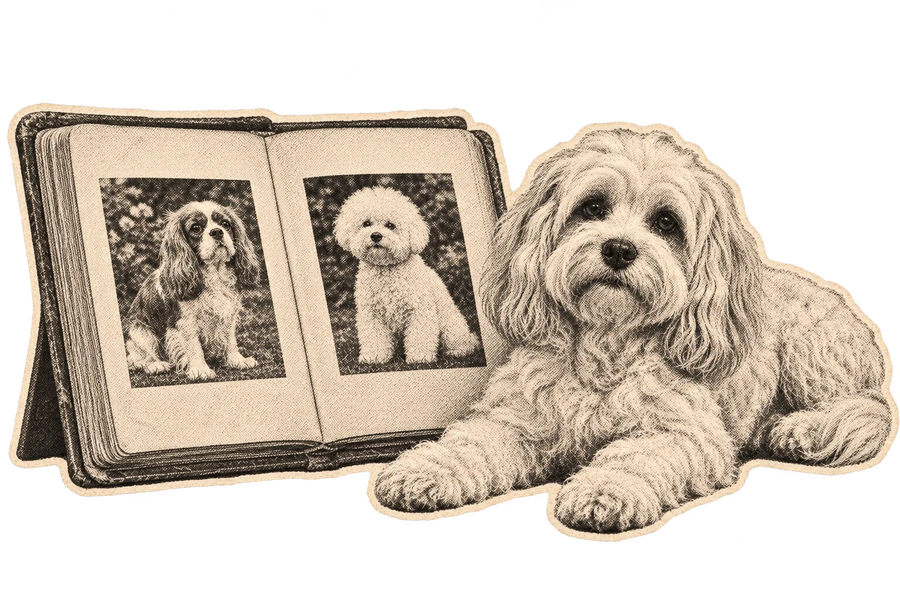
The UK Cavalier club dates its foundation and choice of the Cavalier King Charles Spaniel name to 1928. This was an attempt to recover an older-looking type of small spaniel. The Bichon Frise has a Franco-Belgian standard; the FCI recognises Belgium and France in the parent breed’s history. The Cavachon label joins the two names. It does not give the cross its own ancient history, and there’s no need to borrow one to make it sound worth keeping. 12829
When someone has a long story about the first Cavachon and not much to say about the adult dogs in this particular family, make them go back to the useful bit. What was the mum like in the house? What health issues did the older relatives develop? Can I see the results? You’re buying the dog you’re going to actually live with, not the story on the website.
Cavachon notes / 12
Two histories, one cross name
The parents have documented roots. The cross doesn’t need an invented birthday.
Getting one without getting sold one
An adult in foster can sometimes tell you more than a litter with a tidy photo gallery. Ask whether the dog has ever tolerated a whole groom, how they behave around the door, how they handle being alone and what they did last time they met a cat or a child. Ask what the car ride looks like if you drive everywhere. If the rescue doesn’t know, that’s an honest answer and you can plan the first weeks accordingly. 1111830
For a puppy, use UK government guidance and check the rules for your nation. Meet the puppy with their mum where they’re being raised, see the environment and verify chip and paperwork. Ask for identity, date and scheme or lab for each parent’s tests, and copies that match the right dog. Ask what happens if you can’t keep the dog and give yourself time to check the replies. Walk away from pressure, excuses for why the mum can’t be seen, or an off-site handover. Paying because you feel sorry for a puppy isn’t the same as helping it; if you suspect illegal sale or poor welfare, use the reporting routes in GOV.UK guidance. 4567830
Cavachon notes / 13
What to check before saying yes
Meet them where they live, not where the photo was taken.
| Before money or commitment | Ask or verify |
|---|---|
| Who are the parents? | Real names, actual ancestry, how they live and a chance to meet mum with the litter. 30 |
| Health evidence? | Relevant documents with dates, identities and scheme or lab; compare the actual parents against the list above. 45678 |
| Adult dog? | Known grooming, handling, household and alone-time history; medical records if available. |
| Still a good fit after a day to think? | Sort who walks, grooms and covers the dog when you can’t. Don’t rush a deposit. |
General UK information only; not individual veterinary advice or a vet-reviewed or endorsed article.
Sources
- S1Dogs Trust: Cavalier King Charles Spaniel, including the Cavachon and Cavapoo definitionsUK charity · checked 20 November 2026
- S2Royal Kennel Club: Cavalier King Charles Spaniel breed standardUK registry and screening · checked 20 November 2026
- S3Royal Kennel Club: Bichon Frise breed standardUK registry and screening · checked 20 November 2026
- S4Royal Kennel Club: current breed-specific Health StandardUK registry and screening · checked 20 November 2026
- S5Royal Kennel Club: Heart Scheme for Cavalier King Charles SpanielsUK registry and screening · checked 20 November 2026
- S6Royal Kennel Club: DNA testing and published variant/test scopeUK registry and screening · checked 20 November 2026
- S7Royal Kennel Club: BVA/RKC CM/SM MRI Screening SchemeUK registry and screening · checked 20 November 2026
- S8Cavalier King Charles Spaniel Club: RVC trial description and examples of clinical signsUK breed club · checked 20 November 2026
- S9PDSA: your dog’s Body Condition ScoreUK veterinary charity · checked 20 November 2026
- S10PDSA: grooming pets, including coat texture and high-matting areasUK veterinary charity · checked 20 November 2026
- S11Dogs Trust: separation anxiety, signs and supportUK charity · checked 20 November 2026
- S12Dogs Trust: canine enrichment and training ideasUK charity · checked 20 November 2026
- S13PDSA: mitral valve disease in dogsUK veterinary charity · checked 20 November 2026
- S14PDSA: Bichon FriseUK veterinary charity · checked 20 November 2026
- S15PDSA: luxating patella in dogsUK veterinary charity · checked 20 November 2026
- S16PDSA: eye problems in dogsUK veterinary charity · checked 20 November 2026
- S17PDSA: ticks on dogsUK veterinary charity · checked 20 November 2026
- S18Dogs Trust: getting a dog when you have childrenUK charity · checked 20 November 2026
- S19Dogs Trust: helping cats and dogs live togetherUK charity · checked 20 November 2026
- S20PDSA: bladder stones in dogsUK veterinary charity · checked 20 November 2026
- S21O’Neill and colleagues, 2024: epidemiology of tick infestation in UK dog breeds, primary VetCompass paperPrimary UK veterinary cohort · checked 20 November 2026
- S22O’Neill and colleagues, 2016: epidemiology of patellar luxation in English primary care, primary VetCompass paperPrimary UK veterinary cohort · checked 20 November 2026
- S23Bryson and colleagues, 2024: The doodle dilemma, exact three crosses and owner-survey designPrimary UK owner survey · checked 20 November 2026
- S24Royal Kennel Club: episodic falling testUK registry and screening · checked 20 November 2026
- S25PDSA: ear problems in dogsUK veterinary charity · checked 20 November 2026
- S26PDSA: dental disease in dogsUK veterinary charity · checked 20 November 2026
- S27PDSA: cost of owning a dog and 2024 methodUK veterinary charity · checked 20 November 2026
- S28The Cavalier King Charles Spaniel Club: breed historyUK breed club · checked 20 November 2026
- S29FCI: Bichon Frise nomenclature and official breed standardInternational registry · checked 20 November 2026
- S30GOV.UK: buying a cat or dogUK government guidance · checked 20 November 2026
- S31University Hospitals Dorset NHS-hosted Allergy UK factsheet: pet allergyUK patient guidance · checked 20 November 2026
- S32Dogs Trust: recall training and using a long lineUK charity · checked 20 November 2026
Editorial images: original generated cutouts by Pet Natter. The family album shows generic comparison portraits, not the actual parents of any dog.
