
Breed guide / Cane Corso
Living with a Cane Corso
The Cane Corso is a big Italian mastiff that’s built to move. You feel the weight of one long before you get to the history lesson. The trick isn’t to win a wrestling match on the pavement. It’s to have a dog who can turn with you before the lead goes tight, and enough room at home that the front door doesn’t become everyone’s problem. Get those two things right and the rest of the day gets a fair bit easier. 12345
Jump to a section
The short version
Give yourself a way out of a tight spot before you need it. Pick a route with room to cross or turn and reward your dog for coming with you on an easy stretch. If the only way you can walk them safely is by being stronger than them, find a quieter place to walk. Get a qualified trainer involved. 3467
At home, set up a place where the dog can stay while someone comes in. A shut door or a properly secured barrier can buy you time to put the shopping down without relying on a sit that only works when nobody’s there. If your dog already reacts badly to visitors, keep them apart. Get help rather than practising on your mates. 578
Cane Corso notes / 01
Make the hard moments easier
| Sort this first | What to do |
|---|---|
| Lead handling | Practise turning together well away from distractions. 34 |
| Visitors | Put physical separation in place before opening the door. 58 |
| Floor and transport | Give them good footing and know how you’d get a large, unwell dog to the vet. 910 |
| Bloat emergency | Repeated retching without bringing anything up, especially with a swollen belly or distress, means emergency vet care. 11 |
The breed name is not a legal test
The international FCI standard calls the breed Cane Corso Italiano. It’s an Italian mastiff in the FCI’s molossoid group. A Cane Corso isn’t another name for an XL Bully. Equally, UK restrictions on prohibited types aren’t decided by what someone writes on a pedigree or an advert. If you’re unsure about how the rules apply to a specific dog, ask the relevant authority rather than trying to settle it from photographs. 11213141516
For day-to-day handling, the more useful question is whether you can safely manage the dog you have. Make sure the person taking the lead can keep the dog under control and knows what to do if the route gets busy. Relying on the next person to move their dog is not much of a plan. 3417
Cane Corso notes / 02
Breed and legal type
| What you’re looking at | Where to check |
|---|---|
| Breed description | FCI standard for Cane Corso Italiano. 112 |
| Type rules in England and Wales | Follow the latest applicable government guidance; a breed label doesn’t determine legal type. 1314 |
| Rules in Scotland or Northern Ireland | Check the current guidance for that nation. 1516 |
Big enough to change what you buy
The FCI standard lists males at 64 to 68 cm at the shoulder and 45 to 50 kg. For females it’s 60 to 64 cm and 40 to 45 kg. The height bands have a 2 cm tolerance either way in that standard, and the weight should suit the dog’s size. None of those numbers is a UK average or a target your dog needs to hit. 1
Measure the chest before buying a harness, then check the fit with the dog moving. A broad front can make the size guide feel like it was written for a different animal. Ask the vet to show you how to assess body condition, especially if the dog is still growing and you’re tempted to feed to a number. 318
Short coat, not zero maintenance
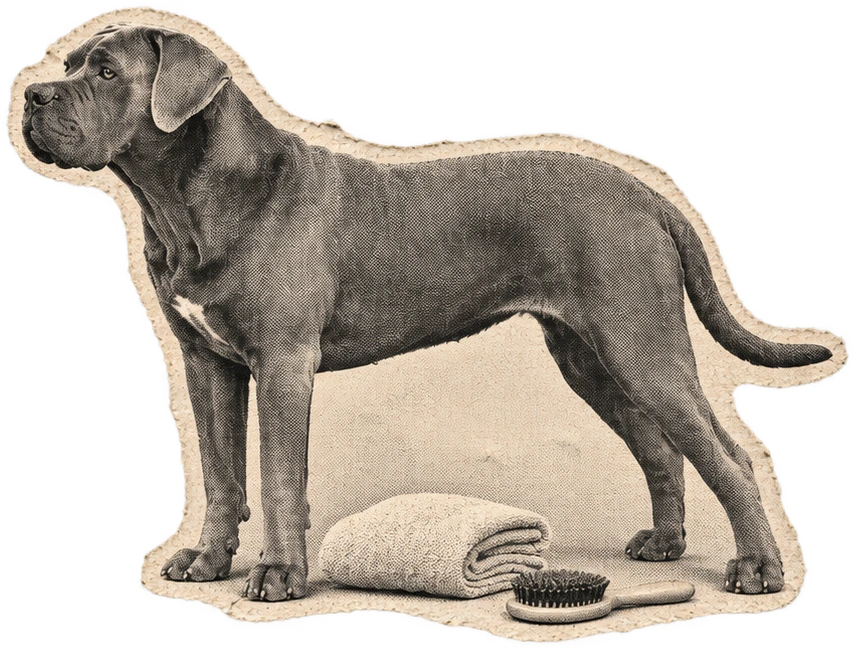
The Cane Corso has a dense short coat. A quick brush is a decent chance to spot a sore patch, and you’ll get more out of it if the dog is happy to stand there. Start by touching the side of the shoulder and reward them when they’re comfortable. Move on to paws later instead of hanging on while they try to leave. 11920
Teach towel time before the first filthy walk. You can leave a towel by the door and have them step across it so you’re not grappling for a muddy foot. If they suddenly object to being handled somewhere they didn’t mind before, check with the vet rather than doubling down. 192021
Cane Corso notes / 04
Check the coat and feet
| What to check | What helps |
|---|---|
| Short coat | A soft brush and a look for changes in the skin. 1921 |
| Feet after a wet walk | Dry them gently and look between the toes for debris. 2122 |
| Ears | Head shaking, discomfort or a bad smell means talk to the vet. 23 |
| Eyes | A red or painful eye, especially if held shut, needs prompt veterinary advice. 24 |
What if they’re wary of visitors?
Don’t take a description of traditional work as a forecast for an individual dog. Watch what yours does when someone approaches. Going still or trying to move away is worth acting on before there’s any noise. Let them keep their distance. A visitor doesn’t need to put a hand out to see whether the dog’s friendly. 14525
If the dog is tense every time that hallway fills up, stop doing introductions there. Use another room with a closed door, and speak to your vet or a qualified reward-based behaviourist about a plan. Never ask a child to see whether the dog has “got used to it”. 57826
Cane Corso notes / 05
Give them room
Teach the turn before you need the turn
Practise with a loose lead in a quiet place. Use the cue just before you turn. Reward the dog for following. Don’t wait until they’re fully committed to heading in the other direction. A dog can have a cracking recall in the garden and still forget you exist on the way past another dog. That’s why you practise in slightly harder places before you really need it. 342728
A properly fitted basket muzzle can be another safety tool, not a punishment. Teach the dog to put their nose in voluntarily and build up from there, so it doesn’t appear for the first time when somebody’s worried. Ask for help to get the fit right. A muzzle doesn’t make it OK to put the dog back in a situation they couldn’t cope with before. 4729
Cane Corso notes / 06
Useful jobs for a normal day
Enough activity without a daily wrestling match
Give an adult who moves well regular exercise and time to sniff without being hurried past everything. Choose the route and distance for that dog. A big body isn’t a reason to spend the whole walk marching, and a dog who gets stiff after a regular outing needs a check, not a harder workout. 2313233
For a growing pup, build exercise gradually rather than making them keep up on your run. On days when going out is awkward, give them an easy search for part of their regular food. Keep an eye on the weather and don’t use an indoor game to wind them right up before a hot walk. 313234
Cane Corso notes / 07
Keep the walk comfortable
| Situation | Better plan |
|---|---|
| A narrow route | Use an alternative if there’s nowhere to create space. 4 |
| Young dog | Short, manageable outings that grow as they do. 31 |
| Hot day | Walk in cooler conditions or skip the outing if it’s unsafe. 34 |
| Repeated stiffness | Get veterinary advice and change activity while you find the cause. 33 |
Set up the house for a big dog
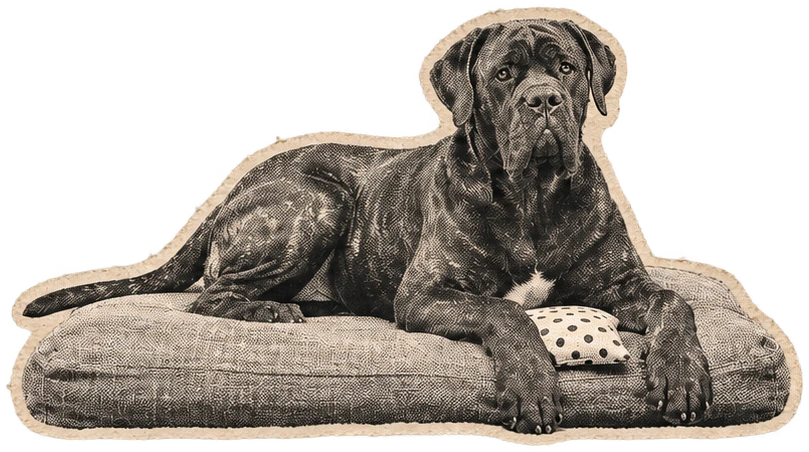
If they skid every time they follow you into the kitchen, put down something with grip where they turn. Give them a bed they can stretch out on without having to get up whenever someone walks past. Don’t buy a tiny cushion because it looks nice under the radiator. They’ll still end up on yours. 935
Think now about getting them in and out of the car if they’re older or injured. Ask the vet what they recommend for your dog, and practise a safe setup before it’s urgent. When you’re teaching time alone, check what happens after you leave, rather than assuming a quiet house on your return means they slept. 1036
Cane Corso notes / 08
A place to rest
Kids, cats and other dogs
The size of the dog matters even when they’re excited rather than upset. An enthusiastic swing round in the hallway can put a small child on the floor. Keep children and dogs together only with active adult supervision, protect the dog’s resting space, and separate them when nobody can watch closely. 226
For a cat, make sure the cat can get away without having to pass the dog. With another dog, give them space to move apart and put away anything they might compete over at first. If you can’t interrupt staring or chasing safely, keep them separate. Ask a qualified behaviour professional for help. 473738
Health checks worth asking about
The Cane Corso Association of America’s screening programme lists hip and elbow screening. It also covers heart and kneecap checks. It also lists DNA tests for neuronal ceroid lipofuscinosis (NCL) and dental-skeletal-retinal anomaly (DSRA). That’s a US club programme, not a UK rule or a guarantee. For a dog from any country, ask to see the actual breeding dogs’ results and talk to your vet about what they mean. A UK study published in 2024 estimated the median lifespan for dogs recorded as Cane Corsos at 8.1 years, with a 95% confidence interval of 6.5 to 9.5 years. The study included 202 recorded Cane Corsos. It’s an estimate for that study population, not a countdown for yours. 3940414243
Bloat is the one where you don’t hang about. If the dog keeps trying to be sick and nothing comes up, or their belly swells and they look distressed, contact an emergency vet straight away. You don’t need to see every sign before calling. Joint stiffness or a new limp needs checking too, but the symptoms on their own don’t tell you which condition it is. 113344
Cane Corso notes / 10
Health conditions and screening
| What to note | What it means for an owner |
|---|---|
| Hips and elbows | Ask for the separate results and how they were assessed. 3941 |
| Heart and kneecaps | Check what was actually examined and get veterinary help interpreting it. 39 |
| NCL and DSRA | These are specific inherited conditions covered by the cited US screening programme, not a full health check. 3940 |
| Repeated dry retching or a swollen belly | Call an emergency vet straight away, especially with distress or collapse. 11 |
| New limp or stiffness | Get the dog examined instead of assuming it’s down to their size. 3344 |
| Lifespan reference | UK 2024 study: median 8.1 years (95% CI 6.5 to 9.5). 4243 |
| Screening isn’t a promise | Ask what a clear result does and doesn’t cover. 3941 |
Cost it for a big dog
Get a quote for this dog rather than budgeting from what your last dog cost. Check the payout limit for each condition and what the excess comes to. Look for an additional percentage you might have to pay as the dog gets older. Get a price for routine care from your own practice. It’s hard to fit an emergency into a budget you’ve already spent on food. 245
Price the bed and harness. Work out what you’ll need to travel safely in the car. Then work out who’ll take them out if you can’t. An available neighbour and an available neighbour who can safely handle this dog are two different things. 3104546
Cane Corso notes / 11
Budget beyond the food
| Budget line | Check this |
|---|---|
| Food | Price a complete diet appropriate to age and size. 218 |
| Insurance | Read the excess, condition limits and exclusions before buying. 45 |
| Equipment | Measure the dog and the vehicle before ordering. 310 |
| Backup care | Check that another adult can safely handle them and understands their routine. 346 |
The Italian working-dog bit
The FCI standard describes the Cane Corso as an Italian breed historically used for varied working roles. It documents a surviving population especially in Puglia and nearby parts of southern Italy. The federation records definitive recognition on 21 May 2007. That’s a date on a register, not the date the first of these dogs appeared. 112
The story about their work explains some of the breed’s history; it isn’t an instruction to test whether yours guards things. Pick modern jobs the dog can get right. Finding a toy or settling when you open the gate makes for a useful afternoon and is rather less work than setting up an ancient Roman estate. 173032
What to ask before bringing one home
If a rescue has lived with the dog, ask how they walk on the lead and how they are with visitors. Ask about vet visits too. If you’re meeting a puppy, see it with its mum where it grew up and ask to see the relevant screening results. Walk away from someone whose main selling point is how hard the dog looks. There’s a lot more you’ll need to know by the time they weigh as much as a bag of cement. 239414748
If you’ve already got one, look at the one moment that regularly feels difficult. Put a simple change in place for that moment first, whether it’s taking a quieter route or shutting the dog safely in another room before the door goes. It doesn’t all have to become a training exercise today. Get help early if you’re worried you could lose control. 3457
Cane Corso notes / 13
Ask for evidence you can use
| Before you decide | Ask or try |
|---|---|
| Day-to-day handling | Ask what the dog’s like on a normal lead walk, not just in a garden. 348 |
| Visitor routine | Find out where the dog goes and what usually happens when someone comes in. 548 |
| Health records | Get the actual results rather than “all clear” in an advert. 394147 |
| Backup | Have a safe walking and transport plan before you need it. 31046 |
Sources
- S1FCI Cane Corso Italiano breed standardSource · checked 21 November 2026
- S2PDSA Cane Corso care and breed health guideSource · checked 21 November 2026
- S3Dogs Trust equipment and lead walkingSource · checked 21 November 2026
- S4Dogs Trust managing a reactive dog and creating spaceSource · checked 21 November 2026
- S5Dogs Trust preparing for visitorsSource · checked 21 November 2026
- S6Dogs Trust Cane Corso rehoming and care contextSource · checked 21 November 2026
- S7RSPCA reward-based dog training and qualified helpSource · checked 21 November 2026
- S8Dogs Trust on aggression around visitorsSource · checked 21 November 2026
- S9PDSA improving footing and accessibility at homeSource · checked 21 November 2026
- S10Dogs Trust travelling with your dogSource · checked 21 November 2026
- S11PDSA emergency guidance for gastric dilatation-volvulusSource · checked 21 November 2026
- S12FCI origin and definitive recognition recordSource · checked 21 November 2026
- S13UK Government guidance on banned dog types and identificationSource · checked 21 November 2026
- S14UK Government XL Bully guidance for England and WalesSource · checked 21 November 2026
- S15Scottish Government XL Bully owner guidanceSource · checked 21 November 2026
- S16Nidirect, current Northern Ireland XL Bully rulesSource · checked 21 November 2026
- S17UK Government on keeping dogs under proper controlSource · checked 21 November 2026
- S18PDSA dog weight and body conditionSource · checked 21 November 2026
- S19PDSA grooming and short coatsSource · checked 21 November 2026
- S20Dogs Trust teaching gentle handlingSource · checked 21 November 2026
- S21PDSA at-home health checks and tolerance of handlingSource · checked 21 November 2026
- S22PDSA grass seeds in dogsSource · checked 21 November 2026
- S23PDSA ear symptoms and when to seek careSource · checked 21 November 2026
- S24Royal Kennel Club eye emergenciesSource · checked 21 November 2026
- S25Dogs Trust understanding body languageSource · checked 21 November 2026
- S26Dogs Trust child and dog supervisionSource · checked 21 November 2026
- S27Dogs Trust positive reinforcement with rewardsSource · checked 21 November 2026
- S28Dogs Trust recall trainingSource · checked 21 November 2026
- S29Dogs Trust positive muzzle trainingSource · checked 21 November 2026
- S30Dogs Trust door trainingSource · checked 21 November 2026
- S31PDSA exercise by age and individual dogSource · checked 21 November 2026
- S32Dogs Trust dog enrichment and scent gamesSource · checked 21 November 2026
- S33PDSA veterinary advice on limping and stiffnessSource · checked 21 November 2026
- S34PDSA preventing and recognising heatstrokeSource · checked 21 November 2026
- S35Dogs Trust reward-based settle trainingSource · checked 21 November 2026
- S36Dogs Trust building time aloneSource · checked 21 November 2026
- S37Dogs Trust introducing dogs and catsSource · checked 21 November 2026
- S38Dogs Trust introductions to existing dogsSource · checked 21 November 2026
- S39Cane Corso Association of America breed-specific screening programmeSource · checked 21 November 2026
- S40Original 2021 study of DSRA in Cane Corsos, not a UK prevalence estimateSource · checked 21 November 2026
- S41British Veterinary Association on health screening and its scopeSource · checked 21 November 2026
- S42Dogs Trust 2024 UK lifespan table with Cane Corso estimate and sampleSource · checked 21 November 2026
- S43Original study of longevity of UK companion dog breedsSource · checked 21 November 2026
- S44PDSA hip dysplasia and veterinary assessmentSource · checked 21 November 2026
- S45PDSA cost of owning a dog and insurance considerationsSource · checked 21 November 2026
- S46Dogs Trust responsible dog ownership frameworkSource · checked 21 November 2026
- S47RSPCA buying a puppy from a responsible breederSource · checked 21 November 2026
- S48Dogs Trust helping a newly rehomed dog settleSource · checked 21 November 2026
