
Breed guide / Bernedoodle
Living with a Bernedoodle
A Bernedoodle is a Bernese Mountain Dog crossed with a Poodle. That tells you something about its family and not nearly enough about the dog coming through your front door. Some are big enough to rearrange you on a lead; others are smaller. The coat might hang in waves or knot into tight curls. Find out who the parents are, practise a calm doorway routine and check the hair underneath the harness, not just the part somebody’s brushed for the photo. 123515
Jump to a section
The short version
Get the doorway and handling sorted before the dog’s fully grown. Reward a wait away from the latch while the house is quiet. If the dog can put their whole weight into a turn, it’s worth practising coming away from the gate before there’s a neighbour or a bike on the other side of it. 11 15 21 23 25
Put your fingers under the coat at the collar, armpits and ear bases. Damp and knots can be hiding near the skin while the outside looks freshly brushed. Work in small goes and get help with anything stuck down tight, especially if it hurts. 5 17 18 20
Bernedoodle notes / 01
Where to start
The name doesn’t tell you the whole family tree
The label means Bernese Mountain Dog × Poodle, but may be used for first crosses, later generations or a cross bred back to one of its parent types. “F1” commonly refers to a direct first cross, not a standard adult height or a promise that the coat won’t shed. The Royal Kennel Club lists Bernese Mountain Dog and separate Poodle varieties, not a pedigree Bernedoodle breed. Look for records rather than reading this off the colour. 1 2 3 8 9 12
Bernedoodle notes / 02
Check the name
Work out what a grown dog would mean for your house
There isn’t a standard Bernedoodle adult height. Ask how big the documented parents are and use them as context, not a precise prediction. If you already have the dog, fit kit to the actual chest and watch it during a turn. Try a travel setup where the dog can move comfortably and be safely secured. Feel the ribs and waist rather than judging through a thick coat. 2 3 4 8 15 16
A nice top layer can hide a mat underneath
Part the coat in the high-friction spots before you decide it’s all fine. Behind the ears, under front legs and beneath a wet harness are places to check regularly. Ask a groomer to show you what this individual coat needs. If the comb catches repeatedly or there’s a tight mat near skin, stop pushing through it and get help. 5 17 18 20
A particular curl, cross or generation doesn’t make a dog allergy-free. Allergy-causing proteins aren’t just in loose hair. If allergies matter in your household, get individual advice rather than relying on the phrase “low shedding”. 10 12
Bernedoodle notes / 04
Check beneath the coat
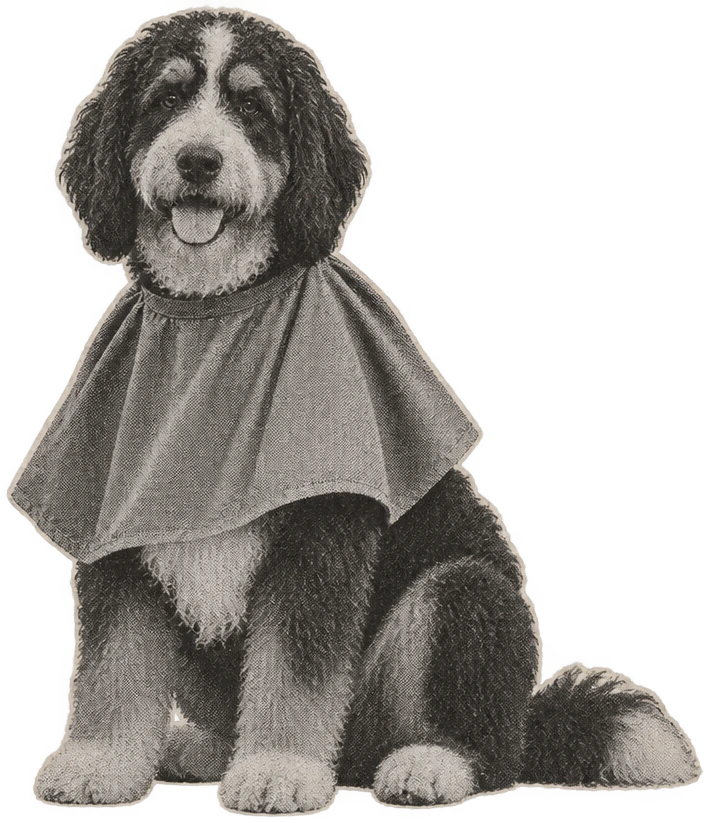
| Where | What to do |
|---|---|
| Harness line | Part the hair and check the skin after damp or muddy outings. 5 15 18 |
| Ears and legs | Comb small comfortable areas, and check for trapped seeds or debris. 17 19 |
| Tight mats | Let a groomer or vet help if the area pulls or hurts. 17 20 |
| Allergy claims | Do not read “fleece” or “low shedding” as allergy-free. 10 12 |
You’ll learn more from a normal evening than a breed description
If the dog follows you all afternoon but sleeps when you go out, that doesn’t tell the same story as pacing or barking after you’ve left. Try a short recording and get help for ongoing distress. For visitors, let the dog choose whether to approach and make it easy for them to step away instead of asking people to keep putting a hand out. 6 7 20 21 22 25
Bernedoodle notes / 05
Let them switch off
Teach the turn before you need the strength
Practise turning with you somewhere the dog still notices what you’re doing. Reward it early. Then try approaching an ordinary gate, turning away and taking a few steps, without asking them to sit there watching everything they can’t reach. Use an easy scent search or a mat afterwards. You don’t have to make every little training session into a trip round the block. 11 15 21 23 24 25
Give them a walk they can actually finish comfortably
Make room to sniff and keep an ordinary rhythm of movement for a fit adult. Choose the pace based on the particular dog. A big younger dog, a shorter-legged one and an older dog with stiffness won’t all need the same outing. If they are slowing down in heat, choose a cooler route or call it a day rather than expecting them to keep up because they managed yesterday. 15 23 26 28 29
Bernedoodle notes / 07
Look ahead
| Situation | Better choice |
|---|---|
| Healthy adult | Steady movement and time to sniff, with the route adjusted to the dog. 23 24 26 |
| Growing dog | Keep activity suitable for age and ask the vet if you’re unsure. 26 39 |
| Hot day | Take an easier, cooler outing and watch how the dog copes. 28 |
| Repeated stiffness after rest | Note the change and get the dog checked rather than extending walks. 29 39 |
Take a look at where the floor is slippery
The place a dog rushes or turns is often the bit of floor they need grip on most. Set up a clear route to a bed away from feet. Give the dog a place for a towel and paw check after walks without blocking the whole doorway, and make sure everybody can get past without stepping over their tail. 20 25 30 31
If the dog is big, enthusiasm needs some space
A friendly dog can still knock somebody over. Supervise with children and stop chase games before anybody gets crowded. Introduce other animals with room to leave, and don’t put food or favourite chews in the middle of a first meeting. If the dog tries to follow a cat no matter where it goes, put a barrier between them and look for support rather than hoping they work it out. 21 22 31 32 33 34
Bernedoodle notes / 09
Give them a way out
Health: read the two sets of reports separately
For breeding, the UK RKC lists hip and elbow screening as Good Practice for Bernese Mountain Dogs. On the Poodle side, use the documented variety. Standard Best Practice lists rcd4-PRA, prcd-PRA and vWD1 DNA tests, eye exam and hip scoring. Miniature Best Practice lists OC and prcd-PRA DNA, eyes and hips. Toy Good Practice lists prcd-PRA, with eyes and hips as additional Best Practice. Those are parent-breed standards, not a combined Bernedoodle certificate. 2 3 8 9 35 36 38 39 46
The Dogs Trust UK table gives the Bernese Mountain Dog a 10.1-year median lifespan, with a reported 9.8–10.4-year interval. Research on histiocytic sarcoma in Bernese dogs also exists; a case series about that cancer isn’t a UK Bernese population rate or a Bernedoodle prediction. There is no defensible way to take a parent median or a generation label and turn it into a lifespan figure for this cross. 40 41 43
A new limp, persistent tiredness or change in appetite is worth describing to the vet. Repeated retching without bringing anything up, particularly with a swollen belly or distress, is a reason to call an emergency vet immediately. That’s a general warning sign, not a claim about how often the cross develops any condition. 13 18 29 42 45
Bernedoodle notes / 10
Health conditions and screening
| Health conditions and screening | What’s useful |
|---|---|
| Bernese parent | Find the actual hip and elbow results. 2 35 38 39 |
| Standard Poodle parent | Check rcd4-PRA, prcd-PRA, vWD1, eyes and hips. 3 35 |
| Miniature Poodle parent | Check OC, prcd-PRA, eyes and hips. 8 35 |
| Toy Poodle parent if documented | Check prcd-PRA and the additional eye and hip results. 9 35 |
| Unproductive retching or sudden belly swelling | Contact an emergency vet immediately. 42 45 |
| Longer-lasting movement or appetite change | Ask the vet rather than assuming it’s their size or coat. 13 18 29 |
| Lifespan and cancer evidence | Keep the Bernese studies labelled as parent-only; no cross estimate. 40 41 43 |
Price the actual coat and the actual dog
Ask what a groomer charges for the dog standing in front of them, not what a “doodle trim” costs in the abstract. If you’ll use a walker, see how they handle a strong dog or a mixed-speed group and whether they’ll follow your lead routine. Look at the insurance excess and what happens with pre-existing conditions before treating the monthly price as the whole answer. 14 17 21 44
Bernedoodle notes / 11
Price the coat
Two names with two different histories
The Bernese Mountain Dog comes from Swiss farm and draught work. The Standard Poodle’s breed history includes water retrieving. That’s useful background, but the modern cross name doesn’t tell you whether your dog likes carrying things, going in water or lying by your feet. Describe what they do before building the plan around what they’re supposed to do. 1 2 3 12
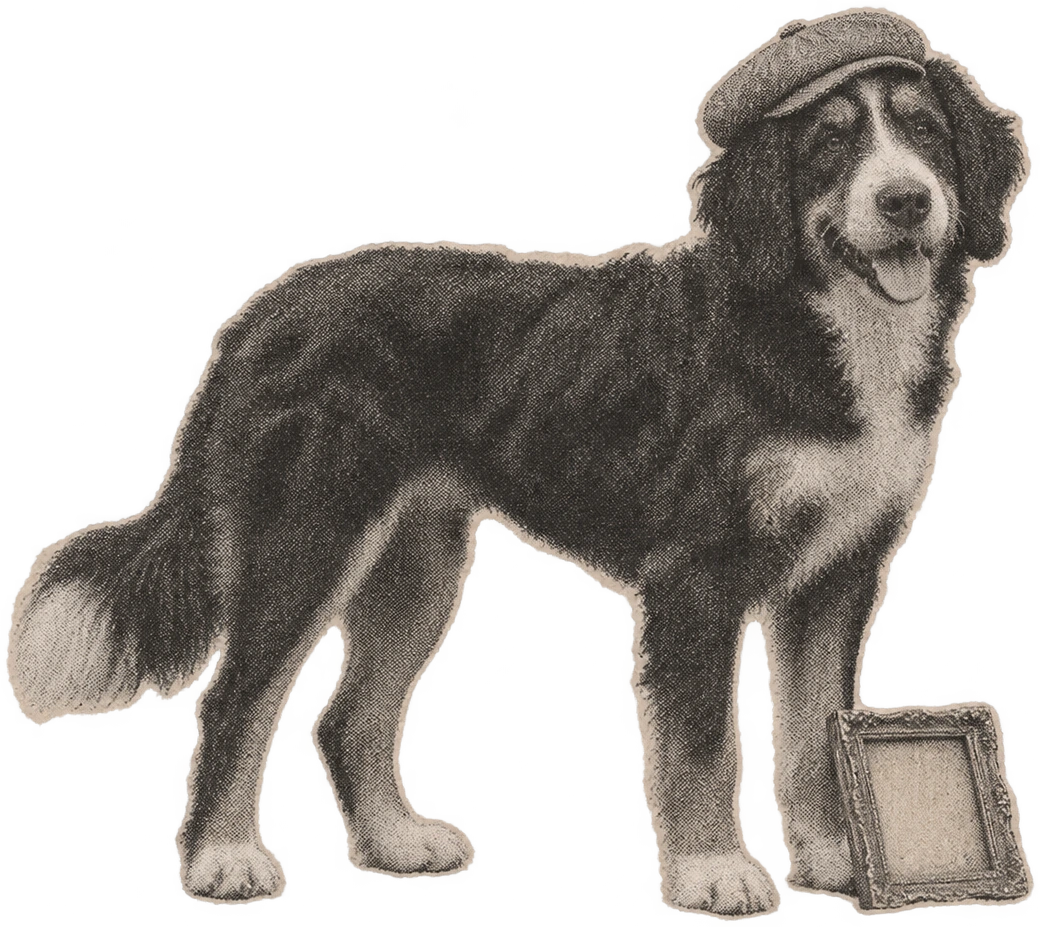
Meet one when it isn’t freshly groomed for a photo
Ask how the dog walks on lead, what the coat needs and how they react to being left. With a puppy, meet the litter with its mother where they live and see the named test results for both parents. With a rescue, find out where they’ve lived and what handling they’re comfortable with. If somebody’s idea of a good answer is “it’s an F1”, that leaves quite a bit you still need to know. 1 6 17 20 35 46 47
Bernedoodle notes / 13
Ask about a day
| Ask this | What helps |
|---|---|
| Who are the parents? | Records of ancestry and the actual Poodle variety where known. 1 3 8 9 |
| Can I see the reports? | Results with names, dates and what each one covers. 35 46 |
| How does the dog cope with brushing and the lead? | Ordinary examples rather than a grooming photo. 15 17 20 |
| Can I meet the mother where the litter was raised? | See the usual surroundings and the way people handle them. 47 |
Sources
- S1Independent Designer Kennel Club US usage of Bernedoodle for Bernese Mountain Dog × Poodle; naming onlySource · checked 21 November 2026
- S2Royal Kennel Club Bernese Mountain Dog official profile and live Good PracticeSource · checked 21 November 2026
- S3Royal Kennel Club Standard Poodle history and health testsSource · checked 21 November 2026
- S4Dogs Trust safe dog travel in the carSource · checked 21 November 2026
- S5PDSA veterinary grooming and coat maintenanceSource · checked 21 November 2026
- S6Dogs Trust introducing time alone, using a recordingSource · checked 21 November 2026
- S7Dogs Trust recognising and getting help for separation distressSource · checked 21 November 2026
- S8Royal Kennel Club Miniature Poodle separate health standardSource · checked 21 November 2026
- S9Royal Kennel Club Toy Poodle separate health standardSource · checked 21 November 2026
- S10American College of Allergy, Asthma and Immunology on dog allergens and low-shedding claimsSource · checked 21 November 2026
- S11Dogs Trust reward-based trainingSource · checked 21 November 2026
- S12Purina UK current use of Bernedoodle label and possibilities within ancestry, context onlySource · checked 21 November 2026
- S13PDSA veterinary guidance on changes in appetite and associated signsSource · checked 21 November 2026
- S14Dogs Trust finding a suitable dog walkerSource · checked 21 November 2026
- S15Dogs Trust harness fitting and checking free movementSource · checked 21 November 2026
- S16PDSA body condition at homeSource · checked 21 November 2026
- S17Blue Cross assessing and caring for coat, skin and matsSource · checked 21 November 2026
- S18PDSA home health check including feet and skinSource · checked 21 November 2026
- S19PDSA veterinary guidance on grass seeds and the signs at ears or pawsSource · checked 21 November 2026
- S20Dogs Trust building comfort with handlingSource · checked 21 November 2026
- S21Dogs Trust recognising and managing reactivitySource · checked 21 November 2026
- S22Dogs Trust sourcing qualified behavioural supportSource · checked 21 November 2026
- S23Dogs Trust recall and long-line trainingSource · checked 21 November 2026
- S24Dogs Trust safe enrichment and search gamesSource · checked 21 November 2026
- S25Dogs Trust building settling skillsSource · checked 21 November 2026
- S26PDSA tailoring dog exercise to the individualSource · checked 21 November 2026
- S27Natural England Countryside Code on keeping dogs under controlSource · checked 21 November 2026
- S28Dogs Trust safe outings in hot weatherSource · checked 21 November 2026
- S29PDSA veterinary advice on limping and stiffnessSource · checked 21 November 2026
- S30Canine Arthritis Management veterinary access and safe flooring guidanceSource · checked 21 November 2026
- S31Dogs Trust children and dog supervisionSource · checked 21 November 2026
- S32Dogs Trust safer dog and cat introductionsSource · checked 21 November 2026
- S33Dogs Trust introductions to another dogSource · checked 21 November 2026
- S34Dogs Trust resource guarding and separate feedingSource · checked 21 November 2026
- S35Royal Kennel Club central live Health Standard exact parent rowsSource · checked 21 November 2026
- S36Royal Kennel Club BVA/RKC/ISDS Eye SchemeSource · checked 21 November 2026
- S37PDSA symptoms and veterinary assessment of ear problemsSource · checked 21 November 2026
- S38British Veterinary Association elbow scheme and official screeningSource · checked 21 November 2026
- S39British Veterinary Association/Royal Kennel Club hip scoring schemeSource · checked 21 November 2026
- S40Dogs Trust original UK breed lifespan table, Bernese Mountain Dog onlySource · checked 21 November 2026
- S41Original McMillan UK longevity studySource · checked 21 November 2026
- S42PDSA veterinary signs and urgency for gastric dilatation and volvulusSource · checked 21 November 2026
- S43Primary Bernese Mountain Dog and Flat-Coated Retriever histiocytic sarcoma case seriesSource · checked 21 November 2026
- S44PDSA costs and insuranceSource · checked 21 November 2026
- S45PDSA veterinary emergency advice for bloat or a swollen abdomenSource · checked 21 November 2026
- S46Royal Kennel Club health results finderSource · checked 21 November 2026
- S47RSPCA buying a puppy and seeing mother with the litterSource · checked 21 November 2026
