Breed guide / Australian Shepherd
Living with an Australian Shepherd
The Australian Shepherd is a medium-sized herding dog developed on American ranches, despite the name. An Aussie who likes watching movement might notice the bicycle long before you hear it, then look genuinely surprised that you had other plans. Give them walks where they can do something besides watch everything, and teach them how to finish an activity as well as start one. That pays off at the park, at the front door and when you’d quite like to sit down. 1234
Jump to a section
The short version
Teach a cue to turn away from the bike, ball or running dog while you’re both still far enough away to think. Choose an easier route if you can’t get that distance. That will be a better lesson than getting the cue right just as your dog gets the wrong end of the lead. 3 4 5
Give the dog something to look for on an ordinary outing, then make room for a quiet finish. At home, reward a bit of calm before you pick up another ball. There’s no need to see what happens when the dog gets better at bringing it back for three hours straight. 6 7 8
Australian Shepherd notes / 01
Where to start
| Start here | Try this first |
|---|---|
| Fast movement | Turn away early, with room to move. 4 5 |
| A busy walk | Include sniffing and a chance to come back towards you. 8 9 |
| End of the game | Put the toy away and reward the dog for settling somewhere quiet. 6 7 |
| Booking a vet visit | If you already have an MDR1 result, tell the practice. 10 |
Aussie, Australian Shepherd Dog and other names
The Royal Kennel Club calls the breed Australian Shepherd. Australian Shepherd Dog and Aussie are names you may hear for the same dog. It’s not the Australian Cattle Dog, and Miniature American Shepherd has a separate UK interim standard. A shorter dog from an advert with “mini Aussie” in it doesn’t tell you what they’ve been registered as. 1 2 11 12
The numbers are for the standard, not your shopping basket
The UK standard gives ideal shoulder heights of 51–58 cm for males and 46–53 cm for females. Those numbers don’t tell you how a particular dog’s harness will fit or whether they’re in good condition. Measure the chest and feel for the ribs beneath the feathering. 2 14 15
Recheck the harness when the dog is moving or turning; some look fine until the strap shifts towards a front leg. If you’ll use a long line, attach it to a well-fitted harness and practise handling it away from traffic and other people. 9 14
The fringe on the back legs is where the walk goes home with you
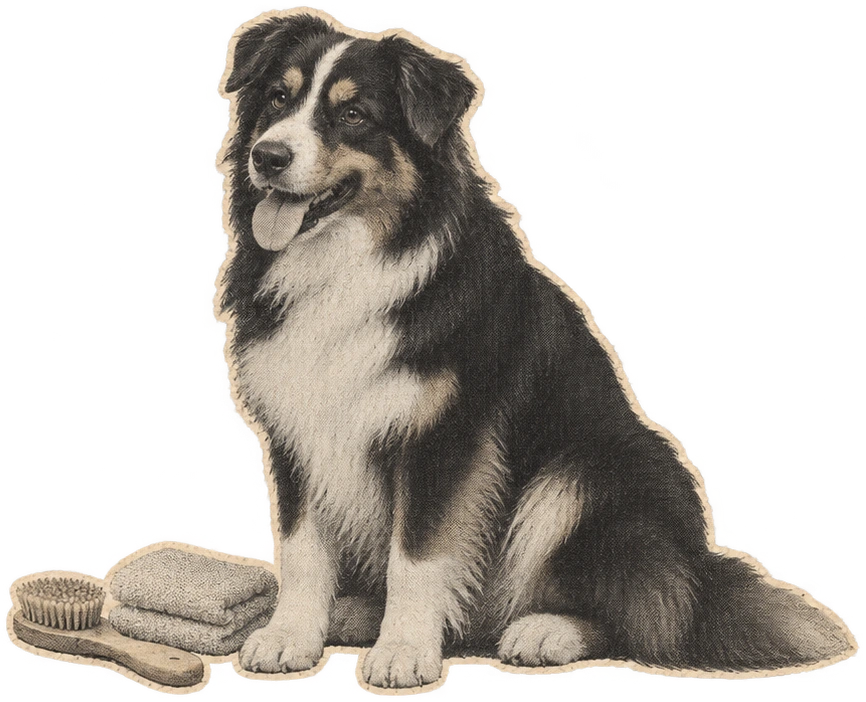
The Australian Shepherd has a medium-length coat with feathering and an undercoat. Run a comb through a parted bit of hair behind the ears and down the backs of the legs, particularly after rough grass. It’s amazing how much of one field fits under an elbow. If there’s a tight mat or sore skin, don’t try to get it out with scissors. 2 3 16 17
Check paws and the coat beneath the harness after wet walks. Look for a thorn, grass seed or a sensitive patch rather than assuming the dog just doesn’t like having its feet touched. If the dog is sore, has a swollen area or won’t bear weight normally, speak to your vet. 14 17 18
Australian Shepherd notes / 04
Check the feathering
| Where | Practical check |
|---|---|
| Backs of legs | Separate the feathering to check for burrs or knots. 2 16 |
| Behind the ears | Comb a little at a time; don’t pull a tight mat. 16 17 |
| Under the harness | Check for rubbing and damp patches. 14 16 |
| Between the toes | Look for debris and changes in how they put the foot down. 17 18 |
A stare can tell you more than a bark
Some Aussies get interested in things that move fast, but they don’t all do the same thing about it. If yours goes still, stares or leans forward around scooters, use that moment to move away. If they’ve already stopped noticing you, go somewhere easier and practise there, rather than insisting they sit in exactly the wrong place. 3 4 19
If you get barking at the window, see what they’re watching and whether a different lookout makes the room calmer. If they’re barking when you go out, it’s worth checking by video. Noise from the postie and worry about being alone are different problems. 20 21 22
Australian Shepherd notes / 05
Spot it early
| What you’re seeing | First move |
|---|---|
| Staring hard at a bike or running dog | Increase distance while you can still move together. 4 19 |
| Barking at people outside | Block or change the view and test whether it helps. 20 |
| Pacing or barking when you leave | Check what starts it and get help if they’re distressed. 21 22 |
Teach both “come with me” and “we’re done”
Use short sessions to practise turning, returning and moving away. Reward the dog once they make it back to you. Start where there isn’t something much more interesting on offer. A cue practised by the sofa is a start. It’s not the cue to bet the lead on when a field full of sheep comes into view. 4 5 9
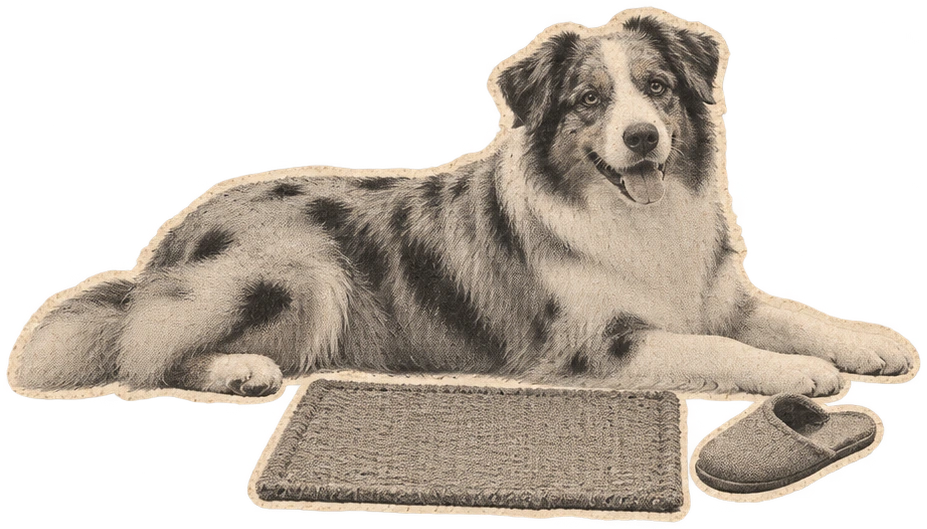
Teach a settle without waiting until everyone’s worn out. After a short search or play, put the gear away and reward a few quiet seconds on a mat. Build on that instead of starting another round because they’ve dropped a toy on your foot. 6 7 8
Give them an interesting walk without making it a competition
Find routes with room to sniff and pass other people without squeezing by. Try hiding a toy in an easy patch of grass, or a reward-based class if the dog enjoys working with you around other dogs. Introduce new kinds of activity gradually; choose what suits their age and joints instead of squeezing the same route into a faster time. 8 23 24
Keep them on a lead around stock. In hot weather choose a cooler time and adjust to how the dog is coping. If an adult suddenly hangs back on an easy route or keeps limping after play, get that checked. Needing exercise and needing rest aren’t mutually exclusive. 18 23 25 26
Australian Shepherd notes / 07
Make it a better walk
| Situation | One useful change |
|---|---|
| Safe, quiet ground | Try sniffing for a toy rather than repeating the same fetch. 8 |
| Busy path | Plan a wider pass if visual movement is setting them off. 4 |
| Sheep and cattle | Keep the lead on and give the animals space. 25 |
| Hot day or new stiffness | Scale back the exercise; seek advice about persistent changes. 18 23 26 |
Move the lookout away from the front window
If the dog keeps watch on the road, see whether you can place the main bed somewhere they can’t see the entire street. Put the rest spot away from the door and make sure everyone can get by without stepping over them. An Aussie doesn’t need to monitor the bin collection from three different rooms. 6 20 27
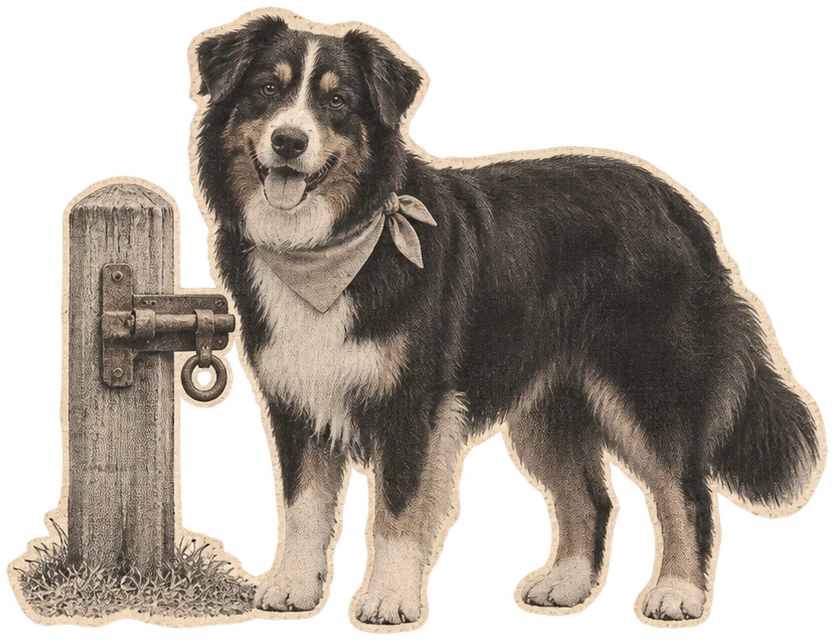
Create a calmer arrival routine before opening the door, and make sure the dog has space to move away. Check the gate and fence if they spend time in the garden. That’s a backup for when real life happens, not a substitute for watching a dog whose favourite hobby is seeing where things went. 4 27 28
Australian Shepherd notes / 08
Quiet places at home
Teach the dog to leave the game, not the kids to stop running
If children are rushing around, use a separate area when the dog starts following, cutting in or grabbing at clothes. Keep an adult close enough to intervene; don’t give a child the responsibility for sorting out an excited dog. If quiet contact is fine, keep it quiet. That doesn’t mean a dog should be in the middle of a football game. 4 19 29 30
Introduce cats or other dogs slowly, with their own exit routes, food and places to rest. Let them spend time apart even if early meetings go well. Find out what your individual dog has lived with before; “herding dog” is not a clear answer either way. 31 32
Australian Shepherd notes / 09
Let the adults handle it
Health: what the eye results and MDR1 test actually tell you
The Royal Kennel Club lists CEA/CH DNA screening as Good Practice. Its Best Practice additions are hip and elbow screening, a clinical eye exam, and DNA tests for HC-HSF4, prcd-PRA and MDR1. These aren’t interchangeable results. For example, a genetic result for a particular eye condition doesn’t replace an eye examination. 1 33 34 35 36 37 38 39
A 2009 study with DNA samples from almost 400 privately owned Australian Shepherds found an association between a particular HSF4 variant and hereditary cataract. It’s not a UK prevalence estimate and doesn’t explain every cataract. If you have an MDR1 result, give it to your vet: it can affect decisions about specific medicines. Don’t change doses or stop anything without checking with the vet. 10 36 40 51
In the Dogs Trust UK study published in 2024, the Australian Shepherd median lifespan was 13.7 years. The published confidence interval was 12.8–14.6 years, which describes uncertainty around the estimate, not the range for individual dogs. 41 42
Australian Shepherd notes / 10
Health conditions and screening
| Topic | What you can check |
|---|---|
| Eyes | Ask for the clinical result and the separately named DNA results. Seek prompt advice about a painful eye. 1 34 36 37 39 43 |
| MDR1 | Share any result with the vet before medicines are prescribed. 10 51 |
| Hips and elbows | Check the parents’ scheme results and speak to a vet about a new limp. 18 35 38 |
| Lifespan | UK median 13.7 years, not an individual prediction. 41 42 |
| Screening | Check the named dog, exact test and result. 1 44 |
| Breeding | Ask about the parents’ health and why they were paired; don’t buy on a colour promise. 1 33 45 |
| Conditions in your dog | The vet should assess new pain, lameness or vision changes, whatever the parents’ results. 18 43 |
Think about who walks them when you can’t
Get real prices for cover and find out what a walker’s day looks like. A steady one-to-one outing and a busy group walk can ask different things of a dog. Tell them if your dog gets stuck watching scooters or puppies running about. You don’t want the first time they hear about it to be when they’re holding four leads and a poo bag. 4 46
When comparing insurance, check the excess, ongoing-condition cover and limits. Budget for a secure harness and time or help for calm handling and grooming. A tidy-looking coat the day you visit doesn’t tell you whether the dog tolerates a comb around the back legs. 14 16 47
Australian Shepherd notes / 11
Price the whole week
| Cost | What to ask |
|---|---|
| Walker or sitter | Where they walk, group sizes and how the dog settles before and afterwards. 46 |
| Insurance | What’s covered over time and what’s excluded or capped. 47 |
| Training | Whether a class builds useful skills without overwhelming the dog. 24 |
| Grooming kit | Get what works for the actual coat, not the kit with the nicest picture on it. 16 |
The name took a different route from the dog
The Royal Kennel Club describes the Australian Shepherd as developed in America for ranch work. The name is an easy one to remember and an easy one to read too much into. Colour and coat patterns can vary, and the standard lists both solid and merle varieties. Don’t assume a coat pattern tells you what sort of work an individual can do. 1 2 48
The useful bit of the ranch history is that a lot of an ordinary day involved paying attention to movement and changing direction. What that means in a pet home depends on the dog, the route and what they’ve learnt. Give them a few sensible ways to use that attention without recruiting the runner in the next lane. 1 3 4 8
Australian Shepherd notes / 12
Ranch dog roots
See what happens when there’s nothing to do
Ask to meet the dog on a normal walk if you can. Watch whether they can look away from movement and what happens when you stop. If you’re adopting, ask who saw them alone and how long they’d been settled in that place. An assessment in one setting is a starting point rather than what to expect at home. 4 21 22 49
If there’s a litter, meet the pups with their mum and verify the actual parent screening results. Watch the adult dog after someone puts the toy away. You’ll live with that bit for longer each day than the ten minutes everyone spends admiring the markings. 1 6 44 50
Australian Shepherd notes / 13
Ask what they’ve seen
| Ask to see or hear | Why it’s useful |
|---|---|
| A routine walk | You’ll see what’s manageable now, not just in training clips. 4 5 |
| A quiet period after doing something | Clues to the dog’s current ability to switch off. 6 7 |
| Both parents’ actual screening results | A way to distinguish real records from general claims. 1 44 |
| Where and when time alone was seen | Makes it easier to plan help for the first weeks. 21 22 49 |
Sources
- S1Royal Kennel Club Australian Shepherd breed profile, origin and individual screening recommendationsSource · checked 21 November 2026
- S2Royal Kennel Club Australian Shepherd UK breed standard and sizeSource · checked 21 November 2026
- S3PDSA veterinary Australian Shepherd breed profileSource · checked 21 November 2026
- S4Dogs Trust practical advice on dogs chasing moving thingsSource · checked 21 November 2026
- S5Dogs Trust loose-lead walking and changing directionSource · checked 21 November 2026
- S6Dogs Trust reward-based training to settleSource · checked 21 November 2026
- S7Dogs Trust helping an overexcited dog to calm downSource · checked 21 November 2026
- S8Dogs Trust scent games and enrichmentSource · checked 21 November 2026
- S9Dogs Trust recall and use of a long lineSource · checked 21 November 2026
- S10Royal Kennel Club MDR1 DNA test and clinical scopeSource · checked 21 November 2026
- S11Royal Kennel Club Australian Cattle Dog separate UK breed standardSource · checked 21 November 2026
- S12Royal Kennel Club Miniature American Shepherd interim breed standardSource · checked 21 November 2026
- S13Royal Kennel Club 2026 recognition of Miniature American ShepherdSource · checked 21 November 2026
- S14Dogs Trust fitting and introducing a harnessSource · checked 21 November 2026
- S15PDSA dog body condition checksSource · checked 21 November 2026
- S16PDSA veterinary grooming and skin housekeeping guideSource · checked 21 November 2026
- S17PDSA veterinary advice on checking skin, coat and paws at homeSource · checked 21 November 2026
- S18PDSA veterinary advice for limping dogsSource · checked 21 November 2026
- S19Dogs Trust recognising canine body languageSource · checked 21 November 2026
- S20Dogs Trust advice on barking triggers and environmentSource · checked 21 November 2026
- S21Dogs Trust building time alone graduallySource · checked 21 November 2026
- S22Dogs Trust signs and help for separation distressSource · checked 21 November 2026
- S23PDSA tailoring exercise to the dog's age and conditionSource · checked 21 November 2026
- S24Dogs Trust positive reinforcement guidanceSource · checked 21 November 2026
- S25Natural England countryside safety around livestockSource · checked 21 November 2026
- S26Dogs Trust warm-weather safetySource · checked 21 November 2026
- S27Dogs Trust visitor preparation and barriersSource · checked 21 November 2026
- S28Dogs Trust preventing escapes and checking boundariesSource · checked 21 November 2026
- S29Dogs Trust child and dog safety and supervisionSource · checked 21 November 2026
- S30Dogs Trust on mouthing and nippingSource · checked 21 November 2026
- S31Dogs Trust successful introductions with catsSource · checked 21 November 2026
- S32Dogs Trust introducing another dog and keeping resources separateSource · checked 21 November 2026
- S33Royal Kennel Club central Health Standard and Australian Shepherd rowSource · checked 21 November 2026
- S34Royal Kennel Club CEA/CH DNA testSource · checked 21 November 2026
- S35British Veterinary Association Hip Dysplasia SchemeSource · checked 21 November 2026
- S36Royal Kennel Club hereditary cataract DNA test for Australian Shepherd, HC-HSF4Source · checked 21 November 2026
- S37Royal Kennel Club prcd-PRA DNA testSource · checked 21 November 2026
- S38British Veterinary Association Elbow Dysplasia SchemeSource · checked 21 November 2026
- S39British Veterinary Association clinical Eye SchemeSource · checked 21 November 2026
- S40Mellersh et al. original Australian Shepherd HSF4 cataract association studySource · checked 21 November 2026
- S41McMillan et al. original UK dog lifespan researchSource · checked 21 November 2026
- S42Dogs Trust original UK breed table including Australian Shepherd estimateSource · checked 21 November 2026
- S43PDSA veterinary advice on a sore or closed eyeSource · checked 21 November 2026
- S44Royal Kennel Club individual health screening lookupSource · checked 21 November 2026
- S45Royal Kennel Club explanation of merle colour and health considerationsSource · checked 21 November 2026
- S46Dogs Trust choosing a walkerSource · checked 21 November 2026
- S47PDSA ownership costs and insuranceSource · checked 21 November 2026
- S48Dogs Australia registry account of the breed's development and nameSource · checked 21 November 2026
- S49Dogs Trust settling a rehomed dogSource · checked 21 November 2026
- S50RSPCA visiting and choosing a breederSource · checked 21 November 2026
- S51Washington State University veterinary clinical pharmacology MDR1 guidanceSource · checked 21 November 2026